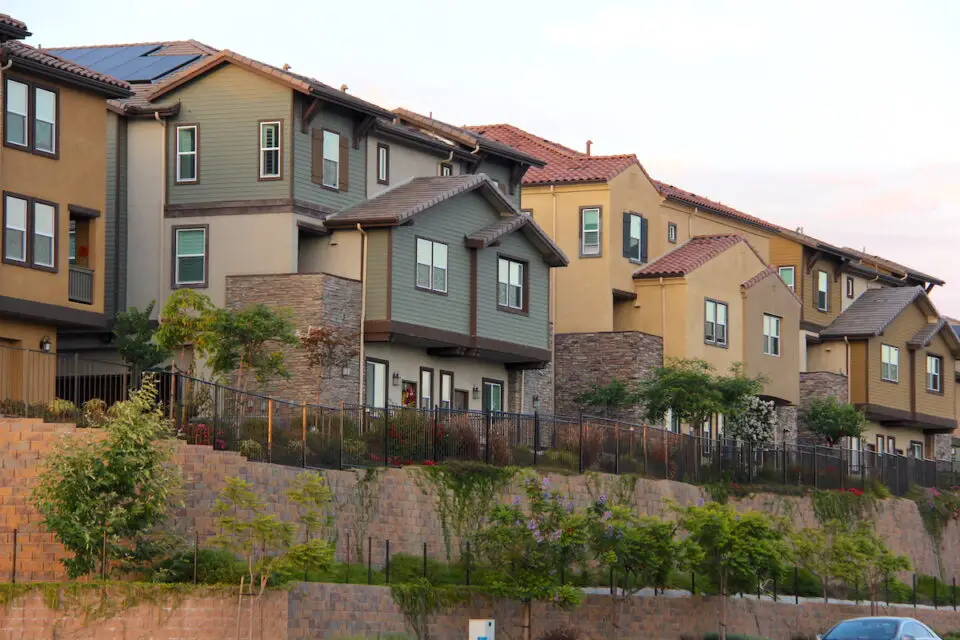
SAN MARCOS — The city of San Marcos is moving forward with a transit-oriented development ordinance that will temporarily exempt certain areas from Senate Bill 79 development, including sites in high fire risk zones.
SB 79 is a new state law that overrides certain local zoning restrictions and allows low- and mid-rise housing development within a half-mile radius of specific transit stops, known as the transit-oriented development (TOD) zone.
Before the law takes effect on July 1, cities may adopt local plans that temporarily exempt certain sites in TOD zones from SB 79 development.
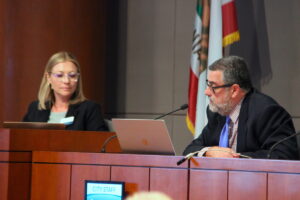
On June 15, the San Marcos Planning Commission reviewed a proposed ordinance to implement SB 79 while also exempting sites in very high fire hazard severity zones and those that cannot be accessed via a direct pedestrian walking path.
By adopting the ordinance, the city has until the start of the 7th Housing Element Cycle in 2031 to phase in development on excluded sites or to develop alternative plans to redistribute the housing capacity to other sites.
The Planning Commission unanimously recommended that the City Council approve the TOD ordinance. However, commissioners expressed frustration with the state’s implementation of one-size-fits-all laws that do not suit a suburban area like San Marcos.
“Unfortunately, I’ve seen a number of these kinds of laws coming down the pipe,” Commissioner Christopher Carroll said, adding that the law would be better suited in a city like San Francisco.
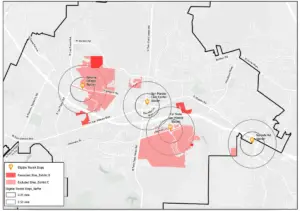
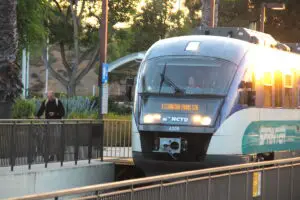
In San Marcos, all three of the city’s Sprinter stations — the Palomar Station, the San Marcos Civic Center station, and the CSU San Marcos Station — are considered Tier 2 stops under SB 79, establishing the half-mile radius of the stop as a TOD zone.
The Sprinter station along Nordahl Road is also a Tier 2 stop under SB 79. While the station falls just outside the San Marcos city limits, the half-mile radius for potential SB 79 development includes portions of the city.

Tier 2 stops allow projects up to 55 feet tall with a density of 80 dwelling units per acre within a half-mile of the stop, and up to 65 feet tall with a density of 100 dwelling units per acre within a quarter-mile.
Projects within 200 feet of a Tier 2 stop can be even bigger — up to 85 feet tall with a density of 140 units per acre.
Within TOD zones, SB 79 applies to sites that are zoned for residential, commercial, or mixed use. Industrial zones are not subject to the law.
Principal Planner Sean Del Solar said San Marcos was not initially believed to be affected by the bill, but recent guidance from the state Housing and Community Development Department indicated that the Sprinter line qualifies as high-frequency commuter rail, thereby classifying all Sprinter stops as Tier 2.
The city of Oceanside, which has several Sprinter stops, recently adopted a phased plan to implement SB 79.
Under HCD’s guidance, the San Diego Association of Governments, or SANDAG, was supposed to release a map confirming which transit stops would be subject to SB 79 before it went into effect.
SANDAG has yet to release any SB 79 maps. San Marcos city staff said they met with agency representatives to confirm which local stops would be affected.
According to Planning Division Director Joseph Farace, SB 79 could allow as many as 90,000 new units in San Marcos based on the affected properties and allowable densities.
Exemptions
Cities can phase in SB 79 on sites that meet specific criteria and require more long-range planning. One of these criteria is if a property falls within a very high fire hazard severity zone.
About half of the TOD zones around the Cal State San Marcos and Palomar College stations fall into the very high fire hazard severity zone and will be temporarily excluded from SB 79 projects.
Smaller areas around the Nordahl Road and Civic Center stations also fall in the zone and will be temporarily excluded.
These sites will become subject to SB 79 in 2031, once the city has had time to evaluate “long-term land use, infrastructure, public safety, environmental, and evacuation considerations,” a staff report states.
Over the coming years, the city will look for areas where SB 79 housing capacity on these sites can be relocated elsewhere. The city will also analyze the local water, sewer, and roadway networks to ensure they can support the increased development proposed under SB 79.
“As a part of the General Plan update, part of what the city’s gonna be doing is looking at how this can be holistically implemented,” Del Solar said.
SB 79 also exempts sites that do not have a publicly accessible pedestrian route within 1 mile of a TOD stop. Publicly accessible paths include sidewalks, marked crossings, trails, and other pedestrian facilities.
San Marcos city staff identified several properties that lack a publicly accessible walking path to a TOD stop within 1 mile, thereby making them exempt from SB 79.
“These areas are generally separated from transit facilities by roadway configurations (i.e. state Route 78), topographic constraints, railroad facilities, or other barriers that substantially increase walking distances beyond the direct radius measurement,” a staff report states.
SB 79 also exempts sites with designated historic resources, those subject to one foot of sea-level rise, and certain low-resource areas as defined by the state. None of these exemptions applies to San Marcos.
SB 79 requirements
To qualify as an SB 79 project, a proposed development must have a minimum of five dwelling units and a density of at least 30 units per acre.
SB 79 requires applicable projects with 10 or more units to deed restrict 7% of units for extremely low-income households, 10% for very low-income households, or 13% for low-income households.
Cities may also enforce their own local inclusionary housing regulations for SB 79 projects. San Marcos requires projects with six or more units to reserve 15% for lower-income households, and permits developers to pay an in-lieu fee.
Commissioner Steve Kildoo said he was surprised by how few affordable units SB 79 requires. He said TOD development should be more targeted toward people with lower incomes, since they are more likely to use and depend on the Sprinter.
“I’m surprised that the amount of affordable housing isn’t higher, because that’s who benefits,” Kildoo said. “The state is famous for not doing it as well as it can be done.”
City staff noted that SB 79 projects are still required to comply with the building code, fire code, objective development standards, the California Environmental Quality Act, demolition and anti-displacement requirements, municipal code requirements that do not conflict with SB 79, and airport compatibility requirements.