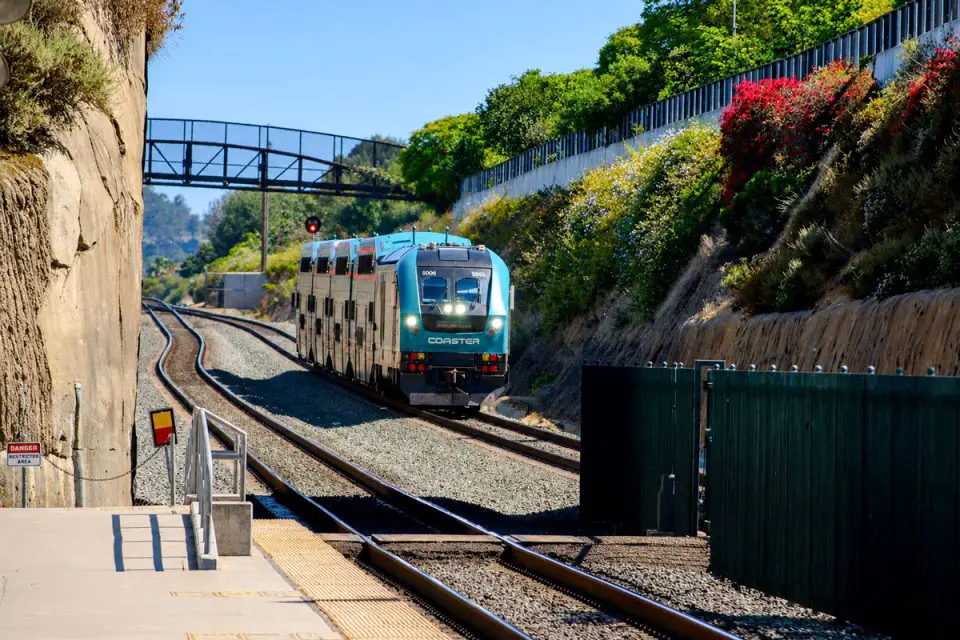
SOLANA BEACH — As the implementation date for a new law allowing high-density housing near certain transit stations draws closer, affected North County cities are considering their options to retain as much local control as possible while awaiting clear guidance on where the law applies.
Senate Bill 79, introduced by state Sen. Scott Wiener (D-San Francisco) and signed by Gov. Gavin Newsom in October, would permit multi-family residential development with heights of up to 85 feet and densities of up to 120 units per acre at sites within a half mile of major transit stops.
The new upzoning law will go into effect July 1 in counties with at least 15 passenger rail stations, a criterion that includes San Diego County and seven others.
Cities are currently waiting for the San Diego Association of Governments, or SANDAG, to release a map confirming which areas and transit stations in the county are subject to SB 79. SANDAG representatives said they could not confirm when these maps would be complete, but the clock is ticking.
At the time the law was signed, elected officials said Vista, Oceanside, and San Diego were the only cities in the county that appeared to have transit stops affected by SB 79.
However, a March 20 advisory about SB 79 from the state’s Housing and Community Development Department includes clarified definitions that would also apply to the Solana Beach Transit Center.
SB 79 allows projects of varying sizes, depending on the distance from an applicable transit stop and the stop type. The largest projects are allowed near Tier 1 stops, defined as those served by heavy rail or very high-frequency commuter rail, equivalent to at least 72 trains per day, excluding long-distance Amtrak service.
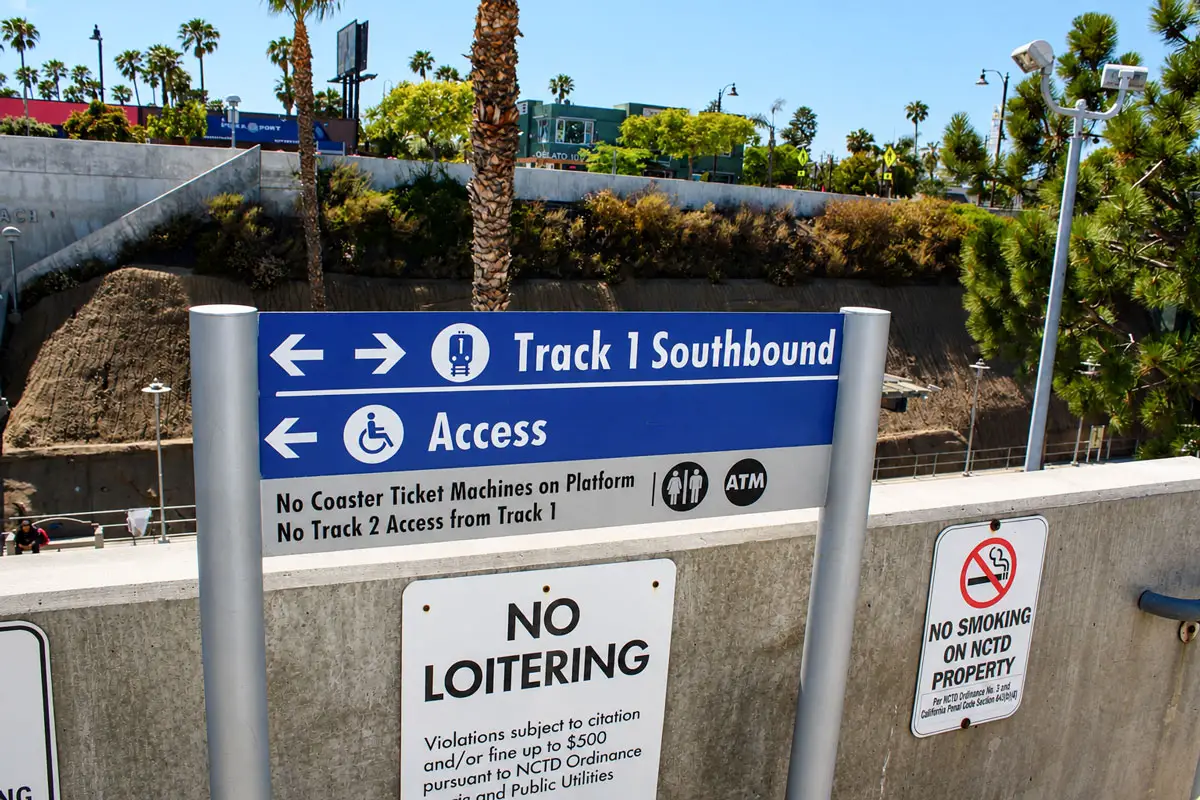
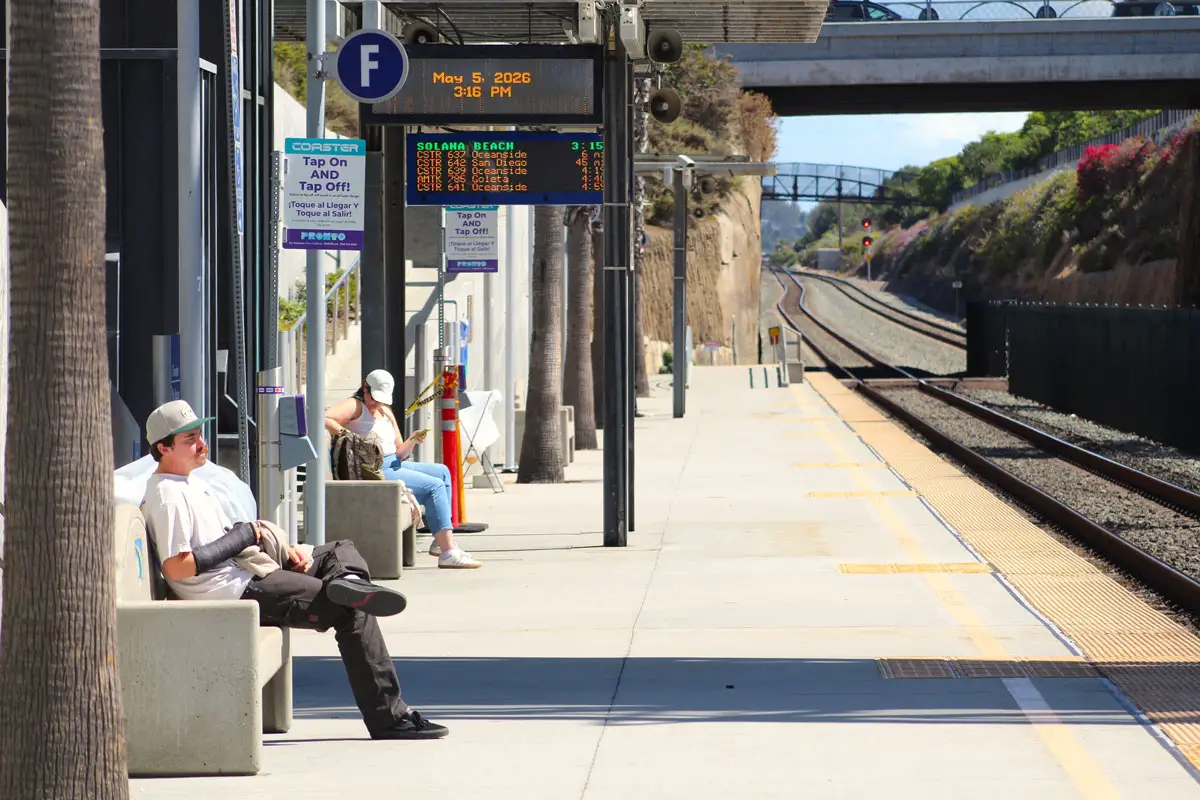
Smaller projects may be built by Tier 2 stations, defined as those served by light rail or high-frequency commuter rail with 48 to 71 trains per day.
The HCD advisory states that if some trains serving a station are operated by multiple commuter rail services, such as the Coaster and Surfliner, all of these services must be counted when calculating the “frequency” of trains serving that station.
“This approach reflects the overall level of transit access and frequency experienced by riders at a given stop,” the advisory says.
Under this definition, the Solana Beach Transit Center — which has an average of 56 weekday trips between the Coaster and Pacific Surfliner — would be considered at least a Tier 2 stop.
Mayor Lesa Heebner declined to comment on HCD’s advisory about SB 79. In the past, however, she and other city leaders in Solana Beach, as well as Vista, Oceanside, Del Mar, and Encinitas, have been clear in their opposition.
“At only 3.4 square miles with a population of 12,900, Solana Beach is a tiny city, but a tiny city with a train station,” Solana Beach City Councilmember Jewel Edson said during a North County Transit District board meeting on March 19. “Tying land use requirements to rail transit frequency is problematic for many reasons.”
State Sen. Catherine Blakespear (D-Encinitas) voted against the bill as it worked its way through the state Legislature.
“I voted against SB 79 because it short-circuits the local planning process. It doesn’t make sense to me for Solana Beach to be covered by this legislation,” Blakespear said. “As the details emerge about exactly how SB 79 would be applied, I’ll continue to closely monitor what can be done and advocate for the interests of the city.”
Tier 1 transit stops would allow projects up to 65 feet tall, with a density of 100 dwelling units per acre within a half mile; and projects up to 75 feet, with a density of 120 dwelling units per acre within a quarter mile.
Tier 2 transit stops could have projects up to 55 feet tall within a half-mile and up to 65 feet tall within a quarter-mile. A project within 200 feet of a Tier 1 or 2 transit stop would be eligible for further size increases, including another 20 feet in height, another 40 dwelling units per acre, and an increased floor area ratio.
Alternative plans
Cities will be required to begin accepting SB 79 projects beginning July 1. However, there are other routes they can take before that date to maintain a bit more flexibility.

One way is for cities to adopt a Local TOD Alternative Plan, approved by HCD, that largely meets the law’s standards but allows them to shift the required density to other sites in the city.
The bill also allows cities to adopt an ordinance delaying the impacts of SB 79 until one year after the adoption of the 7th Cycle Housing Element (around 2030), provided existing laws permit development at at least half the density allowed by SB 79.
Hoping to take advantage of this loophole, the cities of San Diego and Los Angeles are rushing to upzone certain areas in order to meet this standard and delay the effects of SB 79.
Within alternative plans, some TOD areas may be exempt if they meet certain criteria, including sites located within very high fire hazard severity zones, vulnerable to at least one foot of sea-level rise, or with a historic designation.
The city of Oceanside is working on a TOD Alternative Plan, using its own Smart and Sustainable Corridors Plan as a baseline, to shift density out of single-family areas and into more commercial areas. The city is also working on an ordinance to defer the implementation date of SB 79.
“We’re working very quickly on that, so that come July 1, we will be able to provide some immediate relief and some options for our community,” Oceanside City Manager Jonathan Borrego said in April.
Six of Oceanside’s seven transit stops qualify as Tier 2 stops, and the Oceanside Transit Center qualifies as a Tier 1 stop, according to Borrego. However, he noted that nothing is confirmed until SANDAG’s maps are released.
The city of San Diego is also pursuing delays and exemptions to the law.
NCTD officials said in March that all Sprinter stations could potentially be Tier 2 stations under SB 79. The Sprinter services 15 stations between Oceanside, Escondido, Vista, and San Marcos.
Ongoing pushback
While proponents say SB 79 will facilitate multifamily housing construction near public transit, several cities in San Diego County and beyond have lambasted the law, saying it overrides local planning and will not result in needed affordable housing.
Officials have also criticized the bill for undergoing major last-minute amendments before its adoption, including carving out an exception for cities with fewer than 35,000 residents and limiting it to projects within the quarter-mile zone of TOD stops.
In March, the board of directors of the North County Transit District, which operates the rail and BREEZE bus system in North County, came out in opposition to SB 79. The board also opposed two additional clean-up bills that Wiener, who introduced SB 79, had proposed to clarify the bill.
Wiener ended up pulling these bills after HCD released its advisory.
NCTD officials shared concerns that the law could create tension between the district and cities, as increased transit services or routes could trigger SB 79 requirements for additional stations.
“We have expressed concern that these bills may have the unintended consequence of putting NCTD at odds with the cities we serve, should NCTD ever decide to make the operational decision to increase frequencies on Sprinter or Coaster based on increasing demand,” said Chief of Staff Mary Dover.
SB 79 also allows projects on land owned by transit agencies if it is located within a half-mile of a qualifying stop. Only half of the total square footage of these projects needs to be residential, but they must include units for lower-income households.
NCTD CEO Shawn Donaghy noted that existing laws already facilitate the construction of projects on NCTD properties, but that their goal is to work with cities, not against them.
“We have great relationships with our city managers and when we have projects, they’re very involved. We’re not trying to drive a wedge between that,” Donaghy said.