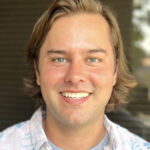
ENCINITAS — Reverend Patrick McCollum did not bring the World Peace Violin to La Paloma Theatre on Oct. 29 in Encinitas.
McCollum, an award-winning peacemaker, attended the pre-release screening of a documentary about his mission to unite the indigenous tribes of South America in an effort to save the Amazon rainforest.
The city’s historic, one-screen theater hosted both a showing of “The Man Who Saves the World?” and a Q&A with its star afterward.
When asked for more information on the violin, McCollum said he built it himself using wood from a sacred tree in the Congo – a token of thanks for helping stop a conflict – and wood from the Tree of Peace in California, gifted in gratitude from Native tribes for his work during a dispute with the government.
“I took those two pieces and I decided they both had something in common,” McCollum told the crowd. “They were both related to conflict and peace. And in the end, peace came.”
The United Nations-recognized instrument could not travel because it had been disassembled to make room for the ashes of Jane Goodall. Goodall – an environmentalist, humanitarian and chimpanzee expert – was a close friend of McCollum’s and nominated him for UN Messenger of Peace in 2020.
“Patrick is probably the most extraordinary person I’ve met,” Goodall said in the film. “He’s different from other people. He truly seems to have been put on this planet with a mission.”
The violin represents one part of that mission. McCollum said he heard a voice tell him to build a violin, even though he did not know how to craft or play one.
“The voice said to me, ‘Patrick, I want you to make a violin and it’s going to become a symbol of peace for the entire world,’” he said.
Following that belief, McCollum created the violin with fragments tied to more than 100 wars and conflicts. Those items include ashes from victims of the atomic bombings of Hiroshima, ashes from the horn of a white buffalo tied to an Anishinaabe prophecy, sand from the site of Jesus’ baptism, and shards from the place where the Buddha gave his first sermon.


McCollum said the instrument sounded terrible until, after being made a saint in India, he asked a crowd of 100 million people to say “peace” in their languages as the violin was submerged in the Ganges River.
“When it dried out, it became something magical,” McCollum said.
The film follows another spiritual mission. Gabe Polsky, writer and director, accompanies McCollum as he seeks to fulfill an ancient prophecy that foretells the unification of tribes in South America.
McCollum said he was called to spark dialogue among tribal elders.
“I believe they’ll save the Amazon, not me,” he said.
If McCollum embodies belief, Polsky brings skepticism. That tension even appears in the title, punctuated with a question mark.
“Things were happening, but I wasn’t sure what,” Polsky said in the film.
The filmmaker participated remotely in the post-screening discussion, adding, “I’m still unpacking the journey.”
McCollum, meanwhile, kept moving despite knee replacements, an MRSA infection and financing the trip with his $1,200-per-month Social Security checks.
“I’ve learned in my life that if you choose to step forward and you refuse to say ‘no’ and you have faith, that you can make things happen far beyond what we believe in,” he said. “We can change the entire planet by just taking a step forward.”
The film lingered on moments of anticipation along the journey. Quiet car rides, plane flights and walks in nature offered the space for McCollum’s resolve to shine through Polsky’s – and the audience’s – bewilderment and uncertainty.
McCollum stressed the value of paying attention to everything around you, saying he speaks in “various magic languages” to communicate with plants and trees. In order to better facilitate listening, he waited for a train to rumble past outside before continuing his story.
Bigness and smallness danced together throughout the film’s runtime and were palpable in La Paloma. One of the biggest laughs came when McCollum ignored a phone call from Mairead Maguire – the 1976 Nobel Peace Prize winner for her work in Northern Ireland – because he was busy.
The audience cheered later as he walked up a hill without a knee brace to fetch water from a well at a house he owns and continually rebuilds outside Albuquerque, New Mexico.
Running the lights, sound and projector was Allen Largent, owner of La Paloma Theatre. Largent told The Coast News he enjoys watching audiences respond.
“We’re controlling photons and electrons to create memories for people,” he said. “It’s just a modern way to communicate with people and elicit some emotions and feelings. It’s kind of a unique business.”
During the Q&A and discussion, McCollum said he considers faith to be a throughline for everything he does.
“When I first started learning about spirituality, one of my very first mentors said to me, ‘When you walk on the ground every day in your life, you’re walking on a path, but the moment you choose to see it as a sacred path, you’re on a sacred path,’” he said.
Polsky said that commitment to your purpose can’t be rushed.
“I think that an important lesson is not to force things,” he said. “We always do that in life – trying to force things. But you know, there’s something to letting things unfold and then magic comes your way.”
McCollum added that in “these challenging times,” people do not need superpowers or grand ambitions to contribute to peace. Simple compassion can move mountains.
“You could just give someone on the other side of an issue a break and recognize they’re human and that we’re all sacred,” he said.
The film itself serves as another step in that direction, urging viewers to walk their own sacred paths.
“In watching the movie, you’re all part of the prophecy now,” McCollum said. “You can’t get out of it.”