ENCINITAS — Like so many others, Encinitas resident Patrick Stoll will spend much of his summer in Europe with friends.
Instead of taking in historic cities and more traditional vacation spots, however, Stoll is currently raising money to spend three months competing in eight events across 10 countries on the elite World Downhill Skateboarding Championship circuit, or, as he calls it, “60-mile-per-hour yoga.”
The WDSC is an international racing series featuring downhill skaters on closed mountain roads and steep paved courses around the world. Riders can reach speeds of 60 to 70 mph while navigating tight turns and technical descents.
Of the sport’s two main styles – freeride (characterized by style) and downhill (characterized by pure speed) – Stoll prefers the latter.
Depending on the road and conditions, riders in organized downhill competitions can reach freeway speeds on professionally managed courses designed to let them safely push their limits.
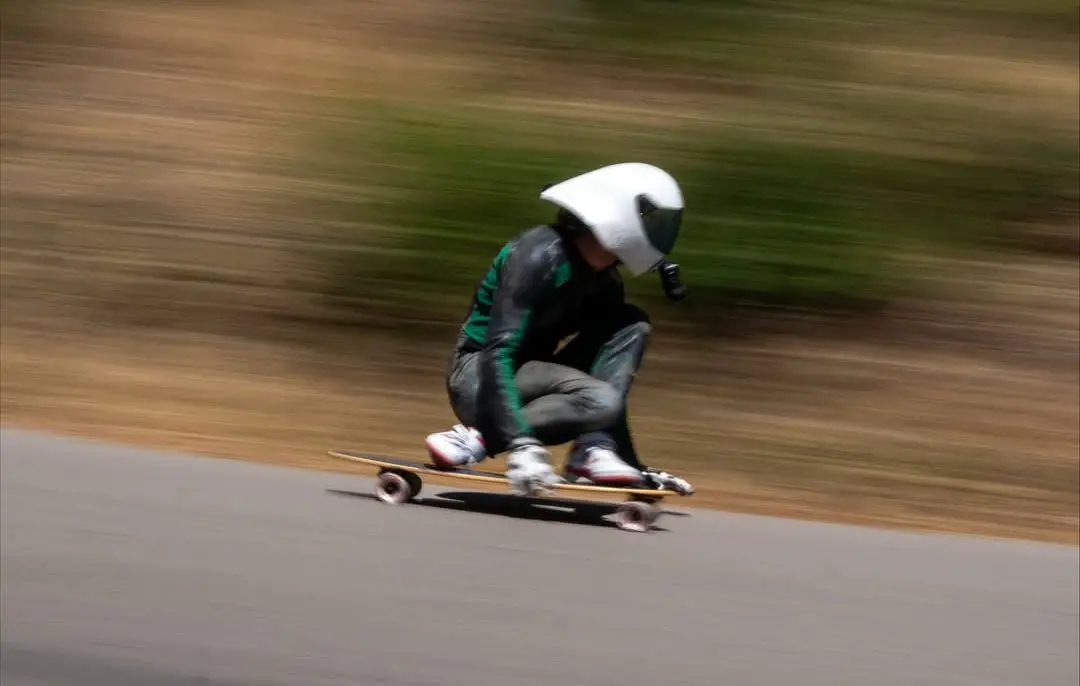

“Normal roads feature three things that downhill skateboarders hate – cars, guardrails and cliffs – which make pushing the edge of your limits ‘not worth the risk,’” Stoll said. “For the competitions, the organization closes down the roads; puts hay bales along the sides of the road; covers guardrails and trees; fills ditches and protects the cliffs with nets.”
Now in his third year competing in the WDSC, Stoll plans to enter all five competitive events this season, hoping to finish in the top 10. Last year, he placed 13th while competing in just three WDSC events.
Stoll joked that while many people save money to travel to San Diego, he lives mainly out of a van in Encinitas and La Jolla, saving enough to travel the world.
More than just competitions
In addition to WDSC events in Erzincan, Turkey, in June, the Isle of Man in July, and the Ekstremsportveko extreme sports festival in Norway, Stoll said he looks forward to traveling around Europe with friends and exploring some of the continent’s best downhill roads.
He has also taken to filming runs and producing video content for social media.
“The first year I went knowing nobody,” Stoll said. “I didn’t know a single European skater really. And I went and just started showing up to these events that are pre-planned. And as that began to progress, people started to see that I was a good filmer, and then therefore they wanted me in their group, and then I would get car rides for free, a lot of the time.”
Stoll said he was first introduced to the sport through videos and social media posts highlighting the skill, scenery and camaraderie of downhill skating.
For Stoll, downhill skating tends to foster community in ways other extreme sports do not. Skaters often stick to groups of 10 to 20 riders with clear safety rules rooted in European skate culture.
“They don’t skate with traffic,” Stoll said.
To ensure safety, groups often send an advance car roughly 30 seconds ahead of the skater as they descend the hill.
“They send the car first with a radio, and that car communicates what’s coming,” Stoll said, “so you can plan accordingly.”
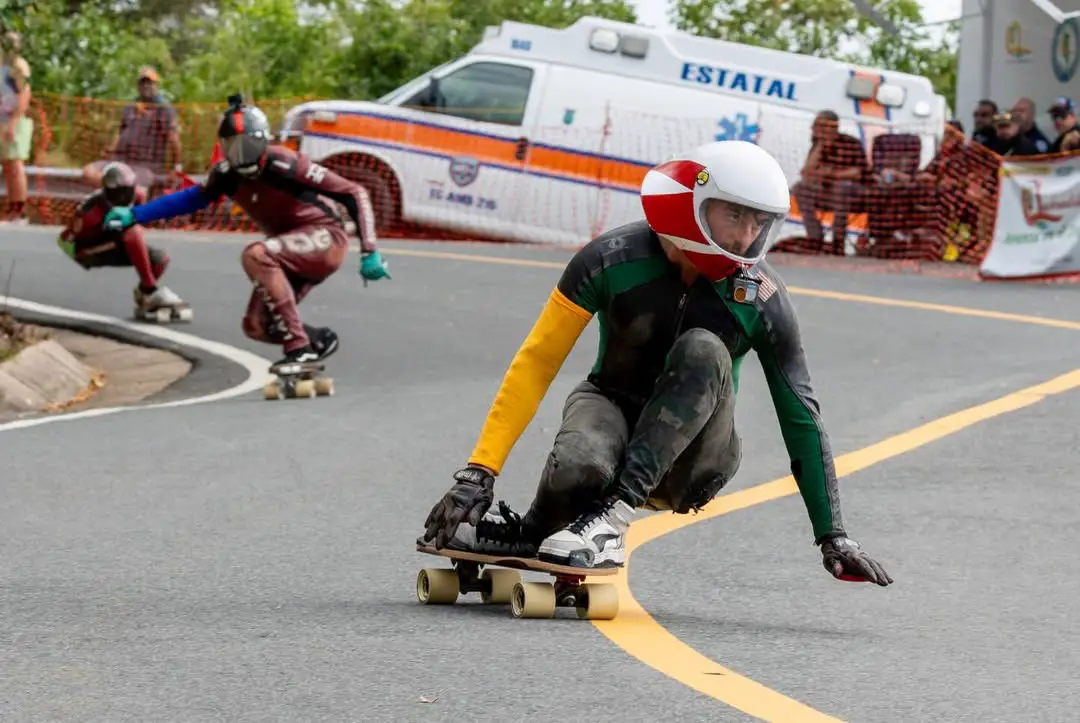

According to Stoll, the system creates a level of trust that fosters deeper connections among riders and improves the experience by encouraging communication and cooperation.
Compared with surfing, another sport he enjoys, Stoll said, downhill skating has a unique community-building advantage.
“There’s no limited resource,” Stoll said. “Surfing, since it’s such a solo sport, becomes like a battle for every wave. The hill’s always there. The wave’s never that. Every day it changes, it’s never the same. When skating, it pretty much stays the same every time.
“It makes it more inclusive, I think. It’s more encouraging and people want everyone to skate better and safer.”
He added that the natural rhythm of the day – catching hills before the morning commute, downtime in the afternoon, and more skating after traffic dies down – creates time to hang out and exchange tips and techniques with “open ears.”
“It’s super cool,” Stoll said. “It’s super cool. I skate with the best – the pinnacle of my sport – I get to hang out with them all the time; compete with them and learn from them. I think that’s the cool part about the sport is you don’t have to be the best to hang out with the best skaters. It’s a very friendly environment.”
Unintentional life skills
Stoll said that before discovering downhill skating, he struggled with anxiety and bouts of laziness. Being diagnosed with anxiety as a child sometimes felt like a built-in excuse.
“I tended to run from things,” Stoll said. “I used to be scared of flying, and I was like, ‘Oh, I don’t want to travel because then I have to face my fear all the time.’”


“But when I started pursuing things that scared me, it started to push me out of my comfort zone, making me more active and travel more – the things that I wanted to do, just was too scared to do, I guess. And so once I conquered my fear of skating, I figured out that almost all my fears are the same. And the only way to get over your fears is to face them. So it started making me want to face my fear more and more often. And that kind of made me progress as a person and in my sport.”
Stoll said he hopes to lean further into the creative side of video storytelling. Rather than focusing solely on promotional clips or social media videos, he would like to make a feature-length film documenting the downhill skating community, competitions and the process of improving the craft.
He said the local and international downhill communities have provided a meaningful opportunity for people to “get together and get off their phones.”
“I think the big thing about it is you’re learning life skills unintentionally through skating,” he said. “I’m stoked I got into this stupid sport.”