
REGION — Carlsbad and Encinitas continue to explore ways to protect their coastlines ahead of an El Niño season that state officials warn could break records.
Carlsbad — which declared a local state of emergency on Sept. 9 over eroding coastal cliffs — is exploring faster, less expensive ways to protect a stretch of Carlsbad Boulevard above North Ponto Beach than a previously identified $280 million project.
In Encinitas, the City Council directed staff at its Oct. 14 meeting to explore how the city could tap state resources following California’s emergency declaration ahead of the El Niño storm season.
Gov. Gavin Newsom issued the declaration Sept. 21, noting in a news release that the “emerging El Niño event is already breaking records, and forecasters expect it to continue to strengthen, potentially becoming the strongest in recorded history.”
“We are preparing for this El Niño early because every Californian deserves to be safe in their home, connected to their community, and protected when severe weather comes,” Newsom said.
Deputy Mayor Jim O’Hara said he hoped city staff could explore tools potentially available under the governor’s declaration, including sand replenishment, temporary protective measures and funding strategies.
O’Hara’s written proposal called for an assessment of current beach conditions, coordination with state and regional partners, and a public communication and preparedness plan. It also proposed routing sand replenishment actions and reports directly through the city manager’s office to expedite decisions, with findings and a recommended action plan due Nov. 15.
The report said reduced sand volumes leave beaches narrower and allow more wave energy to reach the bases of coastal bluffs, accelerating erosion and increasing risks to coastal stability.
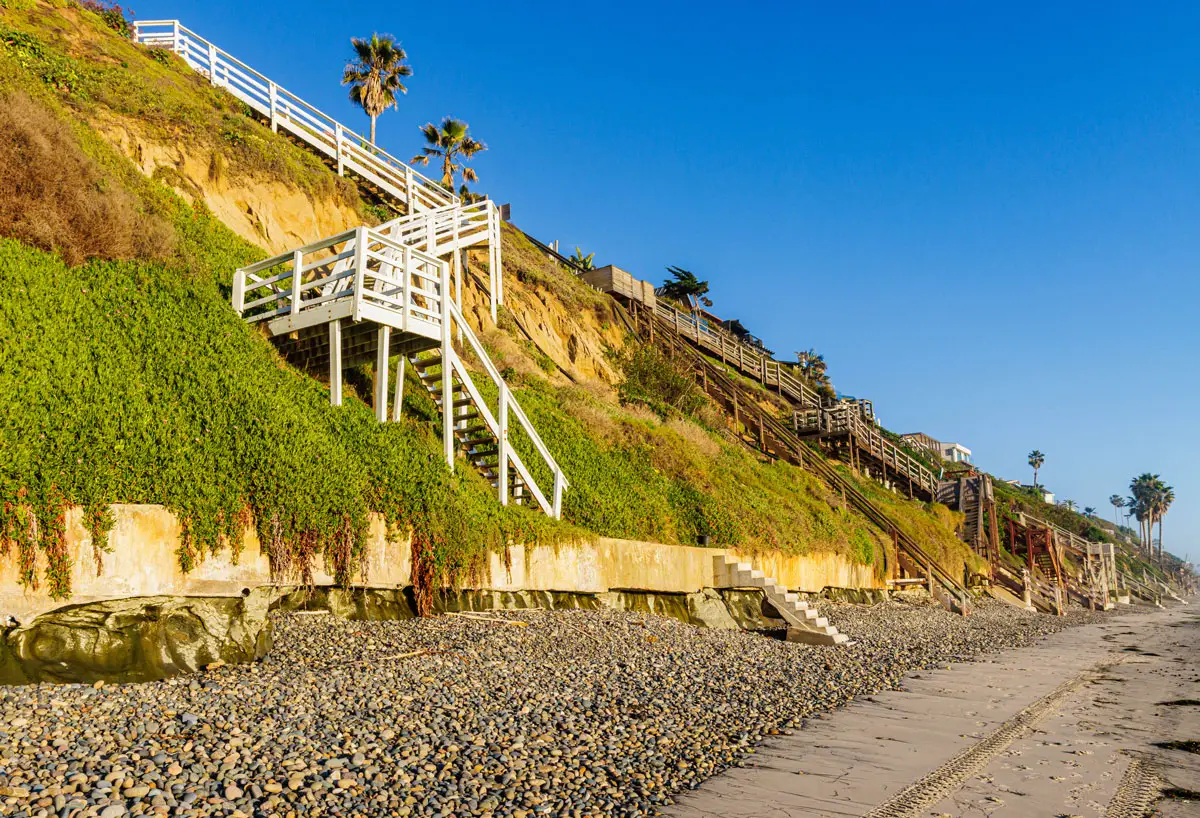
O’Hara said Encinitas’ cliffs are more vulnerable than usual following the “intense summer swell season as we’ve all seen and experienced,” pointing to the bluff collapse at Grandview Beach that prompted the closure of the recently completed staircase.
According to his report, the collapse occurred just weeks after a $1 million staircase repair project.
“Not only do we have a super El Niño, but we also have a rare occurrence this year where there should be plenty of beach right now,” he said. “And instead there’s no beach. And so we’re starting from behind, and we need to be prepared to act for our residents yesterday, for lack of a better way to put it.”
Councilmember Luke Shaffer, an avid surfer, agreed that beaches lacked sand and said the urgency to explore all options stemmed from the fact that “it’s a bit late in the game right now, but we’re here.”
“I wouldn’t be surprised if the train tracks in Cardiff end up with water on them,” Shaffer said. “It’s going to be kind of nasty.”
Shaffer added that he hoped the city would pursue other funding opportunities, including through the Federal Emergency Management Agency, or FEMA, similar to Newport Beach.
Mayor Bruce Ehlers said the discussion was “more than just a beach replenishment item” and that, at Grandview, “the potential for further erosion and threatening of our staircase that we just finished fixing, we could consider immediately adding sand or riprap around it in order to protect it.”
Councilmember Joy Lyndes asked City Manager Jennifer Campbell whether the city would benefit from declaring a local state of emergency, as Carlsbad did.
Campbell said a declaration might help streamline administrative processes, including project bidding. She added that the city had already begun preparing to purchase additional pumps, hoses and sandbag-filling machines within her spending authority.
“So we’re already starting to purchase some things that might make it easier,” she said. “This definitely would help with the proclamation of emergency for the whole state, but we can definitely do our own, which can enhance that.”
Encinitas is also exploring whether sand dredged from the San Dieguito Lagoon inlet in Del Mar could help replenish its northern beaches.
Del Mar declared a local emergency Sept. 22 over sediment buildup that officials fear could restrict water flow and increase flooding during winter storms. The city asked the U.S. Army Corps of Engineers to increase its authorized removal limit from 16,000 to 50,000 cubic yards per dredge.
Leucadia resident Gary Murphy and former Encinitas coastal administrator Kathy Weldon have urged the cities to explore transporting suitable dredged sand north to beaches including Grandview, Beacon’s and Stonesteps.
Southern California Edison, which maintains the lagoon as environmental mitigation for the decommissioned San Onofre Nuclear Generating Station, expects to remove about 15,000 cubic yards this fall. However, transporting that material to northern Encinitas would fall outside the utility’s current authorization and require additional approvals.
Encinitas’ Sand Compatibility and Opportunistic Use Program allows suitable sand from dredging, construction and other sources to be placed at permitted beach locations. The council’s Oct. 14 action also established weekly meetings between the city manager and coastal program staff to coordinate efforts, including exploring available lagoon sand and expanding the recycling program.
Transportation costs remain a major obstacle. Ehlers said moving 10,000 cubic yards of donated sand from Moonlight Beach to Beacon’s Beach recently cost roughly $350,000. The amount of suitable sand available from the lagoon remains uncertain.
The effort would target northern beaches left out of the 2024 federal replenishment project, which placed about 347,000 cubic yards along the Encinitas-Leucadia shoreline. According to SANDAG’s 2025 shoreline monitoring report, the average shoreline in that study area had retreated 40 feet since 2000.
In June 2023, the Carlsbad City Council directed staff to advance a concept that would move the southbound lanes of Carlsbad Boulevard between Solamar Drive and Island Way east, next to the northbound lanes.
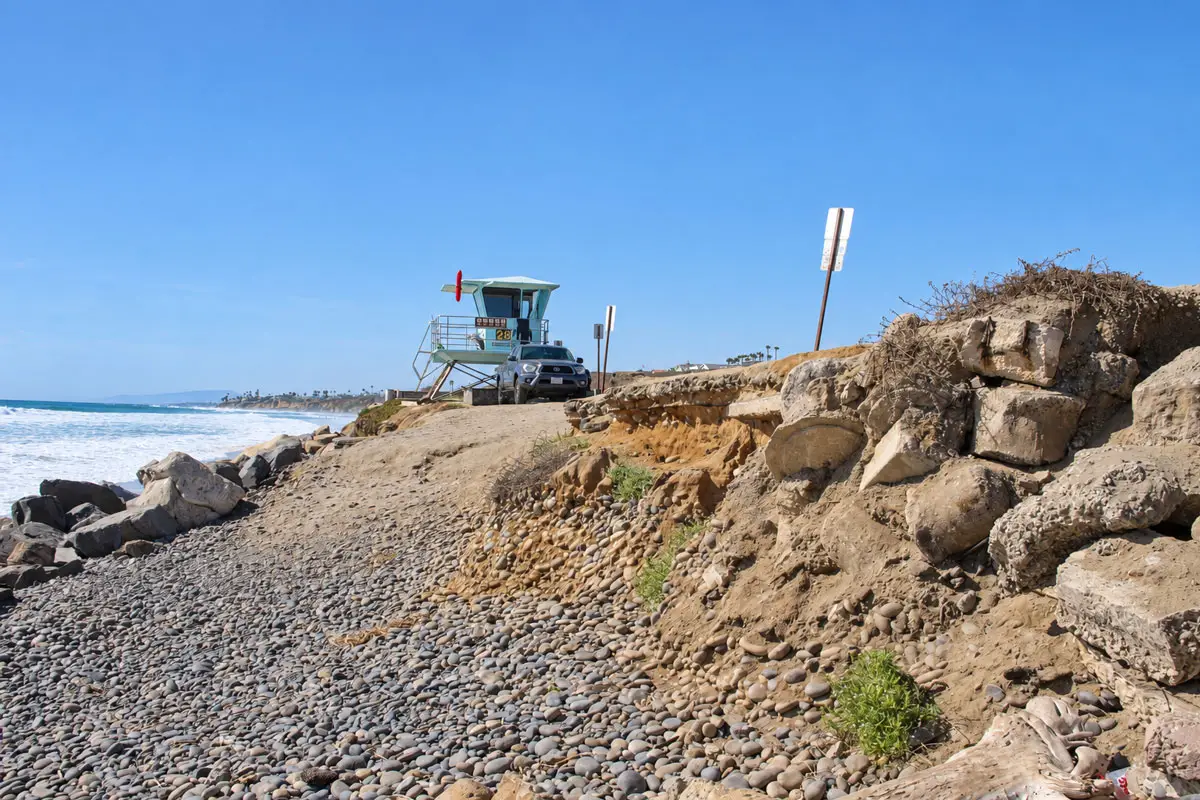
The project carried an estimated $280 million price tag to stabilize a stretch of coastline currently protected by a rock revetment approved under an emergency permit awaiting full review by the California Coastal Commission.
Meanwhile, Carlsbad has begun a separate, approximately $1.9 million emergency project to protect southbound Carlsbad Boulevard north of the Las Encinas Creek bridge, according to a staff report prepared for the council’s Oct. 20 meeting.
The work includes extending the existing rock revetment about 192 feet north, with the possibility of a longer extension depending on conditions encountered during construction. Work began Sept. 30 and is expected to finish in November or December.
City staff identified bluff erosion in the area June 25 and began monitoring it, placing warning cones and sealing pavement cracks to prevent water intrusion. A geotechnical consultant’s Sept. 8 memorandum confirmed that erosion could threaten the roadway’s integrity without prompt action.
The emergency declaration allows the city to bypass formal bidding procedures that staff said would otherwise take four to six months. The work is intended to keep the southbound roadway open and protect motorists, cyclists and pedestrians.
Coastal Commission staff issued an emergency coastal development permit Sept. 17, and the commission concurred Oct. 8, according to the report. The city also obtained approvals from the San Diego Regional Water Quality Control Board, U.S. Army Corps of Engineers and California State Parks.
In a memorandum to the mayor and council, City Manager Geoff Patnoe wrote that the city had signed a contract with GHD Inc. to explore alternative roadway designs for the corridor.
GHD is an engineering, architecture and environmental consulting firm with more than a dozen offices in California, including one in San Diego.
The nearly $200,000 contract, which falls below the threshold requiring full council review, calls for five conceptual roadway alternatives to address longstanding concerns about coastal erosion and flooding.
The memorandum said that with this analysis, “the goal is to determine whether there are practical, more cost-effective approaches that can achieve the city’s objectives while maintaining flexibility to respond as coastal conditions and available funding evolve.”
Any findings would be subject to council review at a date yet to be determined.