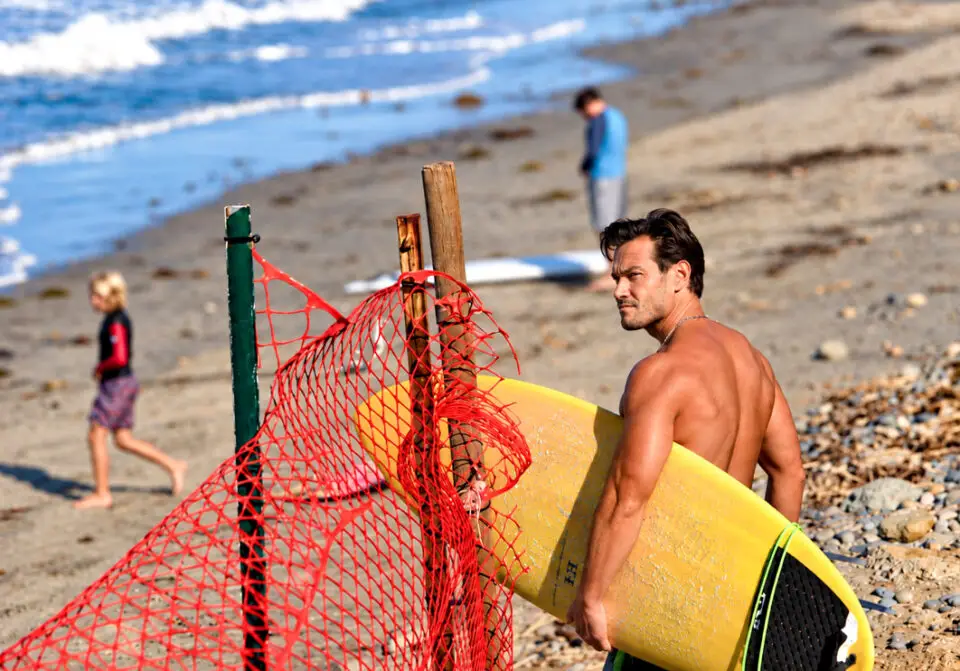
ENCINITAS — For Leucadia resident Gary Murphy and former Encinitas coastal administrator Kathy Weldon, the sand accumulating at the San Dieguito Lagoon inlet represents more than a potential winter flooding problem in Del Mar.
The buildup at the river’s mouth could also help solve another longstanding issue: restoring eroding beaches farther north in Encinitas.
Murphy and Weldon are urging coastal cities to explore recycling sand from lagoon dredging to replenish beaches in northern Encinitas and near Batiquitos Lagoon.
Del Mar officials recently declared a local emergency Sept. 22 over the sediment buildup at the San Dieguito Lagoon inlet, which officials fear could restrict water flow and increase flooding during winter storms.
The Del Mar City Council asked the U.S. Army Corps of Engineers to increase the amount of sand the city can remove from the lagoon from 16,000 to 50,000 cubic yards per dredge, more than triple the current limit. The total amount of sand accumulated at the inlet remains unknown.
Southern California Edison, which maintains the lagoon as part of environmental mitigation for the decommissioned San Onofre Nuclear Generating Station, expects to remove approximately 15,000 cubic yards this fall, according to a utility spokesperson.
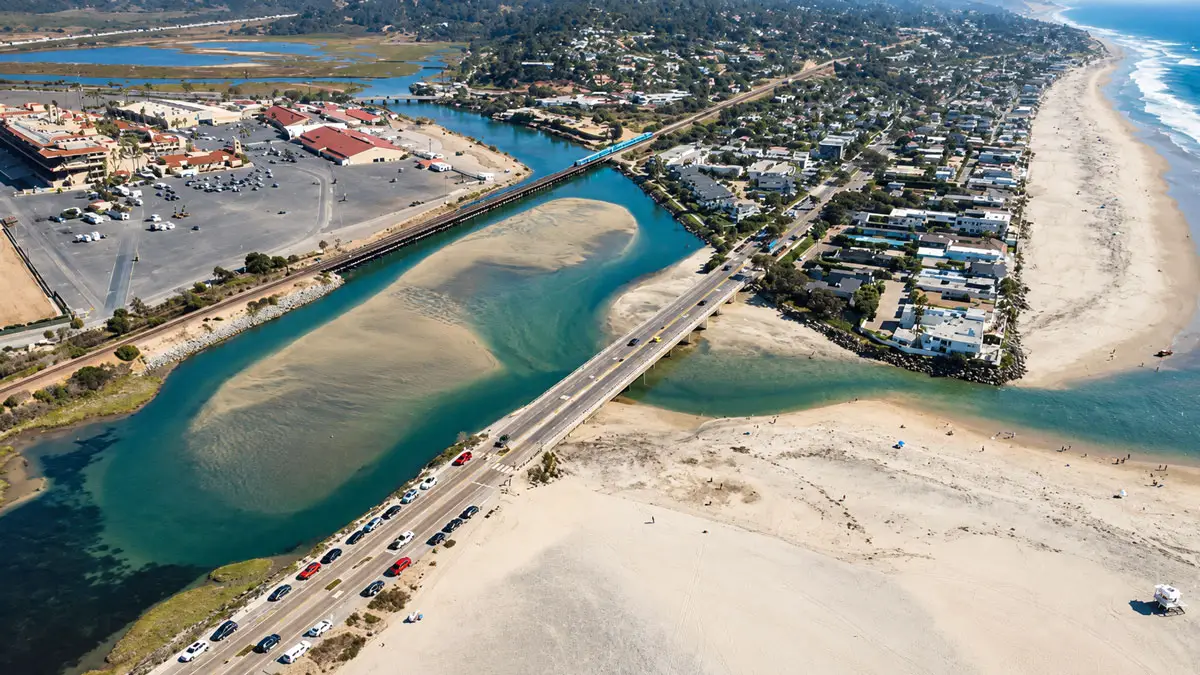
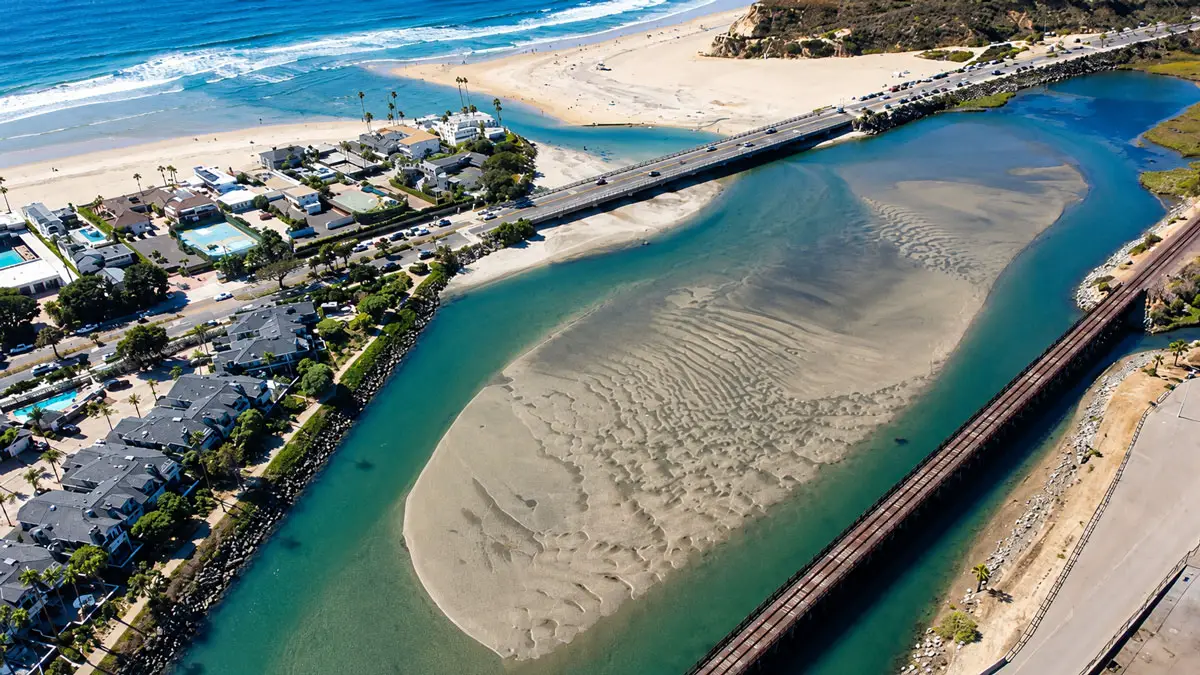
The City of Del Mar has said Edison’s separately permitted fall dredging operation allows removal of up to 20,000 cubic yards. Murphy and Weldon hope to transport some of the dredged material north to replenish Encinitas beaches, including Grandview, Stonesteps and Beacon’s.
The duo also envisions something bigger: a regional sand recycling program in which Carlsbad, Del Mar, Solana Beach and Encinitas share the cost of transporting dredged sand north. The goal is to keep sand within the coastal system while rebuilding a protective buffer against erosion and storm damage.
“The goal is trying to rebuild the beach back up so there’s some buffer when the big waves do come,” she said. “We’re trying to recycle the sand and keep it in the same system.”
But whether relocating the sand could address both coastal erosion and the lagoon’s sediment buildup remains a question of engineering, permits, funding, regional cooperation and the political will to move the proposal forward.
From barges to trucks
Murphy and Weldon initially explored using barges to deposit sand offshore, forming submerged berms that could reduce the force of incoming waves while allowing currents to gradually move sand toward shore.
Murphy developed a map identifying three potential offshore drop sites near Grandview, Beacon’s and Stonesteps, suggesting sand placement in water at least 25 to 30 feet deep, beyond the kelp beds. The proposal’s effects on waves, sand movement and marine habitat would require engineering and environmental review.
The original concept involved a pilot project to deposit approximately 70,000 cubic yards of sand at the three locations to study how waves and currents redistribute the material. However, Murphy said the estimate was based on unverified information about excess sand at the inlet.
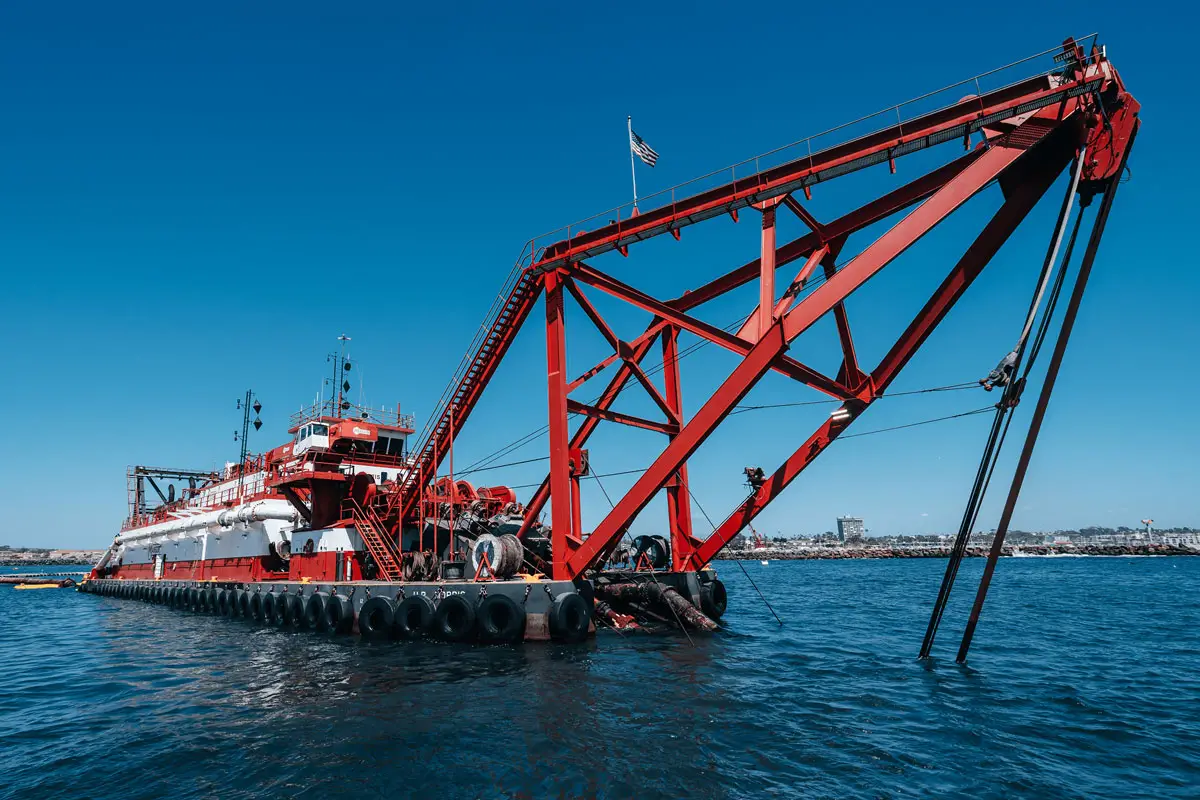
Walt Jellison, president and general manager of Pacific Dredge & Construction, a subsidiary of Pacific Maritime Group, said moving lagoon sand offshore by barge is possible, but the logistics could make a relatively smaller operation difficult to justify.
Jellison, who has worked in dredging since 1977 and pumped sand from Batiquitos, Agua Hedionda and San Dieguito lagoons, said the process would involve pumping material into a flat-bottom scow barge that opens from the bottom, then towing it to an approved offshore drop site. Costs would depend on the volume, destination and permit requirements, he said.
“It can be done, but the volume is minimal,” Jellison told The Coast News. “Mobilizing that amount of material costs a lot of money.”
For comparison, Jellison said he has worked on dredging projects involving 300,000 cubic yards of sand at Agua Hedionda Lagoon and Bolsa Chica Tidal Inlet in Huntington Beach. Even the 50,000 cubic yards Del Mar wants authorized for removal would represent just one-sixth of that volume.
Jellison also noted that San Dieguito Lagoon contains large amounts of cobble, or rocks, which complicates pumping and limits the amount of suitable sand for beach placement. Cobbles the size of bowling balls can clog dredging pumps, forcing crews to stop work and remove the rocks, he said.
Jellison cautioned that offshore sand berms would provide only temporary protection as waves and currents redistribute the material, rather than a permanent solution to coastal erosion.
“You’re not going to stop Mother Nature,” he said. “The land has been retreating for hundreds of years, and it’s never gone the other direction. It’s erosion. Get used to it.”
Murphy, who has spent more than a year discussing the barge proposal with Jellison, acknowledged the logistical challenges, many of which are common to dredging projects, including the risk of rocks damaging equipment and driving up costs.
Still, Murphy believes those challenges are worth tackling.
“At this time, we don’t even know how much sand we can even get,” Murphy said. “My understanding is there may be an extra 10,000 yards that Encinitas may be able to grab (from the San Dieguito Lagoon inlet). Hopefully, there would be more.”
Concerns about cost, equipment access and the potential effects of El Niño storms and king tides have since prompted Murphy and Weldon to put the barge pilot on hold and pursue trucks as a more immediate option.
A path through SCOUP
In Encinitas, the Sand Compatibility and Opportunistic Use Program, or SCOUP, allows compatible sand from construction, dredging and other sources to be placed on authorized beaches, typically using trucks. Past local SCOUP projects have supplied sand to South Ponto, Cardiff State Beach and Moonlight Beach.
For Murphy and Weldon, SCOUP offers a potential route for moving lagoon sand north.
During a Sept. 16 presentation to the Encinitas City Council, Coastal Zone Program Administrator Todd Mierau outlined the city’s sand recycling efforts, including four existing permitted placement areas at Batiquitos State Beach, Leucadia State Beach, Moonlight State Beach and Cardiff State Beach.
The city is also considering expanding those areas to accommodate additional sand, although the proposed locations have not been approved. Mierau emphasized that sand placement is subject to various regulatory requirements.
“Any potential sand for placement would need to be properly permitted through all applicable state and federal agencies before placement along our shores at those specific locations,” Mierau told The Coast News.
Despite those hurdles, Weldon, who spent about 18 years working on stormwater and coastal issues for Encinitas, sees an opportunity to recover sand from an already planned dredging operation rather than seek entirely new sources.
“Why not get trucks to take it from the San Dieguito Lagoon while they’re doing the dredging for Del Mar,” Weldon said.
A vanishing shoreline
Long-term shoreline monitoring illustrates why the city’s northern beaches concern Murphy and Weldon.
According to SANDAG’s 2025 shoreline monitoring report, Encinitas and Leucadia beaches have continued losing sand despite decades of replenishment efforts.
By fall 2025, the average shoreline in the Encinitas-Leucadia study area had retreated 40 feet since 2000. The surveyed beaches and nearby underwater areas held 29 fewer cubic yards of sand per foot of shoreline.
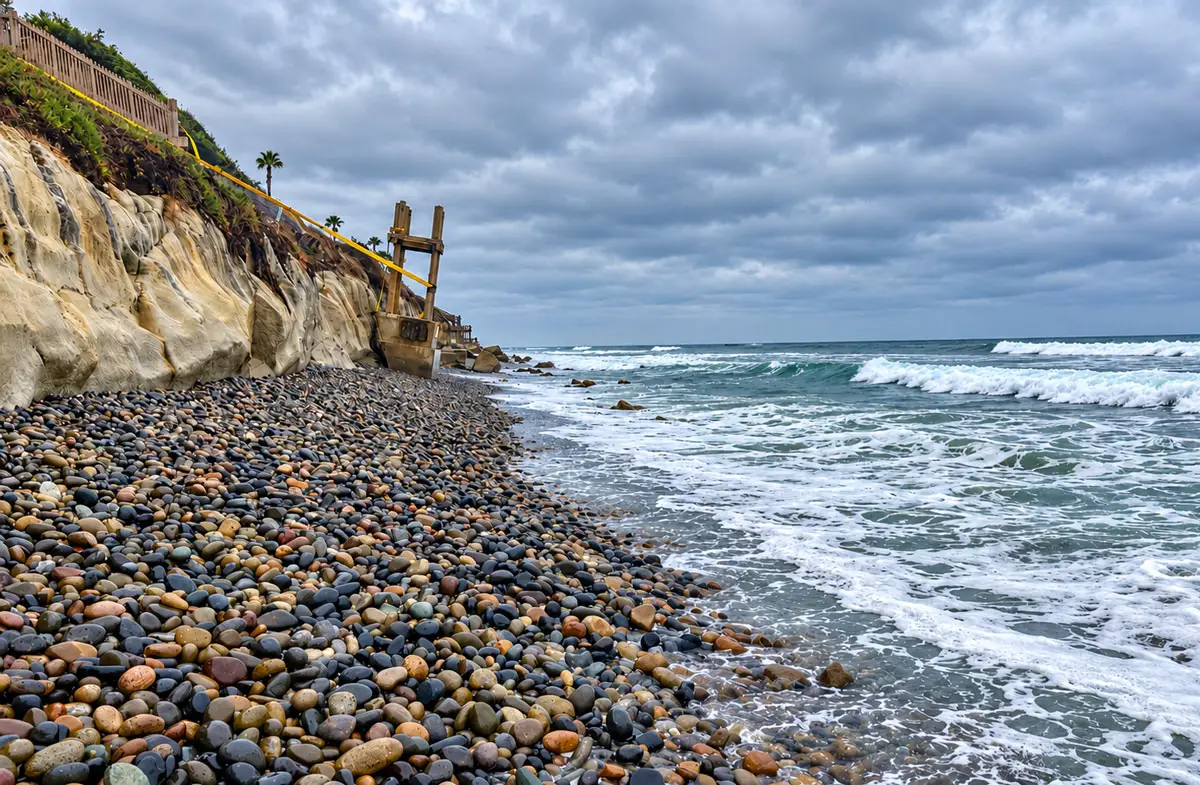
In 2024, a 50-year federal shoreline protection program — which calls for replenishing beaches in Encinitas every five years and Solana Beach every 10 years to provide a protective buffer against waves, high tides and erosion — placed approximately 347,000 cubic yards of sand along the Encinitas-Leucadia shoreline, widening beaches from south of Beacon’s to north of Swami’s.
Encinitas contributed just over $1 million toward the project, part of a combined $3.6 million cost share with Solana Beach. The total project cost was estimated at $43 million to $50 million, with approximately $28 million to $30.5 million in federal funding and $11.5 million in state grants.
However, the project left the northernmost beaches untouched, and sand levels remained below those recorded in 2000. Losses resumed in 2025.
Conditions were better farther south in Cardiff, which the report measured separately. Its average shoreline remained 65 feet farther seaward than in 2000, although beach width and sand volume have generally declined since 2018.
Del Mar experienced shoreline gains over the same 25-year period, with its average shoreline extending 25 feet farther seaward and its beaches and nearby underwater areas holding 62 more cubic yards of sand per foot of shoreline.
The report suggests Del Mar benefited from replenishment sand in Encinitas gradually moving south. The 2024 federal project placed more than 1 million cubic yards of sand across Encinitas and Solana Beach combined, with waves and currents carrying some of that material southward.
However, the Corps has not established whether sand from the project contributed to the sediment buildup narrowing the San Dieguito Lagoon inlet.
“We can’t confirm project impacts or estimate attributable quantities until the completion of our data analysis currently expected to be finalized in April 2027,” Dena O’Dell, public affairs chief for the Corps’ Los Angeles District, wrote in response to questions from The Coast News.
If the replenishment project caused additional sand buildup in the lagoon, the agency would fund the extra dredging needed to keep the inlet open, according to the Corps’ environmental review documents.
Murphy worries that sand moving south from Del Mar could eventually reach the submarine canyons off La Jolla, where sediment can drift into deeper ocean waters.
“Once it goes out into the ocean or south onto the Del Mar beaches, it only has one place to go: the submarine canyons off Black’s Beach and La Jolla Shores. Then it’s gone,” Murphy said.
Del Mar’s dredging dilemma
Del Mar officials want dredging expedited before winter storms arrive. The city’s request would increase the existing removal limit by 34,000 cubic yards, allowing crews to clear more sediment from the inlet.
City officials worry that a narrower inlet could restrict water flow during heavy storms, especially if Lake Hodges reaches capacity and overflows into the San Dieguito River.
“When the inlet is narrowed or closed, the lagoon loses its ability to absorb storm surge and rain, which raises the real risk of flooding in the low-lying neighborhoods that border the lagoon,” Assistant City Manager Clem Brown previously told the Del Mar City Council.
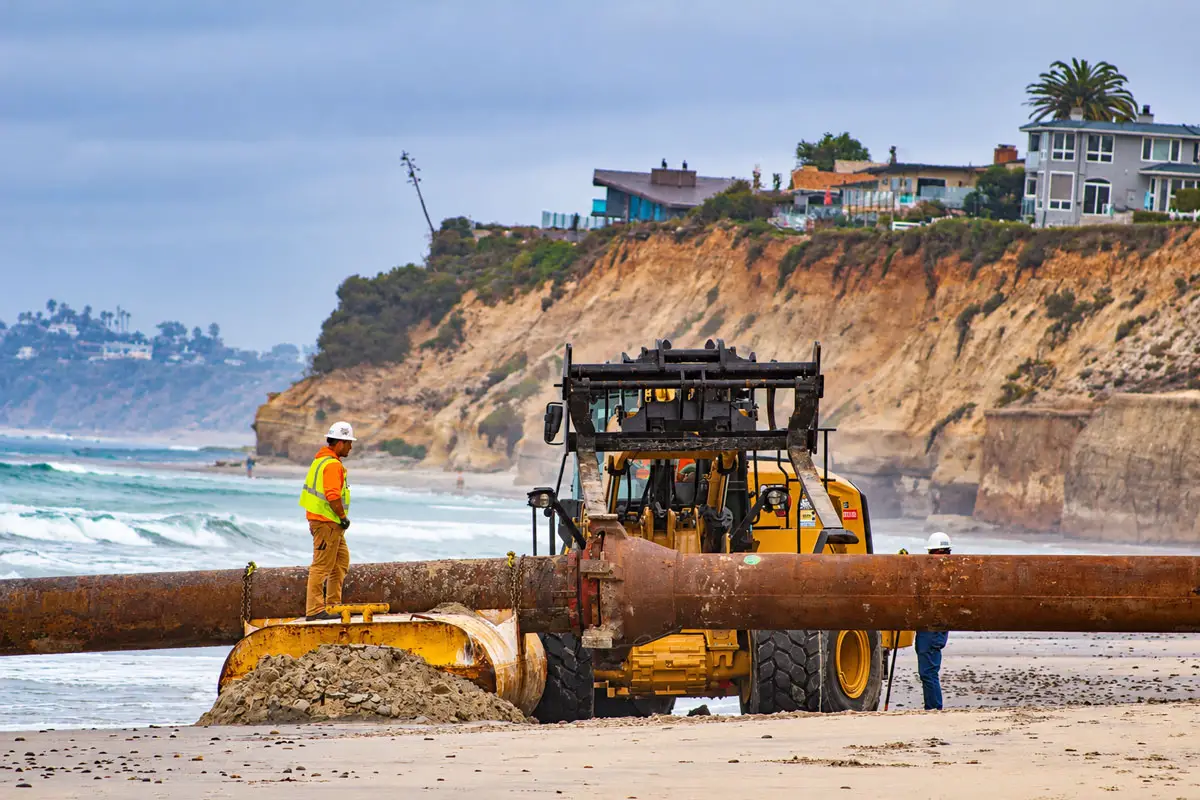
When asked whether more dredging would reduce flooding during winter storms in Del Mar, O’Dell said, “Our project did not address flood risk due to lagoon shoaling.”
Edison spokesman David Eisenhauer said the utility has no current estimate of the total sand accumulated at the inlet. He said dredged material is typically placed on Del Mar beaches immediately north or south of the inlet, while transporting it farther north to the Encinitas-Carlsbad border would fall outside Edison’s current authorization.
“All of this we do under our operating permits,” Eisenhauer said.
For Murphy and Weldon, the immediate challenge is determining how much suitable sand is available and whether they can transport it north before the opportunity passes.
“When they do open the lagoon, we’d like to take the excess sand, whatever we can afford,” Weldon said.
Cost and coordination
Encinitas Mayor Bruce Ehlers, who has been working with Murphy and Weldon, supports finding a cheaper way to move large amounts of sand to northern Leucadia beaches. But he said transportation costs remain a major obstacle.
“The trick is the cost of getting it up there. It could be quite a bit,” Ehlers said, noting that recently moving 10,000 cubic yards of donated sand from Moonlight Beach to Beacon’s Beach cost the city roughly $350,000.
A larger operation hauling material from Del Mar could cost $5 million to $10 million, Ehlers said, although he acknowledged the figure was a rough estimate.
“I don’t think the city has that kind of money,” he said.
Encinitas is pursuing other sources of sand through SANDAG’s proposed third Regional Beach Sand Project, which would dredge offshore deposits to replenish eroding beaches, according to Ehlers.
Ehlers said the city has asked SANDAG to prioritize Beacon’s and beaches farther north. The first two regional projects, completed in 2001 and 2012, added about 3.5 million cubic yards of sand to the region’s beaches. SANDAG is seeking federal and state funding for the next project’s engineering and environmental work.
Locally, Ehlers wants the Planning Commission to require more developers to supply suitable sand excavated during construction to help replenish the city’s northern beaches.
“(Sand replenishment) is multifaceted. The issue is not dead, but we don’t know what will play out yet,” Ehlers said.
This week, the Encinitas City Council considered a proposal from Deputy Mayor Jim O’Hara directing staff to develop a proactive sand replenishment and erosion mitigation plan and explore how the city can take advantage of Gov. Gavin Newsom’s statewide emergency proclamation.

The governor’s Sept. 21 proclamation supports preparations for potential El Niño-related storms, including expedited permitting for flood-risk reduction, which could apply to emergency dredging at the San Dieguito Lagoon inlet, Murphy said.
The City Council unanimously approved O’Hara’s proposal on Oct. 14, directing staff to identify sand replenishment options, potential funding sources and ways to expedite coastal protection and flood mitigation projects under the governor’s emergency proclamation.
The council also agreed to establish weekly meetings between the city manager and coastal program staff to coordinate efforts, including exploring available sand from San Diego Gas & Electric’s parent company, Southern California Edison, and expanding the city’s sand recycling program.
O’Hara said he supports exploring Murphy and Weldon’s proposal but does not yet know whether a sand transfer could be completed before winter storms hit the coastline.
“I want to make sure that the city is acting proactively,” O’Hara said. “I’d like us to do as much as we can, and if we do a little extra and we don’t need it, that’s okay, as long as we protect everything we can to the best of our ability.”
‘We don’t get a second chance’
Murphy said northern Leucadia has repeatedly been overlooked in beach replenishment efforts, including the 2024 federal shoreline project, which stopped short of Beacon’s Beach and areas farther north.
According to Murphy, the Army Corps of Engineers cited cost and relatively stable bluffs in its decision to exclude those beaches, leaving residents with shrinking shorelines and increasingly exposed bluffs.
Murphy, who has surfed Stonesteps and Beacon’s since the late 1970s, believes recycling sand from the San Dieguito Lagoon is about more than protecting the shoreline — it’s also about protecting a public investment before it disappears and restoring beaches that have been ignored.
“We have starving beaches in Encinitas. And material in Del Mar that needs to be removed,” Murphy said. “Why not take two problems and turn them into one beneficial project? It’s a win-win.