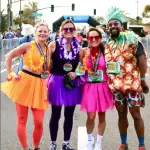
CARLSBAD — In a quiet home studio in Carlsbad, forensic artist and facial reconstructionist PJ Puterbaugh helps create faces without a name.
Often working with only a skull, a photograph, a few teeth, or a forensic anthropologist’s estimate of age, ancestry or body type, Puterbaugh enjoys the challenging, pro bono work.
“I work for the victim. There are way too many people in a box with no name on it,” Puterbaugh said. “Good guy, bad guy — they were somebody’s child.”
Puterbaugh, 68, a Carlsbad resident and co-owner of the Aviara Golf Academy with her husband, Kip, has spent roughly 15 years creating facial reconstructions for unidentified victims nationwide, including dozens of cases tied to North County San Diego.
Puterbaugh’s path into forensic work began through volunteer service with the San Diego County Sheriff’s Office Search-and-Rescue K-9 Unit. During her time there, she learned that the county Medical Examiner’s Office had no in-house forensic artist.
Puterbaugh was already a working artist, trained in classical realism at Watts Atelier of the Arts in Encinitas, where she focused on traditional figure drawing and portraiture.
“I had already worked on faces,” she said. “So I volunteered.”
Since then, she has completed reconstructions for medical examiners and law enforcement agencies in San Diego County, Los Angeles County, Pierce County (Wash.), New York, Arkansas, Arizona and Texas, among others. She estimated that she had contributed to nearly 30 cases in 2025 alone.
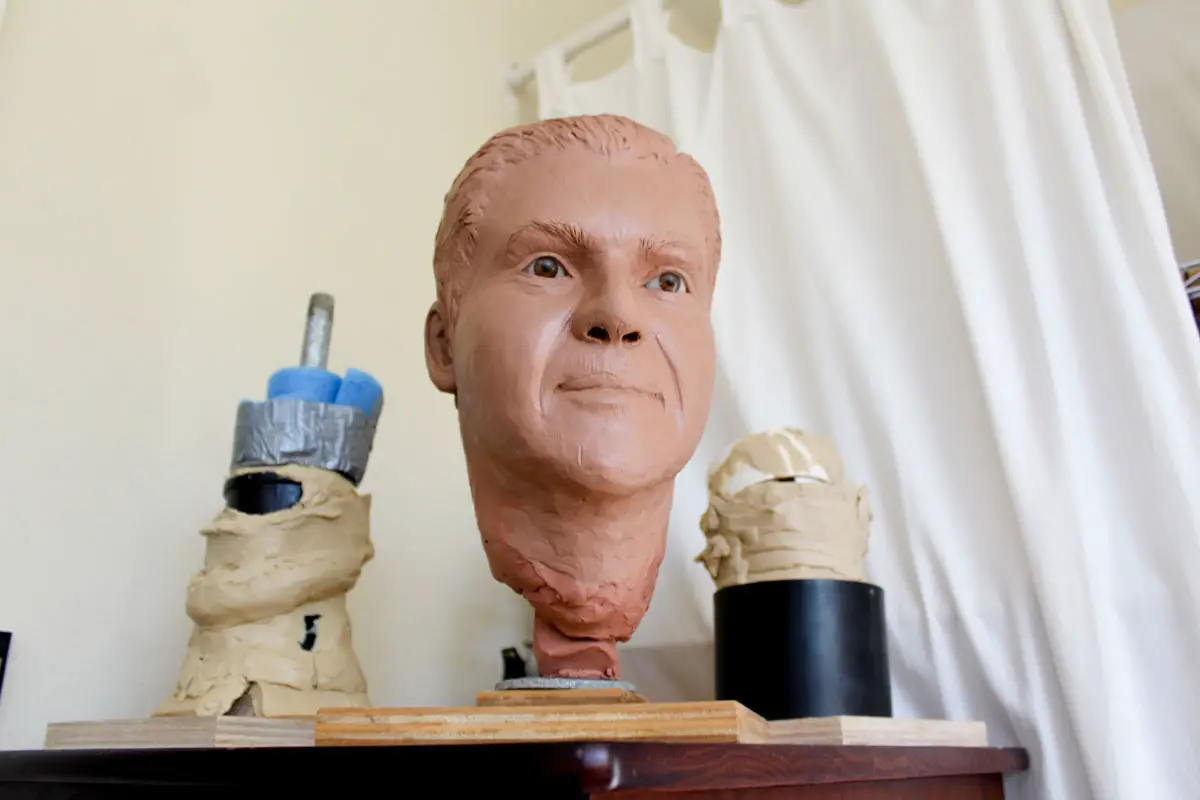

In San Diego County, her work has supported investigations into unidentified individuals found in storm drains, canals, transit corridors and homeless encampments.
Most recently, Puterbaugh developed a color reconstruction of an unidentified woman who was fatally struck by a northbound Coaster train in Carlsbad in August 2024. The case remains unsolved, and the woman’s identity is unknown.
“We don’t know the story,” she said. “Was she visiting from Indiana or someplace? Did she fall at the train station? Did she struggle with drugs? Until we know more, we just keep trying.”
Puterbaugh receives cases from medical examiners, law enforcement, or the National Missing and Unidentified Persons System (NamUs). She does not participate in investigations or speak with detectives about theories.
“They give me descriptions — age range, ancestry, sometimes clothing size — and they send me photographs or remains,” she said. “I recreate the face, send it back and cross my fingers.”
In skull-based reconstructions, Puterbaugh applies tissue-depth markers to the bone in accordance with established forensic anthropology standards. Using clay, digital modeling, and drawing, she builds a face based on bone structure, jaw alignment, dental features (tooth spacing, missing or damaged teeth), and scientific averages for soft-tissue proportions.
Certain features, however, can’t be determined.
“I can’t tell eyebrows, ears, dimples,” she said. “But your skull is individual. That’s why you look like your parents — not because of hair or eyes, but bone structure.”
In many cases, mandibles (jawbones) are missing — often lost to animal activity or exposure — and require additional interpretation by the artist.
Puterbaugh uses Photoshop and artificial intelligence tools to generate multiple variations of a face — different hairstyles, facial hair, age progressions or viewing angles — giving investigators several options when releasing images to the public.


“If they give me a broad age range, I’ll give them someone who looks 40, someone who looks 50, someone with a hat, someone without,” she said. “Instead of one choice, I give them six.”
Still, she cautions the public against unrealistic expectations, noting that the work of a forensic artist is often informed by a coroner’s photo, fragments of physical evidence, and medical investigator accounts, all of which only tell part of the story, leaving the artist to fill in the blanks.
She pointed to a recent Los Angeles area case involving a Newport Beach woman killed by a train, whose reconstruction drew online criticism after she was identified.
“I agree it didn’t look exactly like her,” Puterbaugh said. “But she had severe facial injuries that had to be mended (in the drawing). People often don’t know what material the artist is working with, and so forensic artists deserve a little grace. We’re doing the best we can with a very cold photo. When someone is lying on a table with no expression or energy, that’s what I have to bring back.”
Local cases
In another San Diego County case, Faith Angle, 46, was found deceased in a canal near Forester Creek in Santee during a winter storm in January 2024. Her family, living in Washington state, recognized her after Puterbaugh’s forensic sketch was released.
Angle had been experiencing homelessness at the time of her death.
In another case, the individual, found deceased in San Diego Bay, had a distinctive elephant tattoo, which led investigators to track down the tattoo artist, whose records ultimately helped identify the victim.
“Tattoos are huge,” Puterbaugh said. “Especially for burn victims or decomposed remains. Sometimes that’s all you’ve got.”
She has also worked on long-term cold cases, including the disappearance of Bobby Dale Allen, a Navy sailor who vanished in 1986 after leaving Adelanto, California, to report to his nuclear submarine assignment at the U.S.S. William Bates in San Diego.
Allen never arrived at the naval base, and his 1985 Ford Mustang was later found near San Diego International Airport with the keys still inside. His driver’s license and belongings were also discovered, but he was never seen again.


Decades later, Puterbaugh was asked to age-progress and reinterpret a photograph of Allen. The case remains unsolved.
Recently, Puterbaugh created forensic facial reconstructions for an unidentified female victim from a 1989 homicide and an unidentified male found dead in 1990 in Madera County. The images were developed in part using advanced familial genetic genealogy, which indicated that Jane Doe’s maternal lineage had roots in Nochistlán and Zacatecas, Mexico.
While DNA analysis is becoming faster and more powerful, Puterbaugh said, it’s still a lengthy and expensive process, making facial reconstruction a critical tool, especially as families and investigators wait for test results.
“DNA costs thousands of dollars, and agencies have to raise funding for it,” she said. “A skull reconstruction is often a last-ditch effort while waiting for DNA results.”
Puterbaugh does not charge for the work and does not keep the sculptures. Once photographs of the clay busts are taken, each reconstruction is dismantled and the remains returned to the medical examiner.
She inventories every bone and tooth she receives, documents their condition and returns all evidence exactly as it arrived.
“Every case is potentially a homicide, so you have to be meticulous,” she said.
For her, unpaid volunteer work is both technical and personal, providing satisfaction in helping those without the ability to speak for themselves.
But it’s also the mark of something bigger — a community’s values and compassion.
“I think you can judge a society on how they treat their dead,” Puterbaugh said, a nod to English Prime Minister William Ewart Gladstone’s famous saying. “This is my talent, so this is what I should use it for, right? It’s kind of neat because my art has a purpose.”
Follow Puterbaugh on Instagram at @pjp.artist.