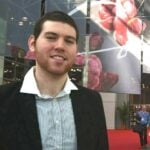
Before turning 50, former NBA center and Torrey Pines High School alum Scot Pollard faced heart failure so severe that only a transplant could save him.
Two dates in Pollard’s life remain seared in memory. One is Oct. 28, 1991, when his father, Pearl, died of a heart attack at 54 in Solana Beach while in need of a transplant.
The other is less precise — a week over the winter of 1999, when the NBA lockout had just ended and Pollard prepared for his second NBA training camp, his first with the Atlanta Hawks after being traded from the Detroit Pistons for Christian Laettner.
During the team physical, he received his first flu shot. Within days, the 6-foot-11 big man was so sick he spent the Hawks’ entire, strike-shortened training camp confined to his hotel room.
“As soon as I got healthy, they said, ‘We have a game tonight, and we’re either going to put you on the reserve list with no injury, or we can cut you,’” Pollard recalled during a recent Aug. 20 webinar hosted by the DCM Foundation.
After consulting his agent, who told him Sacramento was ready to sign him, Pollard asked the Hawks to release him. The next night, he suited up for the Kings in Philadelphia.

“That was the first flu shot I ever got in my life, and it made me very ill,” he said.
Before sharing more, Pollard cautioned attendees: “I’m not a doctor, I’m not a lawyer. I’m just telling my story. I may touch on some things from my medical history that you might find political or divisive. I’m not telling you what to do — just what happened to me and what I’ve been through.”
Two decades later, a routine precaution would trigger a far more serious health battle.
Pollard said he experienced severe symptoms after receiving the second flu shot of his life, recommended during the COVID-19 pandemic, leading to the discovery of a previously undetected genetic heart condition.
Over the next three years, he endured heart failure, multiple medications with harsh side effects, and repeated procedures, including ablations that failed to stabilize him.
“I was out of breath; my heart was racing — something was drastically wrong,” Pollard remembered.
A visit to a Minute Clinic turned into an urgent hospital referral, where tests revealed a virus had attacked his heart, triggering the same genetic condition that claimed his father when Pollard was 16.
Growing up in a “family of giants,” Pollard credited his physical resilience to the people around him. His father stood 6-foot-9 and weighed 380 pounds. His mother is 6-foot-2, and all five siblings were taller than everyone he encountered growing up.
“I wasn’t scared of tall people,” Pollard said. “I was around people that used to kick the crap out of me regularly. So, when I played against guys that were bigger or stronger, it wasn’t anything new.”

After more than two and a half years of heart failure and failed treatments, Pollard faced a heart transplant. Initially hesitant, he was persuaded by his wife, Dawn, who reminded him, “This isn’t about you. This is about me and your kids.” Forcing him to confront the same premature-death reality that had haunted his own childhood.
The father of four, two of Pollard’s children were still school-aged at the time.
Listed at Vanderbilt University Medical Center as Status 1E, an exceptional designation for his size, Pollard received a life-saving heart on Feb. 16, 2024. His donor, Casey Angell, with, as Pollard pointed out, an appropriate last name, was a 45-year-old Texas man who passed away from pneumonia.
Pollard later met Angell’s family in March 2025.
“Casey’s heart is beating inside of me, giving me life and extra time with my family,” Pollard said.
The experience inspired Dawn to found Pearls of Life, a charity promoting organ donation, with Pollard as a spokesperson. Pearls of Life focuses on education, sharing personal stories like Pollard’s to highlight the importance of organ donation.
Pollard’s journey is also chronicled in the 2025 ESPN documentary “Heart of Pearl,” which explores both his medical challenges and the personal connections that shaped his transplant experience.
Pollard attended Torrey Pines High School through his junior year before relocating to Kennewick, Washington, following his father’s death.
As a senior at Kamiakin High School, he earned third-team Parade All-American honors, then played four years at the University of Kansas. Selected 19th overall in the 1997 NBA draft, he played 11 seasons for the Pistons, Kings, Pacers, Cavaliers, and Celtics, winning a championship with Boston in 2008.
“I’m one of about 400 people in the history of the world to ever play over a decade in the NBA,” Pollard said. “There’s only been about 5,000 players ever, and a lot of guys taller or more talented than me didn’t last that long. I say that with humility, but also, I’m bragging a little, because there’s not very many of us.”