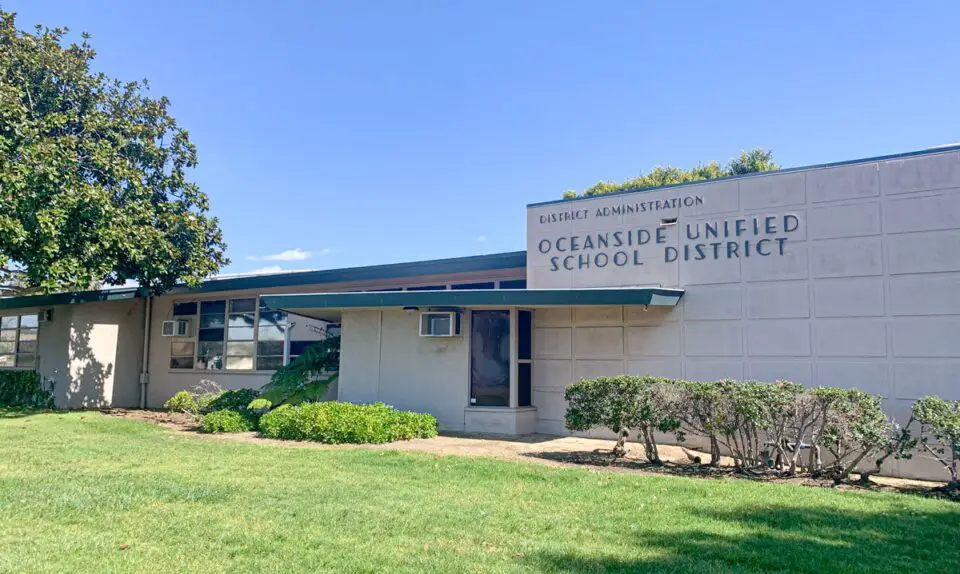
OCEANSIDE — The Oceanside Unified School District has started the new school year by implementing a grading policy that aims to prevent students who miss school due to unforeseen life events from falling far behind in their grades.
The new policy changes an F grade from the classic 59%-0% to just 59%-50% in an effort to give students a “safety net” while trying to improve their academic standing.
For students who miss school due to events outside of their control, such as a personal sickness, a death in the family, or displacement from a house fire, for example, catching up on missed assignments and grades can be difficult.
Giving students a complete zero score creates a “deeper hole for students to climb out of,” said Communications Director Donald Bendz, meanwhile a 50% helps them to catch up and improve their overall grade in a class.
While the policy is new to the Oceanside Unified, as well as San Diego County, the policy has been launched at other districts throughout the state, according to school administrators.
Many teachers already have been applying this grading system in their own classrooms for years, noted Associate Superintendent of Educational Support Services Mercedes Lovie, but this is the first time OUSD has implemented the policy districtwide for middle and high schoolers.
Lovie said the district has been considering the policy since the early 2000s and based it on several sources, including “How to Grade for Learning” by Ken O’Connor and “Elements of Grading: A Guide to Effective Practice” by Douglas Reeves, among others.
According to Lovie, when a student earns a zero for missed assignments, it can be challenging to make up that grade in future assignments, even with straight As.
The district analyzed potential scenarios in which a student who typically makes good grades could suffer with just a few missed assignments. For example, a student who missed three out of 20 assignments but passed everything else could see their overall grade in a class drop as low as a D.
In another example, a student with straight As who missed six assignments at the end of the year due to outside factors – like a family tragedy – could have their grade drop from an A to a D. By turning the 0% into a 50%, that grade could be raised to a B-.
“This makes a big difference for a students’ ability to enter college,” Lovie said. “We want to give good students a fair shot to get back on track.”
An F will also still count as a zero on a transcript for college, Lovie noted.
The move also aims to help alleviate distractions in the classroom and motivates students to keep trying rather than give up knowing that their efforts won’t improve their grades due to the zeros they earned from missed assignments.
“If a student has missed so many assignments, and there’s no way to pass, those students often become so frustrated that they turn into a discipline problem,” Lovie said. “We don’t want that – we want students to come back and be successful if they do the work and are accountable.”
Some have criticized the change, alleging that the new policy allows students to pass without trying.
“A student who refuses to do the work can walk away with half credit and, in some cases, still pass the class,” stated Supervisor Jim Desmond, who represents Oceanside and the majority of North County on the San Diego County Board of Supervisors, in a recent newsletter.
Desmond, who is seeking to replace Rep. Mike Levin (D-San Juan Capistrano) as the 49th congressional district representative, described the move as “negligence.”
“It doesn’t prepare them for college, for a job, or for real life. It sends the message that effort doesn’t matter, that accountability isn’t required, and that failure is just as good as trying,” he continued.
Lovie said this is a misconception.
“When it’s said that a student who does no work will pass, that is absolutely untrue,” she said. “A student who does no work still gets a zero and still gets an F. We don’t believe anyone who doesn’t try should get something for nothing. We believe in giving students who try a chance to get back on track.”
The district also offers students other avenues for making up grades, including a summer credit recovery course that gives students who failed a class another chance to make up their grades.
“We find that sometimes, when things happen in a student’s life, they do so much better with a second opportunity because they’ve learned something,” Lovie said. “We are constantly thinking of ways to give students second chances – but still hold them accountable – so they’re not discouraged enough to drop out.”