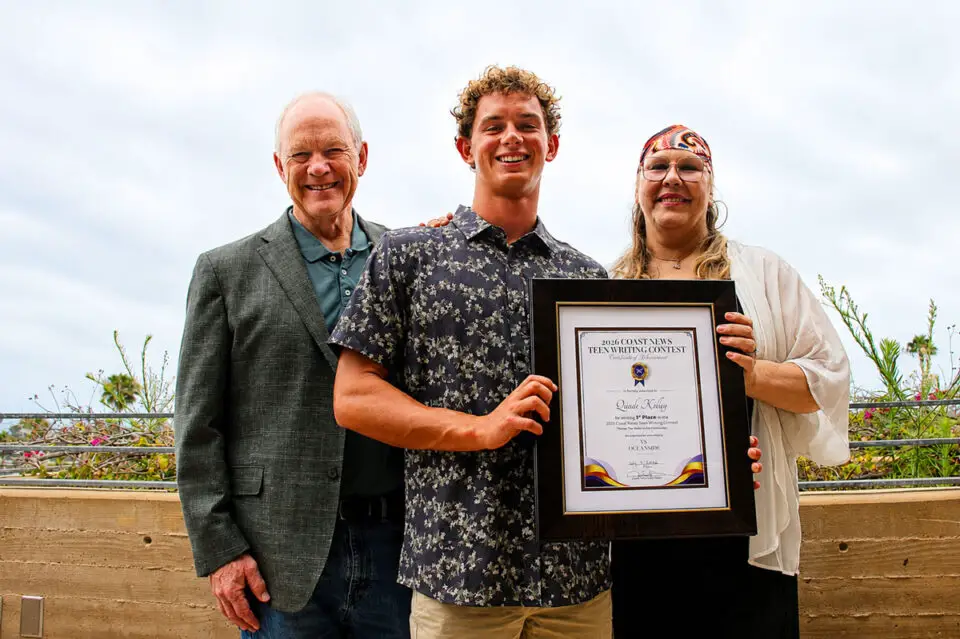
ENCINITAS — Three North County high school students were recognized on July 9 as winners of The Coast News’ 2026 Teen Writing Contest, which invited 11th- and 12th-grade students to reflect on the theme, “A Moment That Changed Me.”
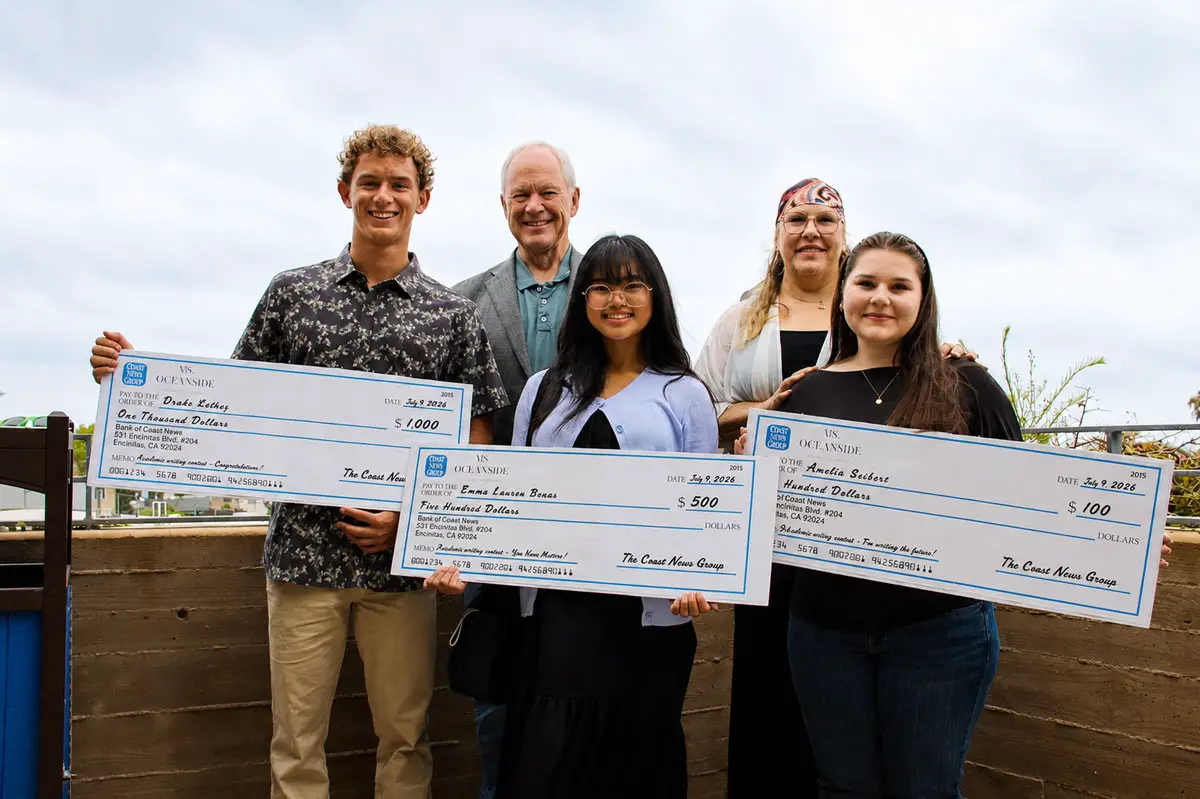
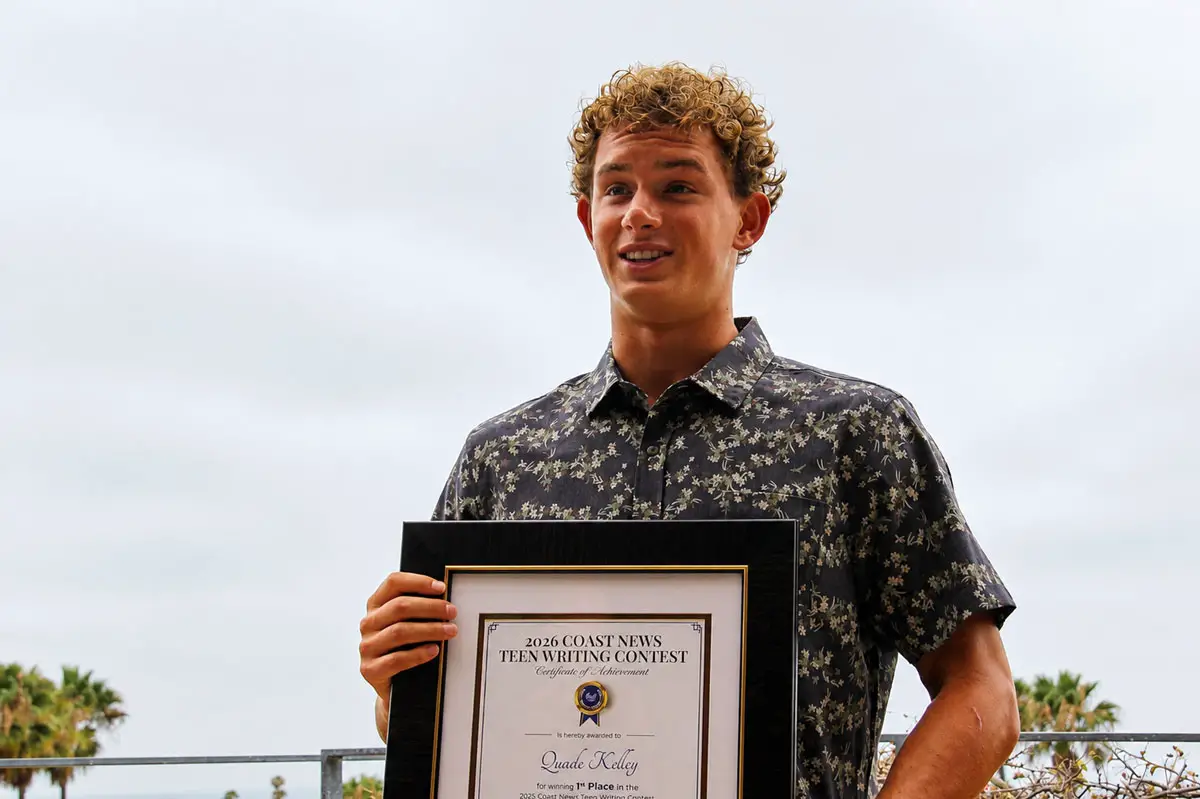
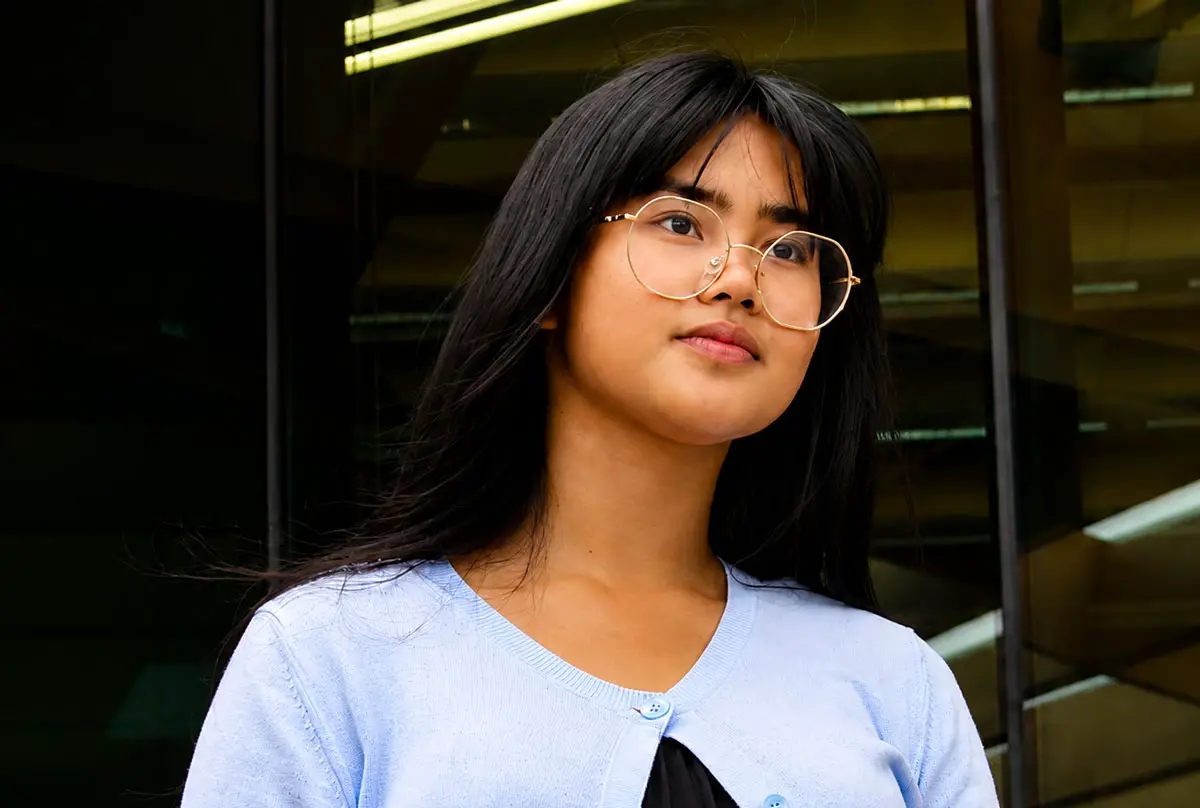
San Dieguito Academy student Quade Kelley earned first place and a $1,000 prize, followed by Emma Lauren Benas of Mission Hills High School in second place with a $500 prize and Amelia Seibert of San Dieguito Academy in third place with a $100 gift card.
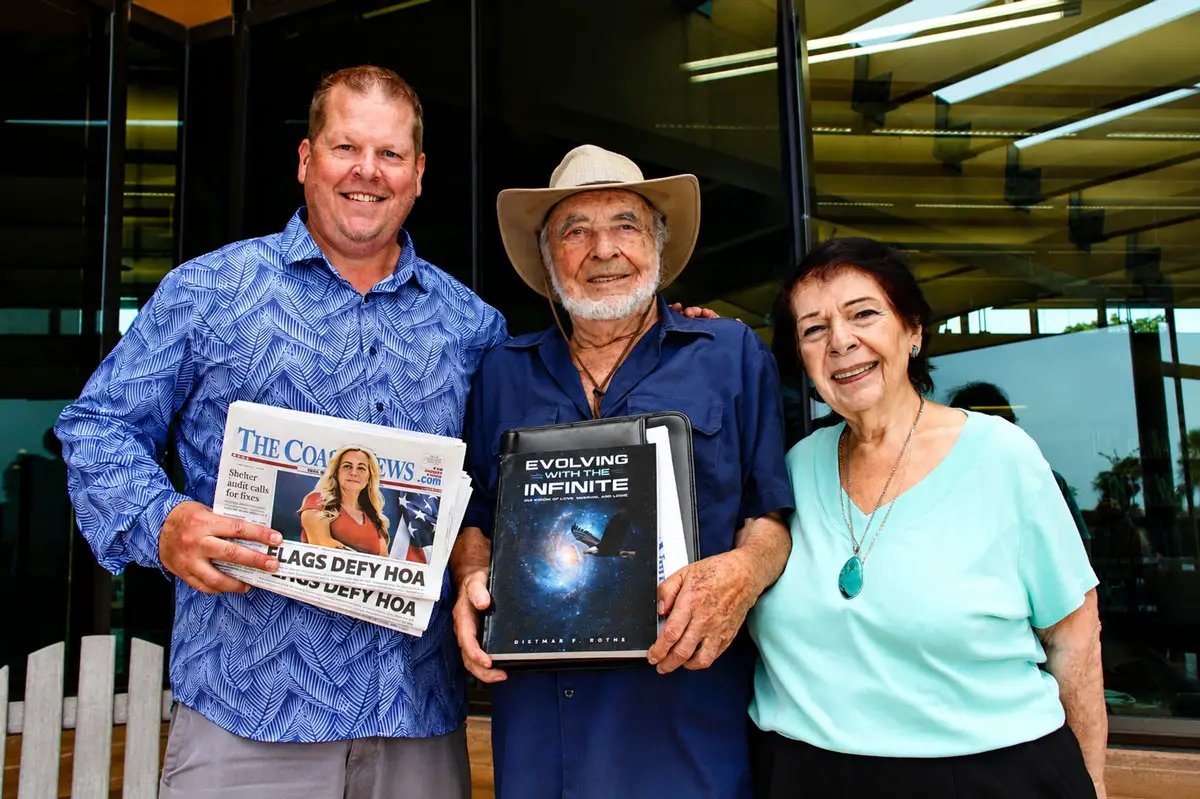
The winners were recognized during a ceremony on Thursday at the Encinitas Library attended by family members, friends and community leaders.
Encinitas Mayor Bruce Ehlers joined contest sponsor Melissa Huk of Ms. Oceanside Real Estate, WriteAway Books founder Rob Weinberg, local author Dietmar E. Rothe, The Coast News Publisher Chris Kydd and Managing Editor Jordan P. Ingram in celebrating the students’ achievements.
Kelley said the contest challenged him to tell a deeply personal story while reminding him of the value of authentic writing.
“Take a risk. Your story matters,” Kelley said, encouraging future contestants. “The version of life you are navigating is something no computer can honestly create.”
Seibert said entering the contest helped strengthen both her confidence as a writer and her connection to the community.
“The Coast News Teen Writing Contest was an extremely positive experience for me,” Seibert said. “Submitting your writing is the hardest part, but getting over the fear of rejection sets you up for so much success.”
Open to students enrolled in public, private and homeschool programs throughout North County San Diego, the annual contest invited participants to submit original essays exploring a moment, experience or relationship that changed how they see themselves or the world. Entries were judged on creativity and originality, writing quality, clarity, structure and relevance to the theme.
The Coast News thanked presenting sponsor Melissa Huk of Ms. Oceanside Real Estate for supporting the contest and helping encourage the next generation of storytellers.
The winning essays by Kelly, Benas and Seibert are published below for the first time.
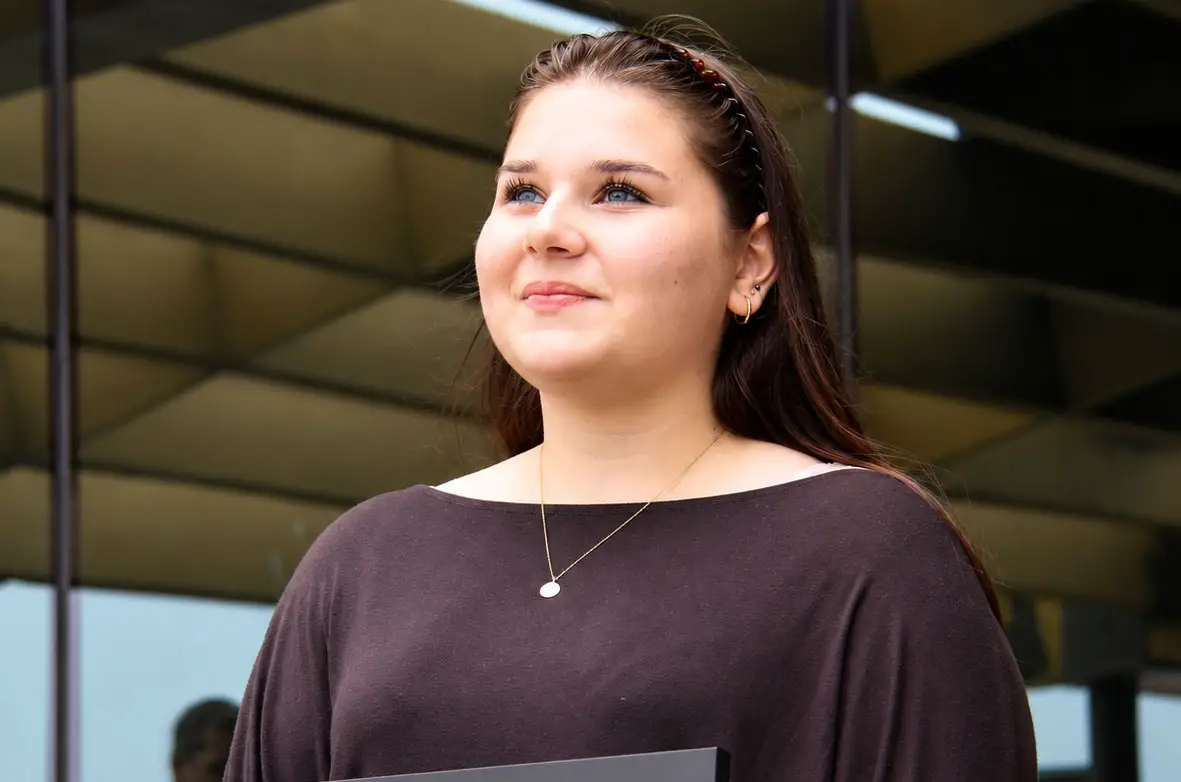
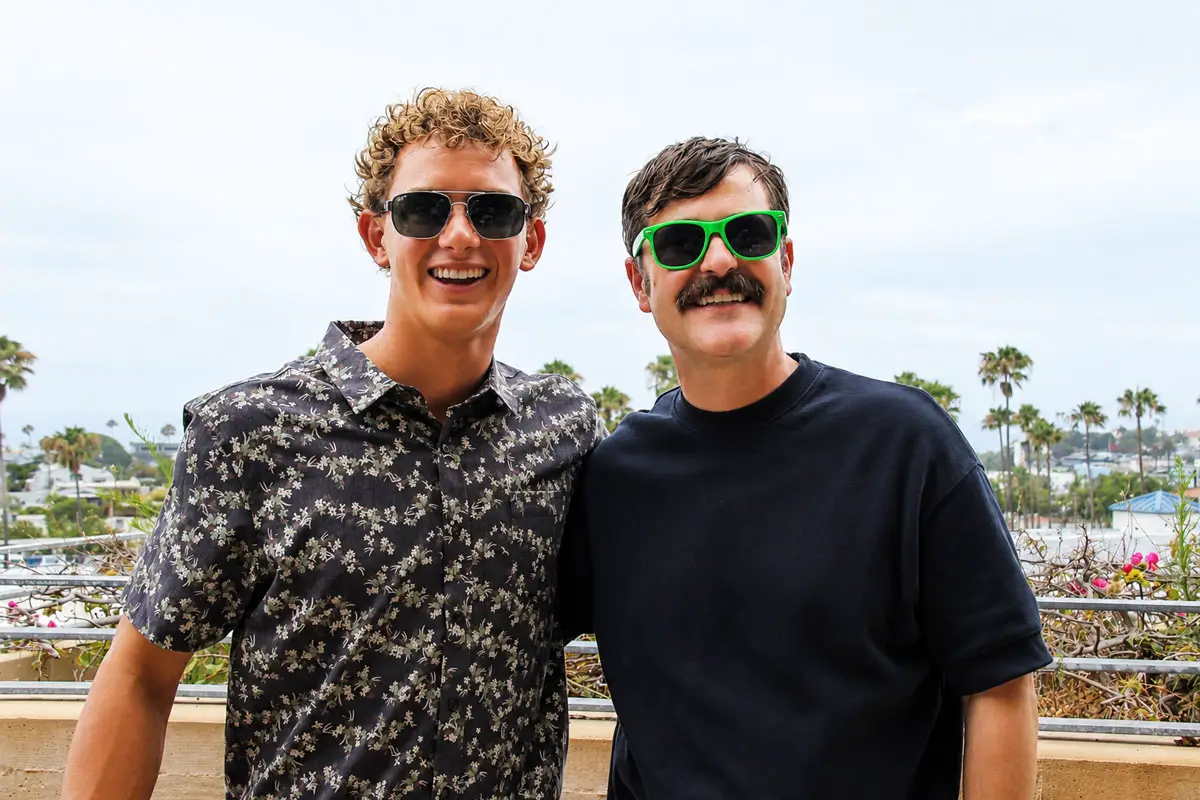
First place – Quade Kelley, San Dieguito Academy
We were wearing matching butterfly stickers.
Mine was pressed to the tip of my nose, his on the collar of a bright blue tee that hung loose on his small frame. Maryanu N. was 8 years old, bald from chemotherapy, and looking up at me in the sun with a grin that took up his whole face.
Then he reached up, grabbed my face with both hands, and laughed with the joy of presence. We were both exactly where we wanted to be.
Maryanu was fighting cancer at Rady Children’s Hospital. When it was his turn to take a victory lap at the 2025 Celebration of Champions in San Diego’s Embarcadero Marina Park, I leaned down to pick him up.
That is when he held my face in his hands and whispered, “Carry me like Simba.” He wanted to be lifted high in the air, like the opening scene of “The Lion King.”
I felt the request in my chest. Then I engaged every muscle from years of athletic training to complete the most satisfying victory lap of my life, carrying a true hero.
When the lap was over, a nurse named Curt stopped me. He had cared for Maryanu and his family through the hardest parts of treatment.
“Maryanu was the torch,” he said, tearfully, “and you are the Olympian carrying him.”
This was a moment that changed me and lit a fire that still burns.
I was already doing the work before that afternoon. I had logged more than 1,700 hours of documented service to earn the Congressional Award Gold Medal, become the youngest member of the Bank Street Children’s Book Committee since its founding in 1909, and built Reading Athlete, a free program that connects student-athletes with books and mental health resources.
After a teammate’s injury led to a mental health crisis, I started using books to help peers begin honest conversations about wellbeing. The awards were stacking up quietly in a drawer.
But I was moving on momentum, without a center of gravity. What I had not fully answered was whether the demands of balancing my own athletic dreams, academic rigor and growing responsibility in work and service commitments were worth the cost. I was asking myself that question when Maryanu grabbed my face.
Meeting him gave me the answer. He had every reason to withdraw from the world, and instead, he celebrated every moment of it. He was not performing resilience. He simply was it.
I am neurodivergent and have sensory processing disorder. I know what it feels like to be in a room that was not built for you, where noise and light and expectations arrive all at once. As a child, I found calm in sport and comfort in books. They became my scaffolding.
Watching Maryanu choose joy so directly, whether he was trying to juggle or playing with his stickers, I understood something I had never been able to name. My neurodivergence was never the obstacle I had been taught to navigate around. It was the instrument that let me see what others missed.
After that afternoon, I stopped thinking about athletic development as a destination. I started thinking of it as a promise, one I keep by checking in with teammates, mentoring younger athletes, and building programs that meet people where they are. Every expansion decision I make now runs through one question: Does this help lift someone else up?
This past May, during Mental Health Awareness Month, Reading Athlete ran in 26 states, reaching hundreds of student-athletes. More importantly, it has been the foundation of several peer-led crisis interventions. It has rebuilt team connections, restored a sense of present-moment awe, and saved lives.
Maryanu probably does not remember me. That is fine. I remember enough for both of us.
The best teachers never know the full reach of what they gave you. That is exactly what makes the gift worth carrying.
Second place – Emma Lauren Benas, Mission Hills HS
I’m a speedwalker.
There’s something intoxicating about the rhythm of my legs moving faster, the ground beneath me shifting with purpose. Speed walking is about precision, control, and the drive to keep pushing — always forward. It’s how I navigate through life — moving quickly, efficiently, always with purpose.
But when I go out with my family, the pace slows. As the eldest daughter, it falls on me to walk alongside my lola, keeping her steady and offering support. While my mom, two sisters, and lolo move ahead, I’m left behind, holding onto her arm and trying to match her careful steps. What frustrates me the most is how each of her steps feels drawn out, each one taking longer than the last. I’m falling behind.
To counteract this thought, I spent every day until 3 a.m. completing lingering homework, devoting all my energy to maintaining perfect grades. I walked as quickly as I could, and the results showed — I seemed to flourish in my classes.
Yet when I’m alongside my lola, I walk slowly, behind everyone else. It serves as an agonizing metaphor for falling behind my peers. To my dismay, no matter how fast I walked or how hard I pushed myself, my legs always burned. I pushed myself to exhaustion until my legs ached. And yet, I never felt adequate.
Although I achieved straight A’s, I never took a risk or expanded my activities beyond what I already knew—completing what was assigned to me, only doing what I was told to do. I lived in terror that my peers were gaining a leg up on me through achievements I could never fathom.
During my waking hours, a few thoughts revolved in my mind:
“I didn’t take as many AP classes as her”
“I got a lower score on this test than him”
These thoughts of inadequacy haunted me and were exacerbated by the visual of walking behind the rest of my family. I was angry. I couldn’t help but lightly tug on Lola’s arm in a frantic attempt to catch up with everyone else. At school, I continued my frantic tugging through joining clubs — not out of passion or interest, but out of desperation.
But next to me, my Lola smiles.
I originally believed Lola only smiled because her body was deteriorating. “Nobody could be content when voluntarily choosing to fall behind, right? If she were youthful, she would never walk so slow.” But in reality, she understood that the effort is the prize.
A fear of stagnation is natural to occur when one wants to accomplish as much as possible. However, accomplishments and accolades aren’t the only things that should define one’s existence; that’s what Lola understood. By understanding that there was no main goal or true finish line to what she could achieve in life, she was able to let go of defining her happiness by completion.
Through discovering this, I appreciate walking slowly alongside Lola. Falling behind doesn’t bother me as much as it used to, and I’ve learned that the worth of my endeavors isn’t merely valued by the score, but by the rigor of the game — the effort I put in.
I now appreciate the time I spend outside of studying as opposed to my previous despair and dread for such “wasted” time. I take time to appreciate my achievements rather than quickly asking “What’s next?” before even acknowledging what I’ve accomplished.
Previously, I completed my assignments simply to get them over with — going through the motions of schoolwork. Now, I’ve dedicated extended time to science outside of school: I curated the first team in school history to represent my high school in Brain Bees and USABO by founding the neuroscience club.
I once believed being passionate about topics outside of school wasted my time — made me fall behind — but I’ve now written and published an extensive research paper on cognitive neuroscience.
Ultimately, although I’ve learned to embrace walking slowly, this does not constitute an eradication of speedwalking. Instead, each of my steps is nuanced — sometimes I may sprint while on other days I crawl. I am an amalgamation and a constant tug-of-war between being intensely disciplined yet allowing room for indulgence, a fear of falling behind yet also contentment with falling behind, and speedwalking yet also slowing down.
— Emma Lauren Benas
Third Place – Amelia Seibert, San Dieguito Academy
Since Feb. 5, 2025, I’ve had a continuous migraine. It was later diagnosed as Status Migrainosus, which is a very vague way to describe the constant ache of waking up and going to sleep every day with the same pain.
After the 5th, my life flipped completely upside down. My routines had to change from those of a typical teenage girl to spending all of my time in dark rooms and doctors’ appointments.
For the next few months, I could rarely show up to class, and my grades all sat at perfect Fs. The migraine that refused to leave was quickly ruining my life.
Each medication prescribed to me came with a promise that it would stop the pain, but I lost a piece of myself with each pill I swallowed. I was drowning in side effects and negative results.
School became impossible. My academically rigorous schedule was no match for the migraine. When I was able to show up to class, I couldn’t focus, think, or read, and the assignments just kept piling up.
School had always been something I used to define my worth, but then I blinked, and it was like reading a foreign language.
After constantly avoiding the need to ask for help my whole life, I suddenly had to talk to every teacher about something I hadn’t even accepted yet. Emails about extensions, asking for accommodations, and admitting that I couldn’t keep up. Most of my teachers worked with me to get my grades back up, but there was only so much everyone could do.
My social life disappeared too. I lost friends because I couldn’t explain what was going on. It felt like the more I said it out loud, the more I changed, so I didn’t tell anyone.
Through the days blurring together, I remember a moment when I happened to catch my reflection in my bedroom mirror. I stopped without thinking and stared at the girl in front of me as if I’d never seen her before. She had glasses on, ones I’ve never had to wear. Her hair was always up; mine was down. She didn’t care how she dressed or if she curled her eyelashes; I did. She hadn’t read a book in months; I read one every week.
I couldn’t recognize the girl in the mirror, and the longer I stared, the more I noticed. The faded bruises from IVs, the insides of her mouth bitten raw, every negative thought. She didn’t want to live anymore, and the thought always lived in the back of her mind. She was hopeless, and she was me.
Looking back, I see something different. Through the pain, she discovered that plans are just plans for a reason, and she is allowed to change her mind. She relied on new ways to keep herself distracted, like movies and long drives. She learned that not everyone will understand her, but that doesn’t mean she’s alone.
I know now that I spent a long time hiding behind pain and punishing myself for things I couldn’t control, instead of actually asking for the help I needed.
There was no specific moment when everything clicked back into place, but there was slow progress. I passed all my classes and took four AP tests without being able to study in person. I started my senior year with the same struggles, but equipped with new ways to stay grounded. I got back into some of my old hobbies and deepened my love for new ones.
When I look in the mirror now, I recognize who’s looking back. I’m not the same girl I was a year ago, but I’m also not the girl who thought she wouldn’t be here today.
Sometimes I still feel close to the version of me who was drowning in everything, and I’m not sure that fear will ever fully go away.
But I have to remember that my story didn’t end when I couldn’t get out of bed, or in the emergency room with a tube in my arm, or when I thought it should have. My story didn’t end when I was rejected by my dream school, and it won’t end when more unexpected challenges are thrown my way.
Maybe one day the migraine will go away, maybe not, but I am going to keep living in spite of it. I am learning how to live a life that looks nothing like the one I planned, and I think that’s good enough.
Related Articles:
- Weekly Crime Reports: Encinitas, Del Mar, Solana Beach August 10, 2024
- Carlsbad High student wins inaugural Teen Writing Contest June 23, 2025
- Del Mar bluff project brings increased concerns… March 23, 2026
- Friday Night Lights: North County prep football preview August 17, 2026
- Weekly Crime Reports: Encinitas, Del Mar, Solana Beach July 15, 2024
- Election Q&A with Oceanside City Council candidates October 22, 2024