ENCINITAS — The city of Encinitas continues to roll out both active and passive measures to improve traffic safety amid growing concern from residents.
Following City Council directives, the San Diego County Sheriff’s Office has stepped up enforcement of traffic laws. The agency is also exploring ways to better deploy resources by using analysts, engaging with the public and coordinating with deputies across the county on maximum enforcement days.
City staff have worked to passively enhance safety through ongoing projects. Encinitas currently has 15 projects in various stages of design or construction, according to city documents. The initiatives aim to improve visibility, reduce conflicts between road users and make streets safer overall.
Traffic safety has become a major issue for residents. On Oct. 9, a child had to be rescued after a driver crashed his truck into Gelato 101 on Coast Highway 101. Many have since called for the city to declare a state of emergency over road safety. In the first four months of the year, four pedestrians were killed in traffic collisions.
One of those victims was 12-year-old Emery Chalekian, a sixth grader at Park Dale Lane Elementary School. Her death prompted calls for safer streets and led to yellow “Emery” stickers appearing around town as reminders.
The Cardiff Kook statue was decorated on Oct. 9 to mark what would have been Chalekian’s 13th birthday.
Dan Nutter, director of engineering for Encinitas, told The Coast News that while traffic safety has a “heightened focus now,” related initiatives are “ongoing in perpetuity.”
“You never are able to stop trying to progress your safety initiatives,” Nutter said. “There never is a stance where we feel as though the job is done.”

Several city projects target pedestrian safety. High-visibility crosswalk striping is being added at intersections across the city, and new crosswalks are being designed at Clark Avenue and Puebla Street, and at Saxony Road and Puebla Street.
Additional crosswalk improvements are planned along Park Dale Lane, featuring new ADA-compliant curb ramps and high-visibility crosswalks at the Willowspring and Countryhaven intersections and additional street lighting at Glen Arbor.
Nutter said the new striping “really helps parents and children be visible in the crosswalk when they’re crossing the road.”
The city is also designing protected bike lanes along Encinitas Boulevard and expanding bicycle infrastructure on Leucadia Boulevard.
The city has completed emergency bicycle safety projects that included green crossbike markings at Manchester Avenue and Mira Costa College, Encinitas Boulevard at Balour Drive and Via Cantebria, and new bike lane buffers on Manchester Avenue between the lagoon traffic signal and Interstate 5.
The work also included asphalt repairs, slurry seal treatments, new signs and striping along El Camino Real and Village Park Way, and shared-lane markings on Requeza Street and Nardo Road.
Following Assembly Bill 43, the city lowered speed limits by 5 mph on major roads, including El Camino Real, North Vulcan Avenue, Rancho Santa Fe Road, Coast Highway 101 and Leucadia Boulevard, according to city records.
“We look at three different categories,” Nutter said. “Our pedestrians – which are the most highly vulnerable users on a road. Then we look at our bicyclists, who are the second most vulnerable user, and then we also look at our vehicles, which are still users, but they are the least vulnerable. We have to ensure that we’re taking all three of those classes into account.”
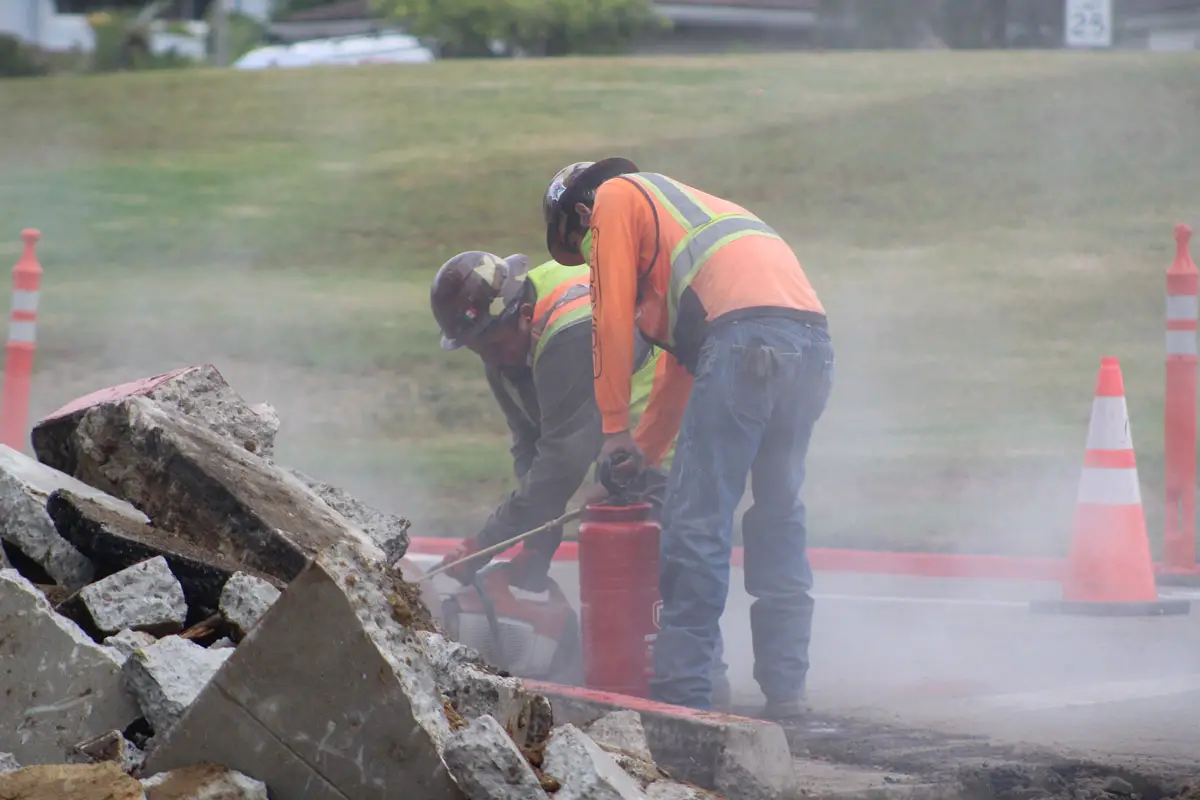
Other design tools, such as radar feedback and changeable message signs, also help ensure “drivers have a good understanding of what the expectation is” on local roads, he said.
Mayor Bruce Ehlers told The Coast News he has asked staff to find consistent ways to guide the flow of vehicle, bicycle and pedestrian traffic across the city in line with neighboring municipalities. While the state dictates most standards, Ehlers said he hopes the city can fill gaps left in the state code.
“Consistency in signage, consistency in everything is key to safety,” he said. “It’s key to getting drivers to follow the rules.”
Ehlers said that while infrastructure changes can help specific areas, the larger problem lies elsewhere.
“Fundamentally I believe we have a driver behavior problem,” he said.
He noted that speeding and distracted driving routinely top the list of violations.
“To me, that is just as big a safety concern as speeding,” Ehlers said. “I see it happening everywhere.”
Ehlers said any solutions — whether through design or enforcement — should be data-driven.
“We have to be very careful that we look at the data properly and that the fixes don’t make the problems worse,” he said, recalling an engineering maxim: “In God we trust, all others bring data.”
Ehlers praised the sheriff’s “traffic blitzes,” or full enforcement days, calling them “absolutely fantastic.”
Sgt. Kristy Trampus, with the North Coastal Sheriff’s Station Traffic Division, told the city’s Mobility and Traffic Safety Commission that Encinitas receives support from agencies across San Diego County.
On Sept. 10, roughly 40 officers “saturated the city” and issued more than 300 citations in a single day, Trampus said. Overall, the Sheriff’s Office issued 644 citations in September, including 90 for speeding, 60 for cellphone use and 48 for stop sign or red-light violations.
Ten people were arrested on suspicion of DUI.
Mobility and Traffic Safety Commissioner Glen Johnson, who said he drives “at a speed that would work for leading a parade,” thanked Trampus and her team for their enforcement efforts.
“We appreciate this and I think all of the law-abiding citizens in town appreciate this,” Johnson said. “I’m not sure that the speeders appreciate it.”
Trampus said her department continues to monitor where tickets are issued, where speeding occurs and what residents report to better target enforcement. Her team works with analysts to maximize the use of that data.
Ehlers said it would cost tens of millions of dollars to rebuild all city streets to fully calm traffic, which is why he supported budgeting for two new traffic deputies — the first in 15 years.
“It was past due to up the enforcement,” he said.