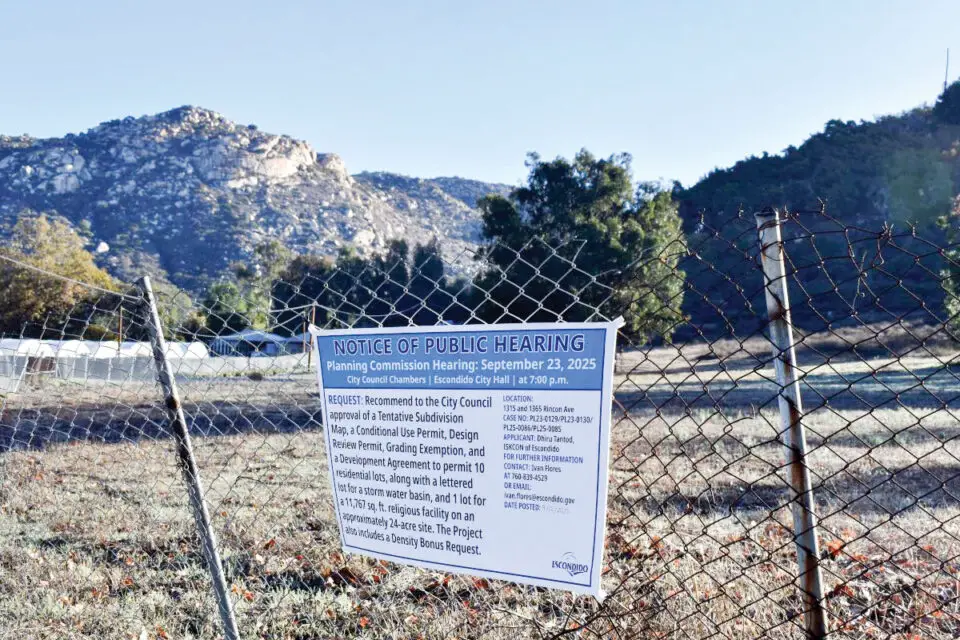
ESCONDIDO — The City Council narrowly approved construction of a Hare Krishna temple and 10 homes on a nearly 25-acre site tucked against the city’s northern boundary earlier this month.
The council voted 3-2 in favor of the temple, which features downsized plans from a previously approved project 25 years ago that never came to fruition, on a 24.5-acre site near the eastern end of Rincon Avenue close to the city’s border with the county and the Daley Ranch preserve.
ISKCON of Escondido owns the property and is behind the proposal. The group is part of the international Hare Krishna movement.
Hare Krishna is a branch of Hinduism. Its name comes from the chant “Hare Krishna,” which practitioners repeat. The movement began in the 16th century in Bengal — now divided between Bangladesh and the Indian state of West Bengal — as a means to worship Krishna, believed to be the supreme god overseeing millions of demigods. Those who practice the religion consider themselves monotheistic in this respect.
Devotees living in Escondido and other North County communities currently travel to Pacific Beach to visit the ISKCON of San Diego temple. Building a temple locally would drastically reduce their commute for worship.
The project drew heavy public interest, bringing more than 100 community members to City Hall on Nov. 12. Council chambers filled quickly, prompting the city to open its Mitchell Room for overflow seating.
More than 50 speakers addressed the council, nearly split between supporters and opponents. The city also received more than 85 written comments supporting the project and about 15 opposed.
Project
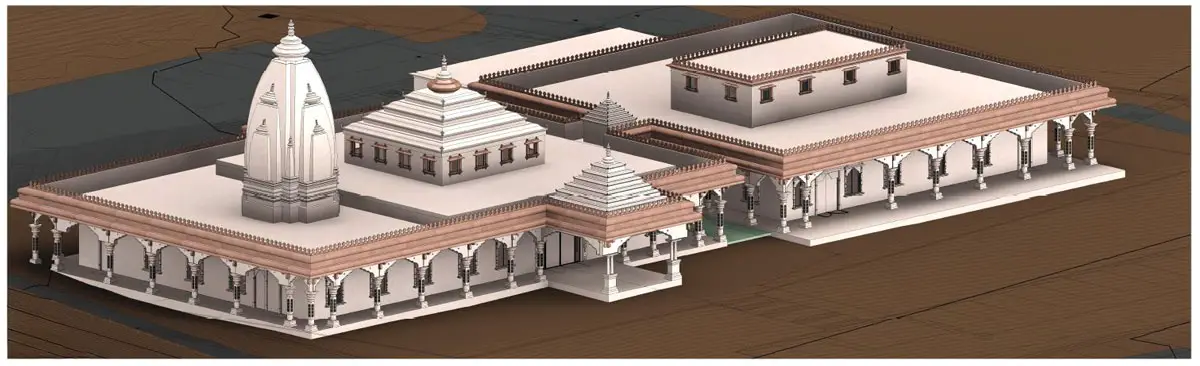
The proposal includes 10 homes — two reserved for low-income households — and a religious temple, built under a conditional use permit.
The temple is nearly 3.5 times smaller than originally approved, according to Kevin Sullivan, a land-use and environmental permitting attorney representing ISKCON of Escondido.
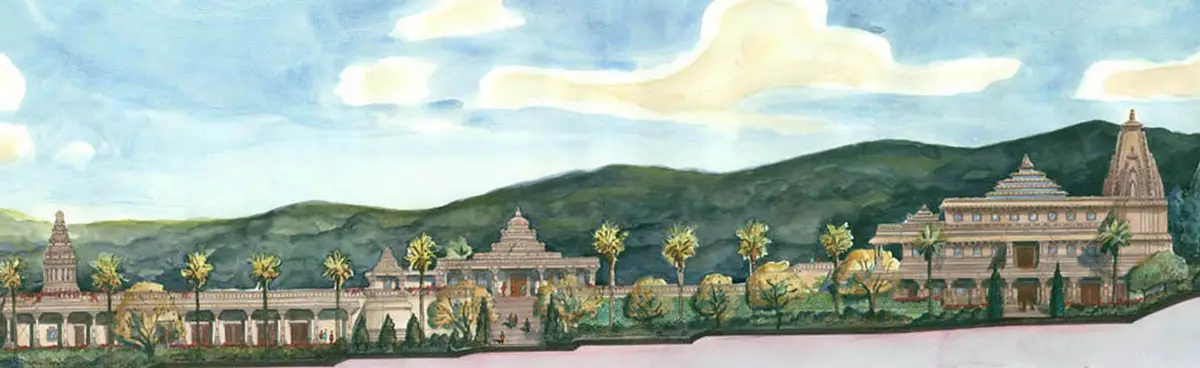
The original approval allowed a 42,000-square-foot temple; the current plan proposes 12,000 square feet. Parking has been reduced from 224 to 72 spaces. Only four monks will operate on site, down from the previously approved 11, and the building’s highest point will be 51 feet rather than 71.
The temple will sit 90 feet from Rincon Avenue and be screened by landscaping. The applicant plans to plant 42 trees, including six street trees, and must widen and improve the south side of Rincon Avenue.
Six daily services will take place between 4:30 a.m. and 8:30 p.m. A Sunday School program will host up to 30 students from 6 to 7 p.m. Other educational offerings include yoga, weekday evening scripture classes and farming education.
Weekend evening events will feature smaller programs such as Bhajans (devotional songs) performed on classical Indian instruments and communal vegetarian dinners. Larger Sunday Bhajans will run from 5:30 to 8:30 p.m.
Weddings will be held on Saturdays and Sundays between 10 a.m. and 9 p.m., typically drawing 50 to 100 guests.
The temple will also hold three major annual festivals — Janmashtami, Diwali and Rama Navami — each requiring a temporary use permit.
Although it is allowed to keep more animals, Sullivan said the temple is willing to limit the site to nine cows and one horse.
“The temple is a community religious facility,” Sullivan said. “It is not intended or marketed to be a destination tourism facility.”
Opposition
Many nearby residents opposed the project, raising concerns about increased traffic, noise and fire hazards in an otherwise quiet, rural area.
Although city staff deemed the plan complete, several residents disputed those findings, arguing that mitigation measures and traffic counts were inadequate.
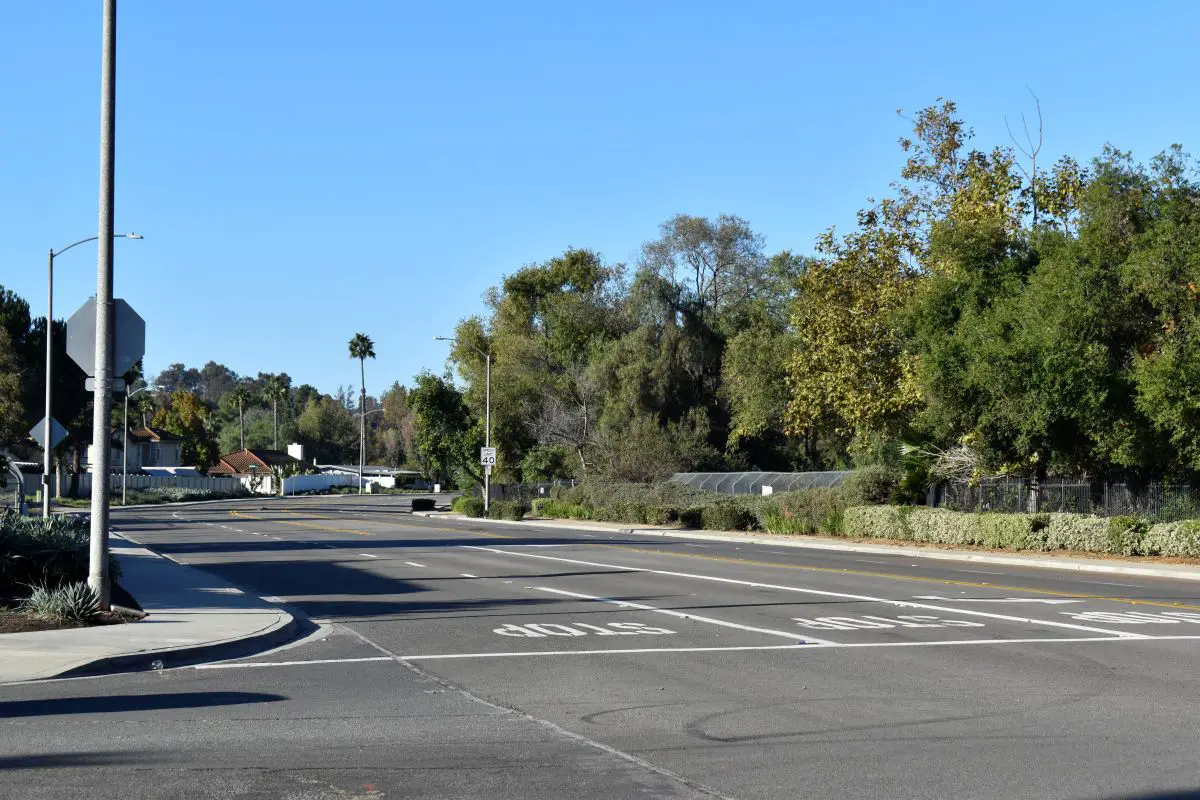
Cheryl Stephenson said the traffic study “does not meet real world experience” and incorrectly describes Rincon Avenue as a four-lane local collector road. She said it fails to account for new housing under construction on nearby North Ash Street and Conway Drive, or traffic from several local schools.
“In short, this traffic study is incomplete, unrealistic and misleading,” she said.
A portion of Rincon Avenue between North Broadway and Ash Street has four lanes, but it narrows to two by Conway Drive, the closest intersection to the future temple.
Opponents also questioned projected daily trip numbers, suggesting the temple could attract hundreds or even thousands more than estimated. They argued it will serve as a destination rather than a typical religious facility.
“The traffic it will bring is not consistent with normal churches,” said Andre Chavez. “Anybody with common sense knows that when you add hundreds of cars flying by your house, that’s a deterioration of the peace and quiet that this place holds and what it was designed to be.”
Fire hazards were another concern. The property, which was once in a high fire severity zone, was recently redesignated as a very high fire severity zone. Residents expressed fear that the temple could clog evacuation routes during a major wildfire.
Some also worried the temple might attract homeless people seeking meals and that they would camp in nearby wooded areas. However, ISKCON does not serve meals to homeless individuals on site; instead, the group delivers food downtown to those in need.
While several neighbors insisted their objections were not based on religion, some suggested the temple does not “fit the character” of the area.
Richard Durd said he and other residents walked the property with Councilmember Joe Garcia and met hostility from caretakers.
“The caretakers were very displeased that there was a group of people coming to look at the site as concerned community members — we wanted to see what we were getting involved with,” Durd said. “I don’t know what kind of neighbors they’re going to make with open hostility.”
One San Marcos resident opposed the project for religious reasons.
“I’m representing the Lord our God,” said Keri Nuckolls, who quoted from Deuteronomy. “It’s inviting on our land of Escondido and California the gods of other nations. If you’re a Christian, I hope you take this to heart, because the Lord sent me here.”
Support
Several Escondido residents spoke in favor of the project. Some were devotees; others were neighbors who welcomed the temple.
Supporters noted that daily services are primarily attended by monks, while most devotees work during the week and visit only once on weekends.
They also emphasized that many adherents are professionals — including doctors, engineers, researchers and entrepreneurs.
Neha Prasad, who grew up in Escondido and still lives there with her family, said she works as an environmental engineer and her husband is a neuroradiologist.
“We’re all professionals with children — none of us are getting up to drive through San Diego traffic to go through the temple,” she said. “We’re looking at maybe a Saturday or Sunday service, and for me it’s Saturday.”

Prasad said the temple values kindness, honesty, compassion, nonviolence, service and responsibility — values shared by many residents of different faiths. She noted that nearby churches also host multiple daily services without generating the level of traffic opponents predict.
She also questioned why some homeowners’ associations claimed the temple did not fit the neighborhood character.
“Approving this temple is not about making Escondido different, it’s about affirming what’s always been true about our city, where people of all faiths and backgrounds and cultures are living side by side,” she said. “I am not coming here to shove something down your throat, I want to be your neighbor.”
Other supporters suggested opposition may stem from prejudice.
“Hindu people have an incredibly rich, spiritual and cultural tradition, and are some of the most inclusive and kind people I’ve ever met,” said Michele Schmalvogl. “I heard some of the comments in opposition say that this was not a normal church. I’m just really curious who defines what a normal church is? What’s your definition of a normal church? I also encourage some of the opposition to look up the term ‘xenophobia.’”
Misty Cater Clark, who lives on Briarwood Place with a backyard facing the site, said she has looked forward to the temple for years.
She challenged concerns about traffic and parking, noting that the Pacific Beach temple does not cause issues despite the area’s higher overall traffic.
“There’s really not a problem,” she said.
She said she is concerned about fire hazards but does not believe the temple will worsen the threat.
“The temple is going to help us,” she said.
Both city staff and the applicant said the project includes significant fire-mitigation measures.
Sullivan said the project will improve fire safety by installing a larger water line to increase supply; adding five new hydrants — three near the temple, one on the latest residential street and one on Rincon Avenue; building ignition-resistant features consistent with state fire code; installing sprinklers in all structures; and completing required fuel-modification zones and fuel maintenance.
Council’s Decision
Deputy Mayor Consuelo Martinez and Councilmembers Christian Garcia and Judy Fitzgerald supported the project. Mayor Dane White and Councilmember Joe Garcia opposed it.
“What I’m seeing here is all standards have been met,” Christian Garcia said. “It seems that the applicant has abided by everything.”
Garcia said he understands concerns about increased traffic, but warned that if the temple isn’t built, a larger residential project could replace it and worsen traffic.
He also rejected accusations that opposition stemmed from prejudice, but responded to the earlier speaker who quoted the Bible against the project.
“When a foreigner lives in your land, you must not mistreat them, and must treat them as a loving one of your own because you were once a foreigner in Egypt,” he said, quoting Leviticus 19:33-34.
Martinez and Fitzgerald agreed that the project met city standards.
Joe Garcia, who represents District 2, where the project is located, said the temple was not ready for approval, citing the caretaker incident and questions over whether the property serves as an animal sanctuary, as some residents claim.
“That erodes trust,” he said.
The municipal code does not define an animal sanctuary. While animals live on the property, neighbors also raise horses and livestock.
White said he did not oppose the proposal on religious grounds and sympathized with ISKCON’s mission, recalling how the Mormon church — to which he belongs — often faces similar scrutiny when proposing temples.
However, he said traffic-related mitigation was insufficient, prompting his “no” vote.
“I hope you prove me wrong,” he said.