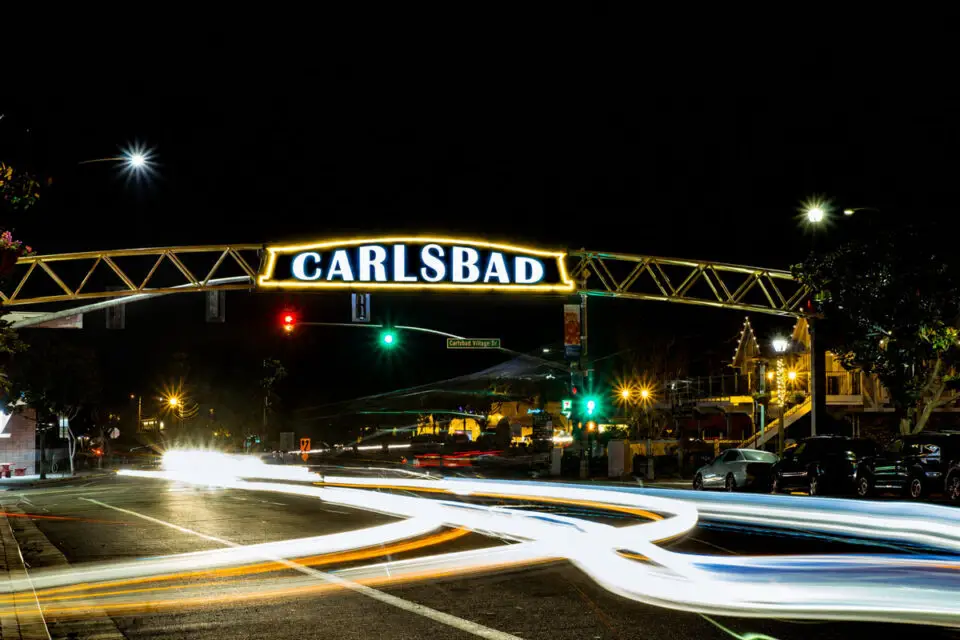
CARLSBAD — The Carlsbad City Council approved annual property assessments to fund street lighting, trees and landscaped medians in two assessment districts for the upcoming fiscal year.
In two unanimous votes on July 21, the council adopted the annual engineer’s reports for Street Lighting and Landscaping districts 1 and 2, authorizing the assessments to be placed on property tax bills for fiscal year 2026-27.
District 1 covers the northwest portion of the city, including much of the Village and Barrio neighborhoods, and stretches east past El Camino Real. District 2 wraps around the southern and eastern portions of District 1 and extends to the city boundaries with Vista and San Marcos to the east, Oceanside to the north, and Poinsettia Lane or Palomar Airport Road to the south.
If the council had not approved the engineer’s reports, the annual assessments could not have been placed on property tax bills to fund the maintenance and eventual replacement of street lights, trees and landscaped medians.
The city plans to use revenue from the assessments to maintain and replace street lighting, street trees and landscaped medians in those districts.
District 1 primarily serves older parts of the city and is funded through a single assessment district, while District 2 serves newer neighborhoods through separate assessments established as those communities were developed.
The assessments pay for the operation, maintenance and eventual replacement of those improvements.
The total budget for District 1 — including street lighting, street trees and medians — totals just over $4.4 million, according to city documents. That includes about $1.6 million in assessments and a $411,000 contribution from District 2, which reimburses District 1 as part of the funding structure, according to Katie Schroeder, a city accountant.
Assessment rates in District 1 average just over $70 per household and have remained unchanged for more than 30 years because of a 1996 state law, according to city documents.
“In order for the city to increase assessments, a notice and ballot must be sent to each assessed property owner and the majority of ballots received must approve any proposed increase of the assessments,” Schroeder said.
The city’s General Fund is scheduled to contribute more than $208,000 toward the program as a “general benefit,” according to the documents.
“Property owners can only be assessed for receiving a special benefit from the improvement,” Schroeder said. “Street lighting along the city’s arterial roads is considered a general benefit, therefore it’s not assessed to individual properties.”
Assessments for District 2 are collected through 16 development zones. Each zone has a maximum and actual assessment rate, which is recalculated annually. The maximum rate may increase by no more than the consumer price index for the San Diego region.
Under state law, each zone has a maximum assessment rate approved by property owners. Annual assessments may increase by no more than the change in the San Diego County Consumer Price Index unless property owners approve a higher amount through a new ballot measure.
“In a majority of these zones, the homeowners’ associations have requested to maintain all or portions of the improvements in those zones,” Schroeder said.
The proposed assessment rates range from $0 in Fair Oaks Valley to $209 in La Costa Town Square. Nine zones have assessment rates below $85 per unit, while the remaining seven exceed $125, according to the documents.
According to the engineer’s report, no assessment will be collected this fiscal year in Fair Oaks Valley because the homeowners association continues to maintain the district’s landscaping improvements.
Related Articles:
- Weekly Crime Reports: Encinitas, Del Mar, Solana Beach August 10, 2024
- Election Q&A with Oceanside City Council candidates October 22, 2024
- Election 2026: City Council candidates questionnaire October 14, 2026
- Election Q&A with Carlsbad City Council, city… October 23, 2024
- Weekly Crime Reports: Encinitas, Del Mar, Solana Beach November 13, 2023
- Weekly Crime Reports: Encinitas, Del Mar, Solana Beach July 15, 2024