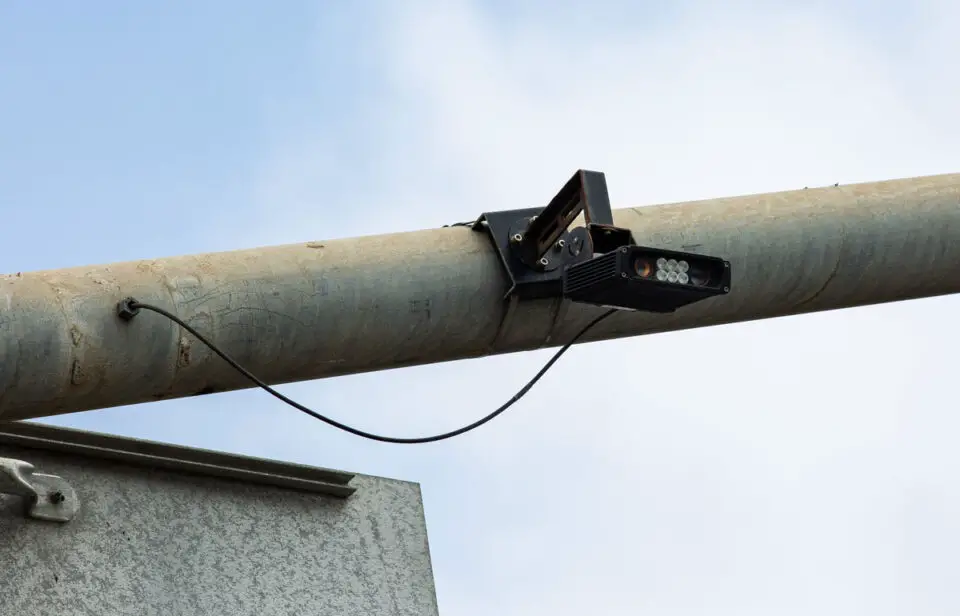
VISTA — Leaders in the city of Vista are still not ready to say yes to license plate reading cameras, rejecting a recent proposal to implement them in the city until sheriff’s officials address concerns about illegal data sharing and share more data demonstrating their effectiveness.
Vista is the last city in the county not to install license plate readers, or LPRs, which record plate numbers at high speeds and alert law enforcement when they capture a plate that matches one they are seeking for a crime. All data from the LPRs are deleted after 30 days, unless retrieved by the San Diego County Sheriff’s Office as part of an investigation. Additionally, data cannot be shared with out-of-state agencies.
Flock LPRs have been used for years by police departments in cities like Carlsbad, Oceanside and Escondido, and more recently in cities contracted with the Sheriff’s Office, including Del Mar, Solana Beach, Encinitas and San Marcos.
The Vista Sheriff’s Station began requesting that the city implement Flock license plate readers, or LPRs, earlier this year as another tool to combat and deter crime in the city. On Aug. 26, the Vista Sheriff’s Station brought forward a proposal to install between 12 and 18 LPRs in the city at an annual cost of $3,000 per camera, plus a one-time $150 installation cost.
“The use of this technology in the county has played a crucial role in solving a variety of serious crimes, including homicides, kidnappings, rapes, vehicle thefts, burglaries, and assaults. Just as importantly, they’ve also been instrumental in locating missing persons at risk,” Vista Sheriff’s Capt. John Malan told the Vista City Council.
However, the council unanimously rejected the Vista Sheriff’s Station’s proposal to implement LPRs throughout the city, in addition to implementing gunshot sensor technology and entering the Safe Streets program.
Councilmembers Corinna Contreras and Katie Melendez expressed concerns about the strength of safeguards to prevent illegal data sharing with federal agencies, particularly in light of the increased immigration enforcement in San Diego County.
They also expressed disappointment that the Vista Sheriff’s Station did not have any data to share regarding the effectiveness of these cameras in other cities, such as the number of arrests made as a result of their use.
“I’m not a fan of making our community a guinea pig for anything,” Melendez said. “I would say that based on the information we have tonight, I don’t have any information as to the effectiveness of this tool and ultimately how that effectiveness weighs with the risks.”
Agencies face stringent restrictions related to data sharing from LPR cameras under Senate Bill 34, which prohibits the sharing of data with out-of-state or federal agencies. Malan said that LRP data also cannot be used for the monitoring or investigation of First Amendment activities or matters related to reproductive healthcare rights.
However, recent reports by CalMatters found that the San Diego County Sheriff’s Office, among other departments in the state, has illegally searched license plate readings on behalf of Immigration and Customs Enforcement and Customs and Border Protection.
Several public speakers urged the council not to approve the request for LPRs, sharing concerns about mass surveillance without proper oversight.
“The Sheriff has stated that the Board of Supervisors, which controls its budget, has no authority over the Sheriff’s Department. If the county can’t provide oversight, and our city certainly can’t, we would be funding a system with zero accountability, one that has already been abused by the very agency that would operate it,” said resident Kenneth Zuniga.
The San Diego County Sheriff’s Office has stated that they are internally reviewing the situation. Malan stated that he was personally not aware of any alleged SB 34 violations by the department beyond what had been publicly reported, but noted that the department would begin conducting quarterly audits of its LPR data.
While other council members were more receptive to the idea of LPRs in general, they suggested it would be good practice to have additional data before making a decision. The Vista Sheriff’s Station also agreed to bring back more information at a future meeting.
“I think they’re fair questions that deserve to be asked and answered,” said Mayor John Franklin, adding that he would like to have LPRs to address crime in the community.
Councilmember Jeff Fox said the LPRs would be a smart financial decision, as they essentially serve as force multipliers for the Sheriff’s Office without requiring the hiring of additional staff.
However, he did express concerns about the long-term storage of license plate data and asked the Sheriff’s Office to investigate the possibility of storing plate information for 14 days instead of 30 days.
Fox also said he would feel better knowing that there would be quarterly audits of the LPR data, and noted the council could always discontinue the program after the initial one-year mark.
“I think I’d be open to something like the pilot program. I think that’s a good idea, if we’re going to do this, to make sure that we already have it on our agenda to re-evaluate and make sure that it’s working the way that we intended [and] that the benefits outweigh the costs,” Fox said.
The Vista Sheriff’s Station has claimed that the city is falling behind in its use of technology to reduce crime. Malan gave an example of a vehicle that was recently stolen in a carjacking in Vista, stating that the car was only located after an LPR in neighboring Carlsbad picked up the plate.
“It in fact hit on Carlsbad’s license plate readers, which allowed Carlsbad to find this vehicle from the carjacking and take the individual into custody,” Malan said. “Unfortunately, Vista is dark in that regard.”
The Safe Streets program, also known as Safe Cities, enables community members to grant the Vista Sheriff’s Station access to live feeds from their security cameras, located at their homes or businesses. They can also register their camera with the department, allowing officers to request footage if a crime occurs in the area.
As part of Safe Streets, the council also considered utilizing pole-mounted cameras in public areas, with footage stored for a period of 30 days. Like the LPRs, data from the cameras can only be pulled and used as part of active law enforcement investigations.
Melendez and Contreras stated that they are strongly opposed to the use of mounted cameras in public spaces. Other residents also shared concerns about surveillance.
“Public safety must not come at the cost of civil rights. Instead of investing in technologies that surveil innocent people, we should start supporting what actually builds community safety — housing for the unhoused, youth programs, and resources that address root causes of insecurity,” said Tazheen Nizam, a Vista resident and executive director of the Council on American-Islamic Relations (CAIR) San Diego office.