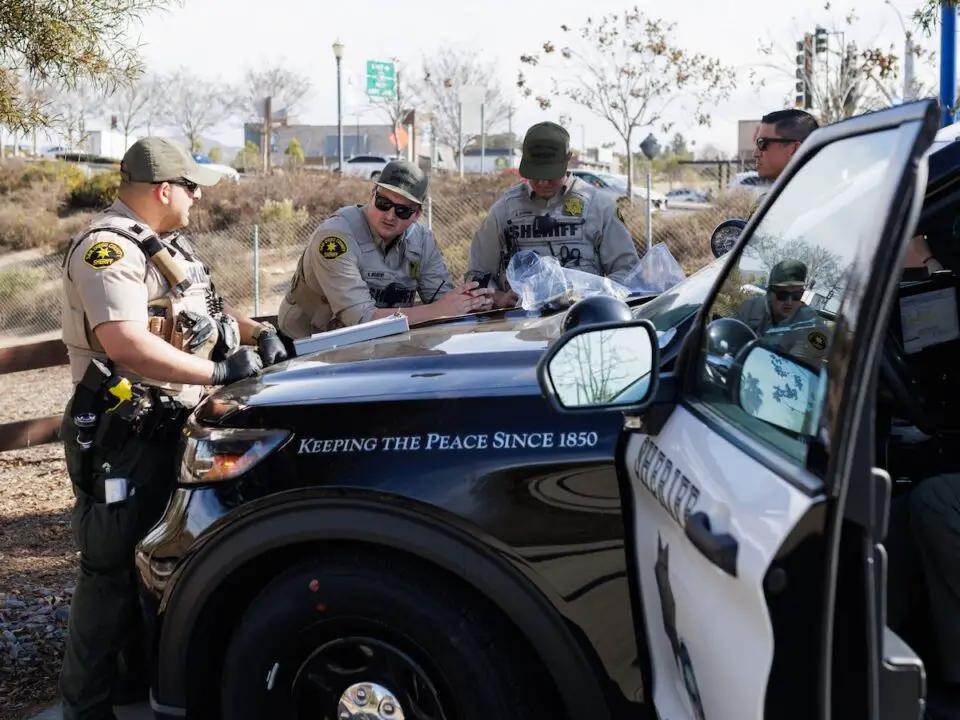
VISTA — The Vista Sheriff’s Station is urging the city to authorize additional resources to better prevent and address crime, including additional personnel, license plate readers, and implementation of the Safe Streets program.
Conversations about the need for increased personnel have been ongoing but have become more urgent in the past year. Vista sheriff’s leaders spoke at two City Council meetings in February about the current workloads among the department’s units and the need for a new gang detective.
The Vista station has 79 sworn staff, including 38 patrol deputies, 17 special purpose officers, 12 area detectives, and 12 traffic/motor deputies. Seven of these personnel serve on the gang enforcement team, and four serve on the street narcotics and gang team.
Vista Sheriff’s Capt. John Malan, promoted to the role in January, said the city is below the average for per-population officers, with an average of 2.4 officers per 1,000 people nationally, 1.32 per 1,000 in San Diego County, and 0.96 per 1,000 in Vista.
Malan said the street narcotics and gang team deals with complex investigations, with over 40 cases currently assigned and around 200 known gang members in Vista. An additional gang detective in the unit would allow for a more proactive response and investigators to work in pairs as they are trained.
“What happens is, it turns into a reactive role rather than a proactive role. We need our investigators to be proactive, to go out and stop these incidents from happening by being out and not being trapped at the station investigating the cases after they happen,” Malan said at a Feb. 25 meeting.
Department leaders have also noted the need for additional officers to handle DUIs in Vista, with the City Council supporting the idea of using cannabis revenue to cover the cost of an additional DUI enforcement in September.
Department data from January and November 2024 shows that crimes against persons decreased 11%, crimes against property decreased by 22.6%, and crimes against society (including weapons, drugs and narcotics offenses) increased by 22%.
Malan noted that the increase in crimes against society is partially due to more deputies being out and making arrests.
No action was taken to add new resources last month, although the council said they would discuss the matter more during upcoming budget talks. Some council members said they would like to see more evidence of the need for a new gang enforcement member before moving forward, noting that the department currently does a great job with what they have.
“I could support creating an additional position for a gang detective, but I do think we have a long way to go in demonstrating that need,” said Councilmember Katie Melendez.
Mayor John Franklin, who has been a strong advocate for increasing deputies in Vista, said he was convinced that another officer was needed.
“I think in other jurisdictions it might require more discussion … But the numbers don’t lie. We are underresourced,” Franklin said. “I, for one, don’t have an issue taking a hard stand against violent criminals.”
License plate readers, cameras
Vista Sheriff’s officials said they would also benefit from surveillance initiatives, including automatic license plate readers (LPRs) and the Safe Streets program, which allows residents and businesses to share feeds from their security cameras with law enforcement.
According to Malan, Vista is the last city in the county not utilizing LPRs. These readers have been used for years by police departments in cities like Carlsbad, Oceanside and Escondido, and added more recently in Del Mar, Solana Beach, Encinitas and San Marcos that contract with the Sheriff’s Office.
“Vista is behind in its approach to reduce crime through technology,” Malan said.
LPRs can record license plate numbers at high speeds and alert law enforcement when they capture a license plate that matches one in their database. All data from the LPRs are deleted after 30 days unless pulled by the Sheriff’s Department as part of an investigation, and data cannot be shared with any outside agencies.
The Safe Streets program, also known as Safe Cities, allows community members to either give the Vista Sheriff’s Station access to live feeds of their security cameras, or register their camera with the department so officers can request footage if there is a crime in the area.
Public speakers and some council members raised privacy concerns, stating that the city needs to hold more community discussions about license readers and cameras before taking action.
“If we’re gonna put street cameras all over our community, I think we really need to have an honest conversation and an honest agenda item,” said community member Sarah Spinks, noting that the topic of cameras was not mentioned in the agenda for the Feb. 11 meeting.
Councilmember Corinna Contreras said that while cameras can have benefits, and the community might want them, she is largely opposed to surveillance.
“The only way I’d ever get there is through many, many community workshops where we are ensuring folks that their rights are preserved, and the community has a lot of say in what a surveillance program would look like,” Contreras said.