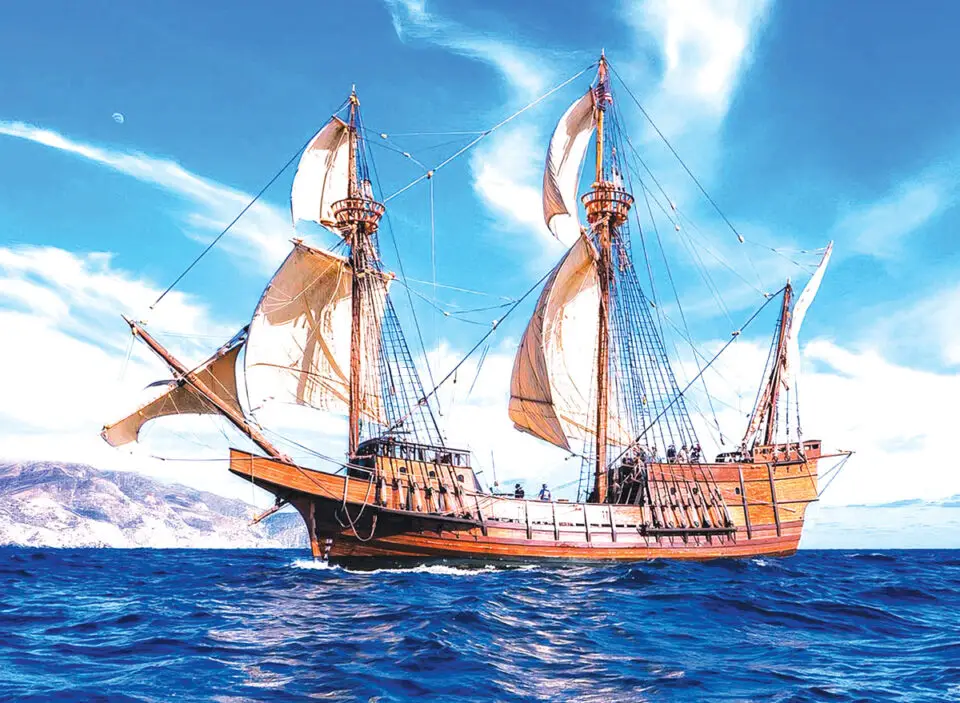
The sight of the 16th-century galleon San Salvador slicing through the waters of San Diego Bay and beyond must look magnificent, but we can’t see it because we’re on it.
No complaints.
My friends and I are privileged to be aboard this masterful replica of the ship that carried explorer Juan Cabrillo and his crew into the bay in 1542. It was built and is maintained and operated by the Maritime Museum of San Diego and its dozens of volunteers. Several onboard today teach us about the age of exploration and life aboard ships in the 16th century.
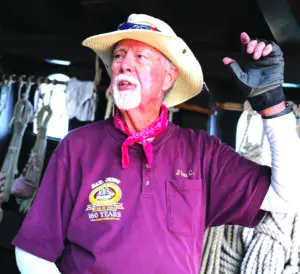
“When crossing the Atlantic or Pacific, you couldn’t reprovision,” says Jim Cassidy, a marine archeologist, an 18-year museum volunteer and Escondido resident. “Plus you had the regular dangers, like scurvy, an unfortunate fact of life and a killer. Think loose teeth, bleeding gums, rashes, brittle bones and fractures, gangrene and death.
“People didn’t bathe, either, so lice were epidemic.”
That caused typhoid fever, and mosquitos in the tropics caused malaria. Bottom line: The lifespan in the 1500s was the mid-40s.
Navigators also suffered blindness from using a tool called an astrolabe that required looking into the sun. And if you needed expert medical care?
“There was the ship’s barber who was also the doctor,” Cassidy says, “and blood-letting was common.”
One more thing: Sailors had to work among the smells of animals — a source of food for the crew — and corpses of those whose religion prevented burial at sea.
The San Salvador would have had 100 people aboard — twice as many as today — because the death rate for long voyages was 50% or greater.
“This worked out well for businessmen who financed these trips because sailors weren’t paid until the end of the voyage,” Cassidy adds.
Considering all this, my moderate seasickness doesn’t seem so bad.
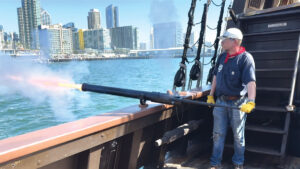
I move to the railing to catch a breeze and enjoy the expansive views of the San Diego skyline, Coronado Bridge and Point Loma’s lighthouses and sandstone cliffs.
When we hit a swell, 40 passengers scramble for whatever is stationary. This gives us a little sense of adventure during the four-hour cruise.
Building this replica of the San Salvador, like constructing the original, required a dream, determination, high risk and seemingly insurmountable obstacles.
“The Port of San Diego was going to build the replica but then decided it was too big of a project,” says Ray Ashley, a San Diego resident whose multiple degrees and extensive sailing experience earned him 30 years as the museum’s president and CEO.
“During my job interview in 1995, they asked me if I could build the San Salvador and I said, ‘Oh, sure,’ because it was a job interview.”
Asked what he was thinking, Ashley says, “I ask myself that every day.”
Even after extensive research, there were no architectural plans for the San Salvador.
“All we knew was the carrying capacity — 299 tons,” Ashley says.
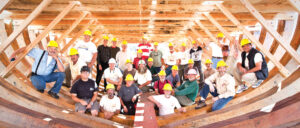
Construction began in 2011 with mostly volunteers. One major setback occurred when the rare white oak needed for the hull was ruined with the application of an epoxy.
“It was incredibly stressful to go through that,” Ashley says. “We had used half of the world’s supply of white oak. Midway through the project, we had to begin again. Everything was riding on getting the ship going again. We couldn’t have done it without all the community support.”
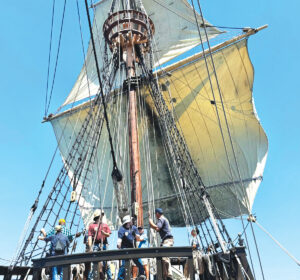
The finished product has a 75-foot-long main deck, an 82-foot-high main mast, and is nearly 115 feet end-to-end, All of the rigging is handmade.
In the end, the project cost about $7 million, but without donated materials and volunteer labor, the cost might have been $13 million.
“It was amazing to get through the experience of building the ship,” Ashley says, “and amazing to sail the ship.”
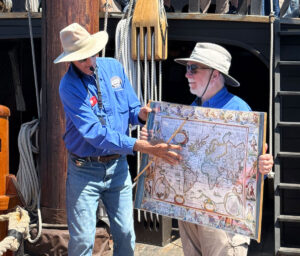
Our cruise also includes a history lesson on 16th century economics, exploration and trade from Encinitas resident and nine-year volunteer Ken Golden. He trains and coordinates the museum’s volunteer docents on both the San Salvador and the Californian. A replica of an 1847 revenue cutter that collected customs for the federal government, the 145‑foot topsail schooner was designed for speed and is the official tall ship of the State of California.
“I’m able to combine the thrill of deep-water sailing, a fascination with history and love for teaching,” Golden says. “Many have told me they appreciate understanding the context under which these ships sailed, rather than just passing the afternoon on some old ship.”