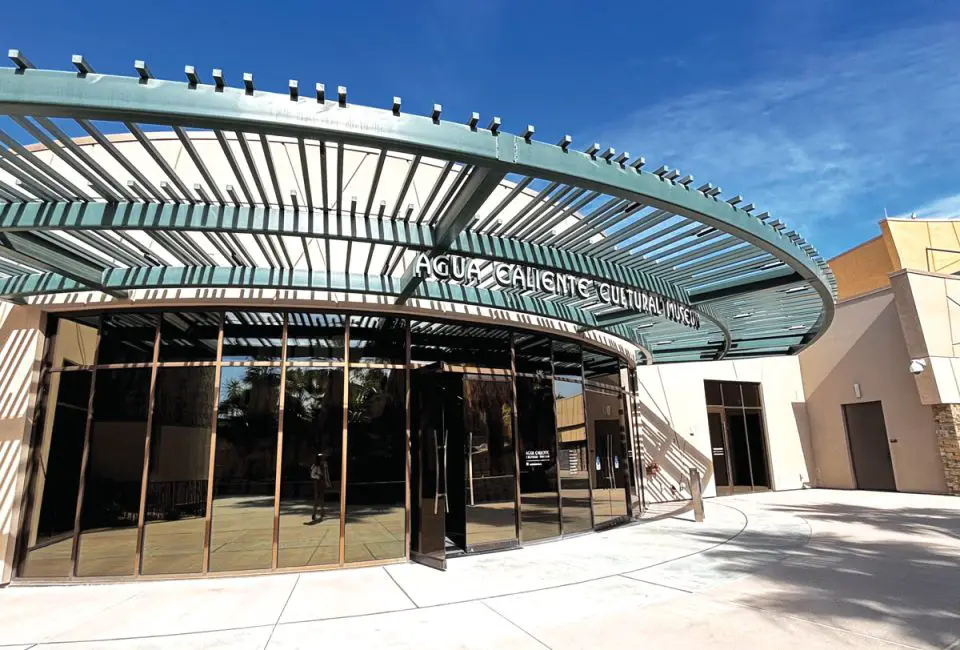
We are standing in the plaza in front of the Agua Caliente Cultural Museum and Spa at Séc-he in downtown Palm Springs. At first pass, this seems like an odd pairing, but what unites the museum and spa bubbles 8,000 feet below us.
It’s a 180-degree boiling hot spring, created by runoff that has cascaded down the mountains across the street for the last 12,000 years. This water makes its way to the surface via a mile-and-a-half natural pipeline, emerging at 105 degrees. As the water travels upward, it absorbs various minerals. This journey is unique because most hot springs are forced through fissures in the earth by seismic activity.
“Séc-he, which means ‘the sound of boiling water,’ is an ancient hot mineral spring that is remarkable in both form and function,” says Kate Anderson, director of public relations for the Agua Caliente Band of Cahuilla Indians, as she ushers us into the entry of the luxurious, 2-year-old, 73,000-square-foot spa.
“Geologic surveys have revealed the unique nature of this ancient hot mineral spring, which is not connected to any other water source in the Coachella Valley.”
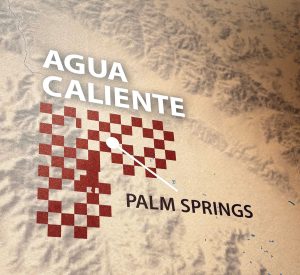
The hot springs were life-sustaining for the Agua Caliente people, who have lived in the Coachella Valley for at least 5,000 years. They used the water for drinking, bathing, cooking and healing.
The designs of both the spa and museum are inspired by the Agua Caliente people’s harmonious existence with the desert, Anderson says, and the patterns found in their artwork and everyday tools.
The museum features two galleries.
The 10,000-square-foot Permanent Gallery introduces visitors to the Agua Caliente Indians, one of 10 bands (tribes) within the Cahuilla (ka-WEE-ah) Indians. The five exhibit spaces tell the stories of creation and migration via a digitally animated film projected onto a 360-degree screen.
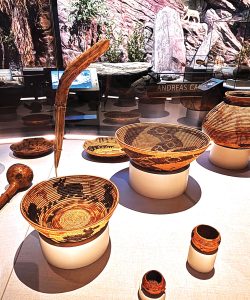
Further on, there are replicas of nearby desert canyons; artifacts and artworks that include 100-year-old baskets and pottery; and a timeline of events in the Coachella Valley and Agua Caliente history using digital projections on a large light table.
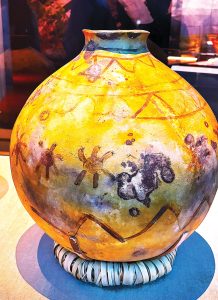
Also, under glass and dim lights, are some of the probably 8,000-year-old tools, shells and weapons uncovered during the 2018 excavation for the spa and museum.
The Permanent Gallery also pays homage to the ubiquitous Washingtonia filifera palm, the only palm native to the California desert. It provided food, clothing and shelter, and indicated the location of water.
In the other exhibit space, the Changing Gallery, is “Section 14 The Untold Story.”
The components focus on Section 14, 1 square mile of the Agua Caliente Indian Reservation in the center of what today is downtown Palm Springs and the ancient hot mineral spring. A 16-minute film features tribal elders who recall life on Section 14 and the struggles their families and community endured.
The exhibit also presents documentary evidence that private interests worked to deny the tribe’s rights and take the land on which Agua Caliente peoples lived for millennia.
“Over time, this land became the focal point of greed and ambition,” a tribal elder says in the film. “The settlers in Palm Springs coveted our land… (and disregarded) centuries of Cahuilla stewardship.”
Visitors learn how the tribe fought to regain those rights and hold on firmly to its land and its culture.
Outside, the museum and spa buildings and the plaza are as enchanting as the interior.
The landscaping mimics the desert environment, employing rocks, Washingtonia palms, water features and canyon-like spaces. On this warm March morning, shade from the palms provides respite from the heat, and the sound of tumbling water provides a comforting softness.
In 2024, the plaza’s design earned Time Magazine’s designation as one of the World’s Greatest Spaces.
The Agua Caliente Band of Cahuilla Indians is a federally recognized Native American tribe that today numbers 500-plus members. Many are listed on a large, basket-like, woven board at the museum’s entrance. The tribe’s 34,000 acres lie in portions of Palm Springs, Cathedral City, Rancho Mirage and unincorporated Riverside County.
For more photos and discussion, visit www.facebook.com/elouise.ondash, and Instagram @elouiseondash.