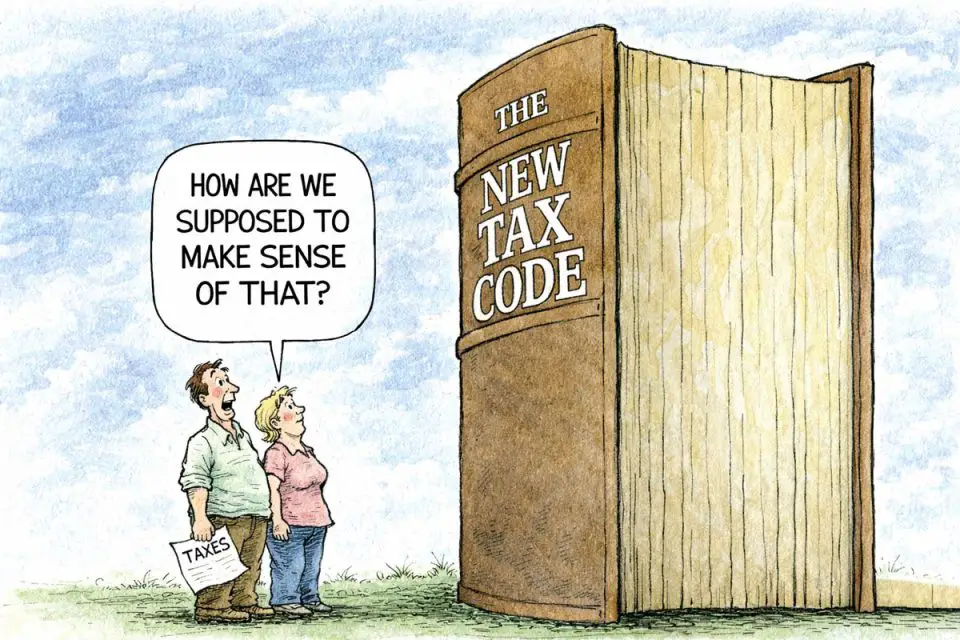
2025 was an advantageous year for some taxpayers, with several provisions under the One Big Beautiful Bill Act (OBBBA) structured to deliver benefits early. However, filers should be aware that the next tax year will bring significant changes, as 2026 is the first full calendar year operating under the OBBBA.
The rules have changed, and the tax strategies that made sense 12 months ago may no longer function in the same way. Proper planning with the guidance of your accountant and advisors will be crucial as taxpayers navigate new challenges.
Rethink your charitable giving
In 2025, many CPAs helped clients accelerate charitable giving to take advantage of strategic deductions. That window is now closed, as, under the OBBBA, charitable deductions are subject to a 0.5% AGI reduction on top of the existing 2% reduction that applies to all itemized deductions. In a high-income year, that stacks up pretty fast.
The counterintuitive result is that the more you earn, the less tax benefit you get from charitable giving.
One approach to consider for the 2026 tax year is “bunching”: concentrating several years of donations into a single, lower-income tax year. If you earn $1 million annually, charitable deductions generally don’t start producing a significant tax benefit until you’ve donated around $30,000 in that year. In a high-income year, the benefit shrinks even further.
Donor-Advised Funds (DAFs) are an excellent vehicle to consider, as they are essentially savings accounts hosted by public 501(c)(3)s that enable donors to make deposits and claim the tax deduction immediately.
The practical advantage of DAFs is undeniable — beyond an immediate tax deduction post-deposit, they offer a wide range of tax benefits compared to other tax vehicles. For example, if you donate appreciated assets like stocks or other long-term investments through a DAF, you can avoid capital gains tax as well as reduce your marginal income tax.
Know exactly where you land on SALT
The OBBBA raised the cap on the state and local tax (SALT) deduction, but not equally. Where a taxpayer falls on the income threshold scale determines everything.
Under $500K AGI: You now qualify for the full $40,000 SALT deduction. That covers state income taxes, property taxes and DMV fees, which is a nicely sized deduction for most California households sitting in this bracket.
$500K–$600K AGI: The deduction phases down. You’ll get some benefit, but not the full $40,000.
Over $600K AGI: You’re back to the $10,000 cap. The SALT increase doesn’t help you at all.
For high earners in California making more than $600K per year, one common workaround is the Pass-Through Entity Tax (PTET), which has recently been extended until 2030. By paying California’s 9.3% entity-level tax through an S-corp or partnership, the deduction manifests as a federal business expense, effectively bypassing the SALT cap.
The question is whether a taxpayer’s income justifies the compliance cost of setting up or maintaining that entity structure. Generally, if a taxpayer earns $250,000 or more through an S-corp, partnership, or LLC, it’s worth considering.
Five things to do before mid-year
- Project your 2026 income now. Nearly every planning decision (e.g., SALT bracket, charitable timing, entity structure) depends on income level, and having a basis to work from helps with planning.
- Review planned giving. If you’ve been making the same donations every year, check the numbers and consider a DAF. You may be better off skipping a year and “bunching” on the next, especially if your yearly income varies.
- Review your SALT position and confirm which tier you fall into. If you’re near the $500K or $600K threshold, income decisions this year could determine which bracket you land in.
- Evaluate PTET if you’re a California business owner earning above $600K. Your CPA can help assess whether a PTET election makes sense for your situation.
- Don’t assume your 2025 tax plan is applicable this year. Last year’s strategy was specific to the 2025-2026 OBBBA transition, and following the same playbook in 2026 may yield different results.
The bottom line
2026 isn’t a bad year for taxpayers, but it is a planning year. While the OBBBA may have complicated the tax landscape for some, the cost/benefit analysis cuts both ways. Those who understand the new rules still have time to benefit.
Those who don’t may end up missing out on deductions they’re actually entitled to. If you haven’t yet reviewed your 2026 tax position with your CPA, set an appointment as soon as you can, as mid-year is still early enough to develop a proactive 2026 tax strategy.
Yishai Kabaker, CPA, partner at Gursey Schneider in Los Angeles, provides tailored tax planning, compliance, and advisory services to high-net-worth individuals, families, entrepreneurs, and family offices. He has been with the firm for more than 10 years and has a background in business management, enabling him to guide clients through complex tax matters with clarity, precision, and discretion.