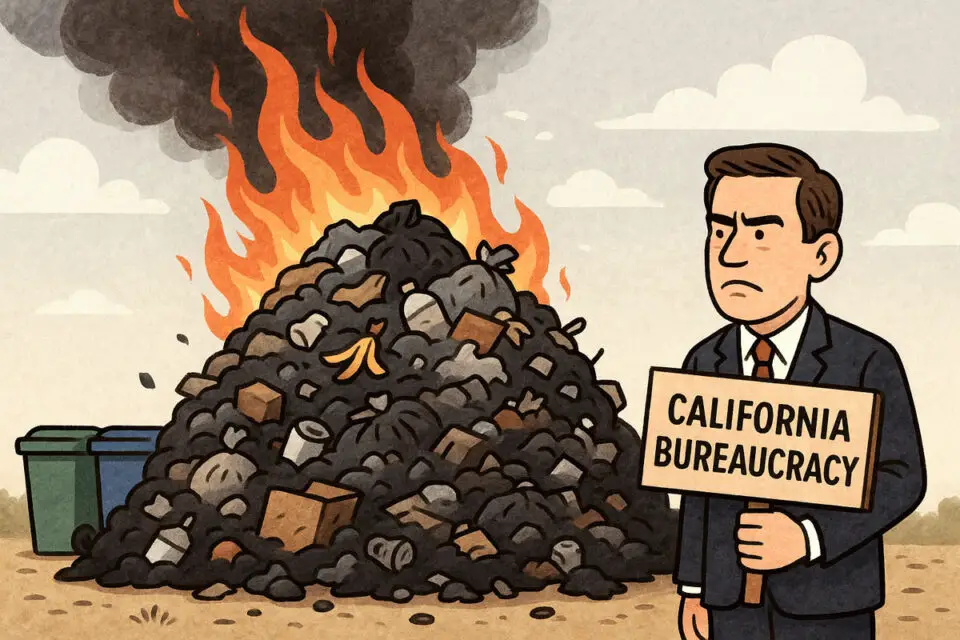
Every Californian cares about trash — especially the type they put on the curb each week. But our California government bureaucracy is working against our best interests.
This year alone has been a stinker for California taxpayers. In July, Orange County trash collectors went on strike, requiring temporary waste drop-off sites in multiple cities.
Trash collection fees are increasing by 54% in Los Angeles and are being levied in San Diego for the first time in over 100 years. Elsewhere, Californians are already paying high rates for trash service — such as in San Jose, where the service starts at $110 per month.
But the pile gets bigger because behind these costs are taxpayers already struggling to keep up with the nation’s most expensive state.
And speaking of the pile, where does the bureaucracy plan to toss the hundreds of millions of disposable COVID masks Governor Newsom bought from Chinese manufacturers for about a billion dollars.
Residential landfills are struggling to keep up with solid and toxic waste from the devastating Los Angeles-area fires earlier this year, which destroyed the tight-knit communities of Altadena and Pacific Palisades. Its residents still struggle to rebuild under tons of debris while the government fiddles.
And it gets worse. Even though California’s landfill standards already exceed federal requirements, and modern technology has made major improvements, environmental radicals are turning the state’s waste management systems into a dumpster fire.
For more than a decade, they have tried to close Kettleman Hills, one of two hazardous waste facilities in the entire state. Located in a remote area of the San Joaquin Valley, radicals and their like-minded friends in California’s agencies have attempted to block this hazardous waste facility from processing hazardous waste.
They conveniently ignore that as far back as 2010, a health investigation by the state declared it could find no correlation to local health issues, or “any indication that emissions from the facility affected air quality.”
Last year, though, they did succeed in closing Los Angeles’ second-largest landfill, in partnership with the aforementioned oversized bureaucracy. The Chiquita Canyon landfill had been attempting to manage a rare chemical reaction in partnership with officials and the community, but local politicians instead turned it into a scapegoat, while activists filed lawsuits.
For context, the facility handled 34% of Los Angeles County’s waste. Now it handles none.
This all raises a simple question for Sacramento’s policy-makers: where exactly do you suggest state residents put their trash? Are your backyards available? Because when you shut down well-run landfills, it gets loaded onto trucks and hauled further away – burning more fossil fuels, creating more emissions, and sharing more delightful trash truck aromas with motorists on a hot California day.
Running a landfill isn’t easy or for the faint of heart. Operators must safely process hazardous materials while protecting nearby communities and the environment. Waste, chemicals, and toxins don’t vanish on command.
But again, this seems to be a universal problem in California. LA officials celebrated the Chiquita location’s closure by closely watching for “price gouging” when their political realities required trash to be hauled further away at greater expense.
California has record-setting deficits, but it also has CalRecycle’s director, Zoe Heller, who in 2024 was paid $205,000 to run a state department responsible for overseeing the elimination of trash. She was elevated from the agency’s Division of Circular Economy — an office with a name straight out of Monty Python’s Ministry of Silly Walks. Its mission: end “disposable systems” and make California “waste-free.” Really?
The reality is that landfills, like America’s air quality, are cleaner and more efficient than ever before. So while China continues to open new coal-fired power plants and churn out 33% of global carbon dioxide emissions, California’s regulators are inventing expensive solutions to non-problems and forcing Californians to pay more for garbage collection due to political theater, virtue signaling, and agendas.
It is impossible to be waste-free, but fewer people means less trash. The government has been successful in making daily life in California so expensive that, in the last few years, employers and workers have been leaving the state and taking their capital with them.
The high taxes and regulatory burden forced hundreds of companies to flee California, including Tesla, Oracle, Chevron and the owner of native-born In-N-Out Burger. The state has lost at least a million people over the last decade, and a majority of Californians are now considering joining them.
It is time state officials stop breaking things, and instead find real solutions to problems facing everyday Californians – including trash. Their pursuit of ideology over reality and the hard work it takes to solve problems must join the rest of the state’s trash in its landfills.
Jerome Stocks is a former mayor and city councilman of Encinitas. In his capacity as an elected official, he was involved in contracts and regulations related to local waste management.