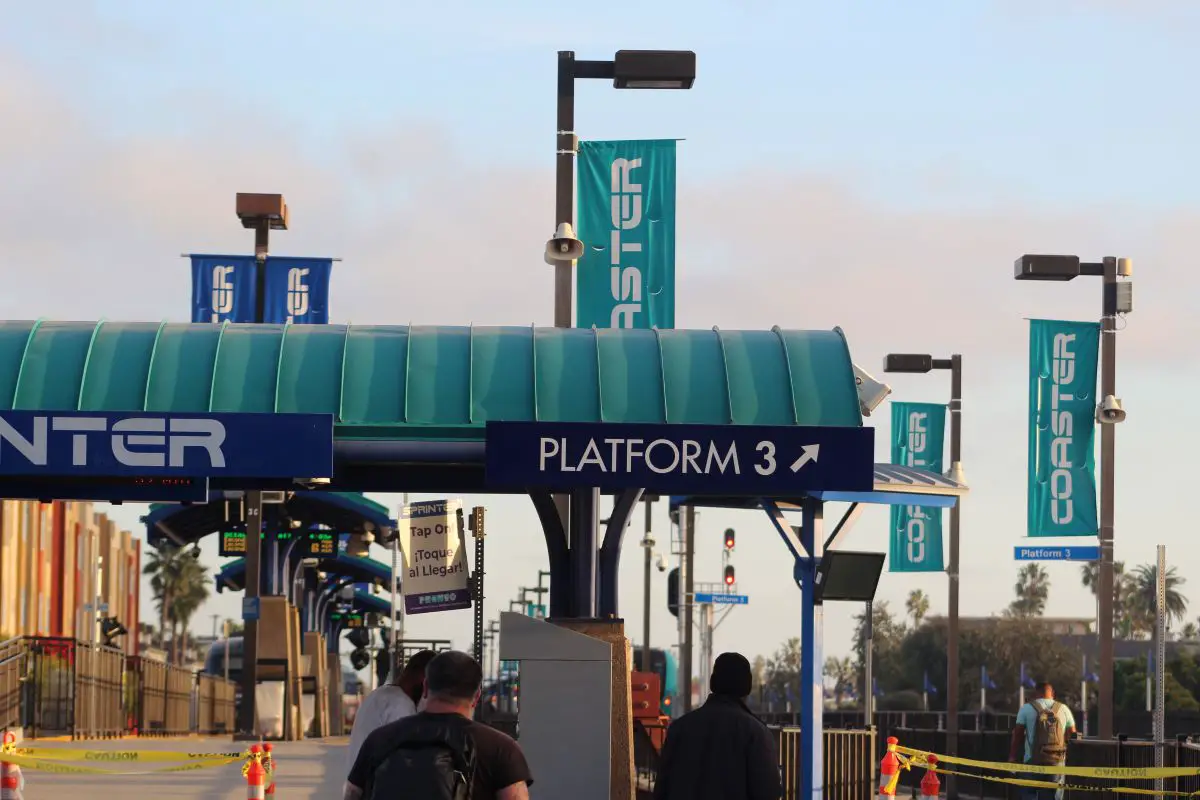
OCEANSIDE — After delaying its vote last month, the Oceanside City Council has recently signed off on two major redevelopment proposals that will overhaul the Oceanside Transit Center and North County Transit District’s 810 Mission Avenue headquarters, adding hundreds of apartments and a range of mixed uses.
The council’s approval last week follows its Oct. 7 decision to continue the transit center project to seek clarification and potential revisions from developer Toll Brothers Apartment Living. That delay also pushed back action on the 810 Mission Avenue project, which is tied to the larger redevelopment.
Plans for the Oceanside Transit Center call for five-story residential buildings with 547 apartments and 790 parking spaces. Fifteen percent of the units would be affordable, including 55 designated for low-income households and 27 for moderate-income households.
The project also includes 1,768 public and private parking stalls, anchored by a new above- and below-grade parking structure with 801 spaces — 611 of them public. The existing city-owned structure at Cleveland Street and Seagaze Drive would remain.
Other key components include:
- Relocating NCTD headquarters from 810 Mission Avenue to a four-story, 59,156-square-foot office building with a 1,692-square-foot Amtrak customer service center on the ground floor.
- Creating a central transit plaza for small events, art installations and performances with green space, shade structures and seating.
- Adding a 173,463-square-foot boutique hotel with 170 rooms and 12,806 square feet of retail and food and beverage space.
- Constructing 29,196 additional square feet of commercial space.
- Changing bus circulation and relocating bus bays to the site’s southwest corner, shifting them away from Seagaze Drive.
While many residents backed the project overall, several raised concerns that moving bus service to Missouri Avenue would increase safety risks, noise and pollution along Missouri and Michigan avenues, which are narrower and closer to homes than Seagaze Drive.
Other issues raised by the public and council members included prevailing wage requirements and local hire provisions, hotel construction timing, long-term maintenance of parkways, the need for a traffic demand management plan, whether Cleveland Street could function as a two-way multimodal corridor, the transit center’s removal from the downtown district, available open space and the inclusionary housing percentage.
The redevelopment is expected to generate about 5,048 jobs, including 4,390 temporary construction jobs and 658 permanent positions. Roughly $100 million in public improvements would be built using prevailing wage labor, while private elements would not. The developer said imposing prevailing wage requirements on privately financed components — including housing and the hotel — would increase costs 20% to 25% and render the project infeasible.
City staff emphasized that Oceanside has no oversight over NCTD’s bus operations and noted that Missouri Avenue’s width is comparable to other shared roadways. The developer plans to improve half of the roadway along the project frontage to reinforce the asphalt for bus traffic. NCTD also noted it is replacing diesel buses with a zero-emissions fleet, which would reduce air quality impacts.
Staff also clarified that the hotel will be built as part of the project’s second phase, ensuring the city receives transient occupancy tax revenue. A traffic demand management plan must be approved before occupancy.
Cleveland Street’s role as a two-way multimodal corridor is tied to the project’s designation as one of eight SANDAG mobility prototype sites aimed at increasing transit ridership and improving NCTD operations. Staff said the street design prioritizes pedestrians, slows vehicles and reduces conflicts between transportation modes. A dedicated bike lane was studied but found inconsistent with the city’s bicycle master plan and NCTD policies.
Staff further clarified that the downtown district applies only to nonresidential project areas. Because the residential buildings fall outside the district boundary, they do not count toward the city’s 5,500-unit downtown cap.

The developer said the project provides significantly more open space than what exists today, exceeding minimum requirements. While only 88,050 square feet are required, the plan includes 101,639 square feet.
Although the project is legally required to include 10% affordable housing — because the Coastal Commission has not yet certified the city’s local coastal program amendment raising that threshold to 15% — the developer is voluntarily providing 15% by designating 10% of units for low-income households and 5% for moderate-income households.
The council approved the transit center project 4-1, with Mayor Esther Sanchez opposed.
“I’m very, very disappointed in the lack of responsiveness by a public agency that we have a representative on,” Sanchez said, adding the project “basically flipped off the neighborhood” by not addressing bus route and safety concerns. “I have to support the community here. I think they’ve asked for very little.”
Deputy Mayor Eric Joyce, the city’s representative on the NCTD board, backed the project but acknowledged communication gaps between the agency, the developer and the city. He noted that bus routes would likely have been relocated regardless of the council’s decision and said the project could return if the Coastal Commission requires changes.

At the same meeting, the council unanimously approved the 810 Mission Avenue redevelopment, which will demolish the existing NCTD headquarters and replace it with a 326,647-square-foot, seven-story mixed-use building containing 206 apartments.
The building would include 53 studios, 99 one-bedrooms, 40 two-bedrooms, nine three-bedrooms and five live-work units, with 21 units reserved for low-income households and 10 for moderate-income households.
A three-level parking structure with 225 spaces — half of them below grade — would serve the development, with its main entrance on Nevada Street. The project includes bicycle racks and lockers, one parking space per unit and a requirement that residents pay for additional spaces. Each resident will receive a free PRONTO transit pass. The Oceanside Transit Center is roughly one-third of a mile away.
The architecture blends historic and contemporary styles inspired by Irving Gill to complement nearby downtown buildings. The project will remove existing palm trees and will not plant new ones, except for those remaining along Mission Avenue. Some residents expressed concern about losing mature pine trees along Nevada Street due to the stormwater retention basin. City Manager Jonathan Borrego said the city would try to find a compromise, though it may be a “tall order.”
NCTD Chief Executive Officer Shawn M. Donaghy praised the council’s decisions.
“The Oceanside City Council’s decision today advances our efforts to improve the customer and employee experience at the Oceanside Transit Center while bringing much-needed housing and economic development to the area,” he said in a news release. “NCTD is committed to better serving our communities through the redevelopment of our stations, providing a more welcoming introduction to our transit services.”
Michael McCann of Toll Brothers Apartment Living also voiced support.
“The vision for a reimagined Oceanside Transit Center is the result of more than three years of public outreach, collaboration and compromise between a diverse coalition of local residents, nonprofits, transit and housing advocates, and of course the City of Oceanside and NCTD,” he said. “Downtown Oceanside has become such a unique destination that deserves a world-class transit center. We’re proud to be part of the team that will deliver a project that benefits not only Oceanside, but the region as well.”