Shores Park update; tree trimming ordinance also discussed
DEL MAR — The City Council voted Tuesday night to declare a local emergency over high levels of sand in the San Dieguito Lagoon. With a “Super” El Niño predicted to bring high waves and heavy river flows this winter, council members said it is vital for the U.S. Army Corps of Engineers and Southern California Edison to remove sand to prevent flooding.
The unanimous vote came at the end of a 5½-hour meeting during which the council also heard an update on the Shores Park redesign, discussed the city’s tree removal permit process and approved a staff recommendation for a policy on spending sales tax revenue from Measure Q, which voters approved in 2016.
The council also declined a request from an attorney representing Carol Lazier to delay approval of a contract with a consultant who will work on a rezoning proposal that could affect Lazier’s ability to develop the Seaside Ridge project.
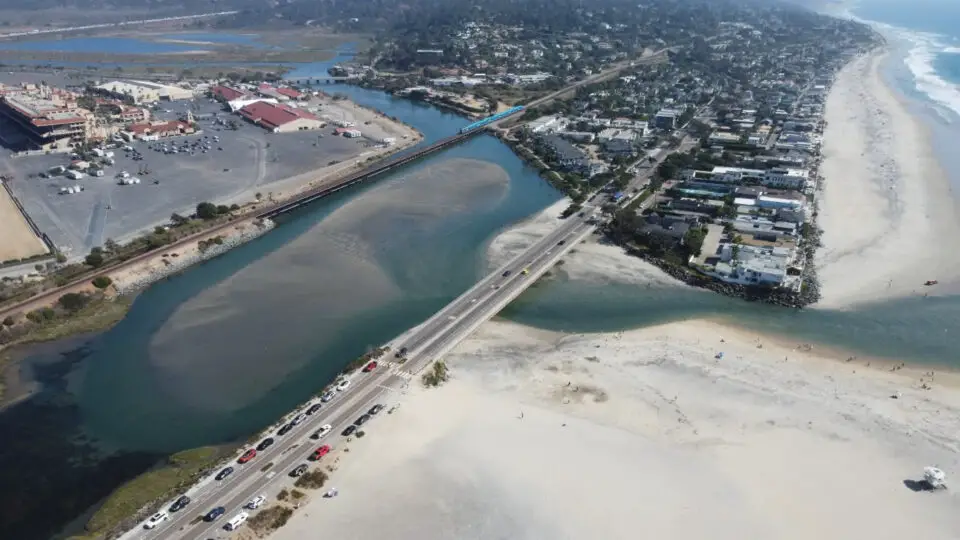
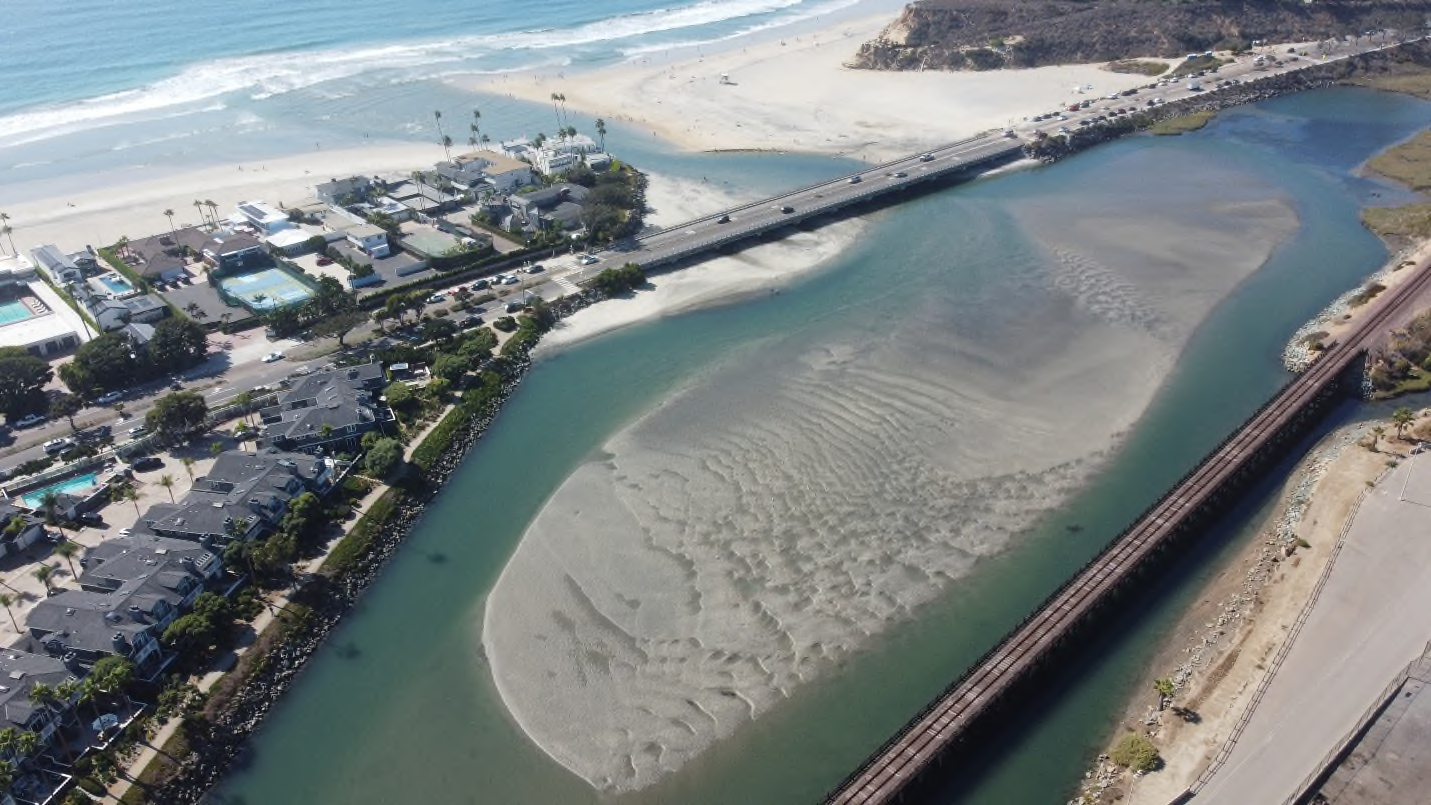
A city staff report on sedimentation in the lagoon noted that it was last dredged nearly two years ago, with the next dredging scheduled for November. In 2024, the Army Corps of Engineers also deposited more than 1 million cubic yards of sand on beaches in Encinitas and Solana Beach. Natural wave and current action has been carrying that sand south toward Del Mar, where some of it has accumulated in the lagoon, dramatically narrowing the inlet.
Assistant City Manager Clem Brown told council members, “When the inlet is narrowed or closed, the lagoon loses its ability to absorb storm surge and rain, which raises the real risk of flooding in the low-lying neighborhoods that border the lagoon.”
The city is awaiting a report from the Corps with data on current sedimentation levels in the lagoon. Photos shared with the council, however, show the inlet choked with sand and additional sediment deposits throughout the lagoon.
Under a 1992 agreement with the state Coastal Commission, Southern California Edison, a Los Angeles-area electric utility, was charged with restoring and maintaining the lagoon as environmental mitigation for the impacts of the San Onofre Nuclear Generating Station. Edison pays for the dredging but relies on permits from the Corps and the Coastal Commission, which determine how much sediment it can remove.
This year’s permit allows dredging 16,000 cubic yards of sand. Staff and council members expressed concern that the amount may not be enough to clear the inlet to the ocean or allow the lagoon to absorb heavy flows if Lake Hodges dam reaches capacity during winter storms and is opened or overflows.
In addition to declaring a local emergency, the council directed staff to request emergency action from the Corps and Edison to expedite dredging ahead of expected storms. It also directed staff to ask the Corps to increase the permitted dredging volume from 16,000 to 50,000 cubic yards.
Councilmember Dan Quirk asked whether the city could perform the dredging itself. Brown said it could, but the work would still be subject to the Corps’ 16,000-cubic-yard limit. Staff did not have a cost estimate Tuesday night.
“At some point, we can’t let bureaucracy put our city at risk. … we actually need action,” Quirk told his colleagues.
Deputy Mayor John Spelich echoed that concern, saying, “We could go there and then can try to bill them back afterward.”
Quirk replied, “At the end of the day, we can’t let our city get flooded in an El Niño year.”
City Manager Ashley Jones said declaring a local emergency “Puts more pressure on all of the agencies. It will enable us at some point, if we have to take actions on our own, to submit for reimbursement.”
She also noted that Gov. Gavin Newsom has declared a statewide emergency ahead of the expected El Niño storm season.
Tree removal
The council requested a discussion of the tree removal permit process after residents raised concerns during public comment at its Aug. 25 meeting.
At that meeting, several residents described difficulties obtaining city permits to remove diseased or otherwise dangerous trees belonging to protected species. Del Mar protects two native tree species: the Torrey pine and Monterey cypress.
On Tuesday, staff presented a 10-year overview showing that only four of the 309 tree removal applications filed since 2016 were denied.
Staff offered the council several options, including a temporary emergency amnesty to make tree removal easier ahead of the expected heavy storm season and relaxing the requirement to replace every removed tree.
Jones reminded the council that the city has not yet fully implemented the state’s new “Zone Zero” fire prevention standards. Staff is still developing proposals for the council to consider.
“The goal is to maintain our tree canopy in our city,” Jones said. “The reality is we’re coming up against a time when a large portion of our city has been placed in a high fire-severity zone. We’re going to try to balance that.”
Staff also noted that the fire marshal can already waive the tree replacement requirement under certain conditions. In those cases, a resident removing a tree can instead pay into the city’s tree mitigation fund, which is used to buy replacement trees for public property.
The council took no action, leaving the tree regulations in place for now.
Related Articles:
- San Dieguito Lagoon thrives after restoration October 2, 2024
- Newsom declares state of emergency in preparation… September 22, 2026
- Oceanside to test out fall schedule for sand dredging February 9, 2026
- Lagoon access center of Coastal Commission,… August 11, 2025
- Oceanside wraps harbor dredging, eyes long-term… June 3, 2026
- Oceanside prepares for strong winter storm season September 1, 2026