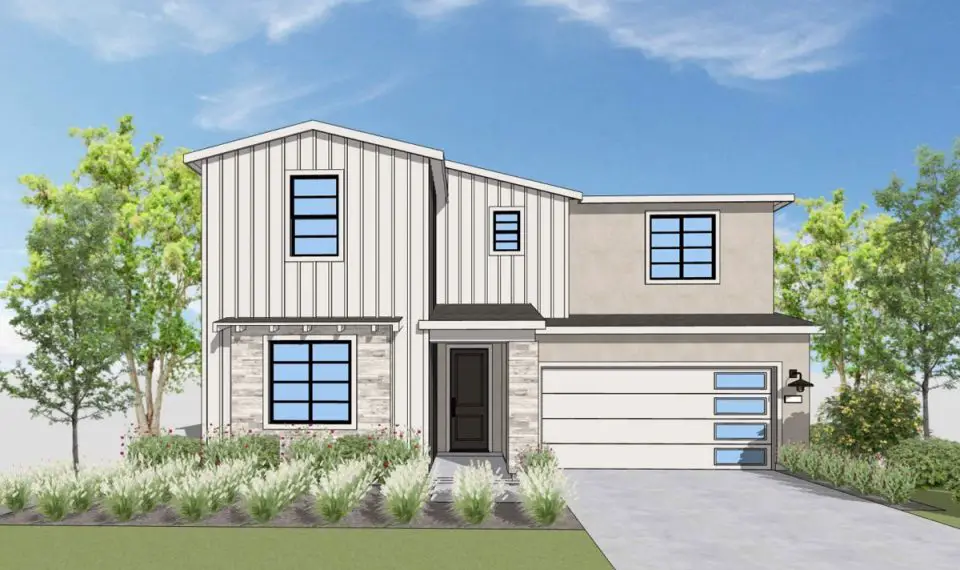
ENCINITAS — The Encinitas City Council voted 4-1 on June 24 to reject an appeal challenging a proposed 27-home subdivision atop a bluff overlooking Encinitas Boulevard, allowing the project to move forward after months of scrutiny over its geology, drainage and traffic impacts.
The Ocean Bluff project, proposed by Rincon Homes for a vacant 7.2-acre site at 501 Ocean Bluff Way, will construct 27 detached single-family homes on about 4.5 acres while preserving the remaining 2.7 acres as protected open space due to steep slopes.
The development also includes a new private loop road, frontage improvements along Ocean Bluff Way, landscaping, stormwater facilities and the removal of three existing wireless communication facilities on the property.
Three of the homes will be deed-restricted for very low-income households and permanently affordable. Those units also cannot be sold to institutional investors, according to city documents.
The affordable units qualify the project for a 50% density bonus under state law, allowing the developer to increase the site’s maximum allowable density from 18 to 27 units. The project also received several waivers under California’s Density Bonus Law, including exemptions from local requirements related to setbacks, lot dimensions, street design, pedestrian connectivity and sidewalk requirements within the private development.
The Planning Commission unanimously approved the project on May 7 after certifying a final Environmental Impact Report that concluded all environmental impacts could be reduced to less-than-significant levels through mitigation measures. Commissioner William Whitteker encouraged neighbors to challenge the decision.
“I hope the community considers appealing. Please do.”
Neighbor Carol Wood subsequently appealed the approval, raising concerns about bluff stability, geotechnical investigations, drainage, roadway design, traffic safety, affordable housing placement and the project’s reliance on state density bonus waivers.
During the June 24 hearing, Wood criticized the city’s response to her appeal.
“This is not analysis,” she said. “It is a conclusion without reasoning that is vulnerable to legal challenge.”
She also questioned whether enough evidence existed to conclude the bluff could safely support the development.
“A project meant to last decades on a fragile bluff top should not be approved on weak or incomplete analysis or on waivers and assumptions affecting bluff encroachment, geology, drainage, lot layout, road design and traffic.”
City staff disagreed, concluding that the project complies with state housing law, the California Environmental Quality Act, the city’s Local Coastal Program and the Encinitas Municipal Code. Staff said the project had undergone extensive review, including multiple geotechnical studies, peer review by the city’s independent geologist, three traffic studies and a comprehensive hydrology analysis.
Representing Rincon Homes, Jonathan Frankel said the development had received more scrutiny than any other project he had worked on.
“We focus exclusively on creating home ownership opportunities as part of smaller scale infill developments,” Frankel said.
He noted the project would provide 95 parking spaces — more than required — and said the developer could have pursued even greater density under additional state housing laws.


“After all of this exhaustive review, it was unanimously approved not because they loved every aspect of the project,” Frankel said. “There were aspects, frankly, they didn’t love, but because they knew that it met all of the criteria, the city and state criteria, it needed to be approved.”
Frankel also disputed concerns that the project would worsen bluff erosion, noting that instead of uncontrolled runoff flowing over the bluff today, stormwater would be captured and released through a controlled drainage system.
“It would be channeled in a very slow, very controlled release,” he said, adding that the improvements would have a positive long-term effect on bluff stability.
Several residents urged the council to uphold the appeal, citing concerns about traffic, roadway safety and the possibility of bluff failures that could affect Encinitas Boulevard. Others supported the project, arguing it represented a more appropriate scale of development than other housing proposals approved elsewhere in the city.
Councilmember Luke Shaffer said approving the project would ultimately help preserve local control over future development.
Comparing it with other housing proposals, he said the project was relatively modest.
“Goodson was going to be five homes and now it’s 250, right?” Shaffer said. “Quail Meadows was going to be 13 and now it’s 448.”
Shaffer said he, Mayor Bruce Ehlers and Deputy Mayor Jim O’Hara all campaigned on protecting local control over development but argued state housing laws leave cities with limited options.
“I’ve said this time and time again, if Marty McFly showed up with his DeLorean to go back to 1985, I would go,” Shaffer said. “But it’s not happening anytime soon. And so the two options here are we build it or they build it.”
Later, Shaffer added that approving projects consistent with state law could help the city avoid even larger developments in the future.
“Right now, there’s not one vacant open property in Encinitas other than this one,” he said. “Everything else is green houses or stuff that has to be taken down. There are no more sites for us to go find. So, this property is ripe.”
Shaffer said the council needed to take a broader view.
“We may have gotten more if there was better work done before, but this council is going at this hard and one of the best ways to fight state housing is to actually approve this project,” he said. “It may not feel like that right now, but the fact of the matter is, unless you’re doing the research and doing the deep dive like most of all of us up here, you’re not getting it then because the state isn’t slowing down. They’re speeding up.”
Seeking to address questions about the project’s geotechnical review, Ehlers, a former planning commissioner, asked Jim Knowlton, GeoPacifica’s longtime geotechnical consultant for the city, to explain his background.
Knowlton said he has worked with Encinitas for nearly as long as the city has existed.
“You’re not mysterious – I think I’ve dealt with you on many a planning commission hearing,” Ehlers said. “You are our eyes and ears as an expert and have been for 30 plus years and so nothing is a mystery.”
Regarding stability, Knowlton said the bluff consists primarily of Torrey Sandstone, which is significantly more stable than formations found elsewhere along the coast.
“Beacon’s [Beach] – which is a good example – there’s a layer of what we call claystone that has planes and [the bedrock] slides along that claystone,” he said. “And we have none of that claystone bedrock on this project.”
He added that excavation work performed during the construction of Encinitas Boulevard exposed the rock face decades ago.
“There are no indications of any instability or any kind of landsliding potential,” he said. “Torrey Sandstone is not known for any kind of landslide potential.”
Councilmember Marco San Antonio acknowledged residents’ concerns but said approving the proposal could prevent a much larger development under future state housing mandates.
“I mean, if you’re worried about the bluff there now, I feel like the bluff when they decide to build something multi-story there, that would be even worse,” San Antonio said.
Councilmember Joy Lyndes said the city had to balance neighborhood concerns with private property rights.
“I think there are a lot of people who really want to say no, and I think you’re hearing that in different ways,” Lyndes said. “We’re concerned with your quality of life and what we really want to do, and what I want to do is to approve a solution that works best.
“This is private property. Keep in mind that private property owners have rights. So this is the same kind of development that a property owner can do here. We have to, here on city council, need to follow the same laws that the planning commission said they needed to follow.”
The council ultimately rejected the appeal, with O’Hara casting the lone dissenting vote.
Before the vote, O’Hara proposed requiring the developer to plant additional native trees, conduct additional soil sampling in the southwest corner of the site and dedicate a permanent easement that could someday accommodate a pedestrian connection to Encinitas Boulevard.
“I definitely hear the concerns of residents who don’t want something else to come along and I think that is a recognized discussion up here,” O’Hara said.
O’Hara said he agreed with much of the council’s reasoning but believed those additional conditions should be required.
“If we’re going to say yes, it’s got to be the best project and this is how we do it,” O’Hara said.
Although City Attorney Ajit Thind advised against adding formal conditions during the appeal hearing, Frankel told the council the developer would voluntarily work with city staff to explore additional native landscaping.
“You have my commitment that we’re happy to work with staff to see what opportunities could be done,” Frankel said. “We have no objection to trees there. We understand the benefits of them. There’s just lots of details that have to be worked out that I can’t do on the fly.”
In response to O’Hara’s other requests, Frankel said that neighboring residents had previously opposed creating a pedestrian connection to Encinitas Boulevard because they preferred to maintain the neighborhood’s quiet character. Frankel also said the requested soil testing had already been completed in accordance with standard engineering practices.