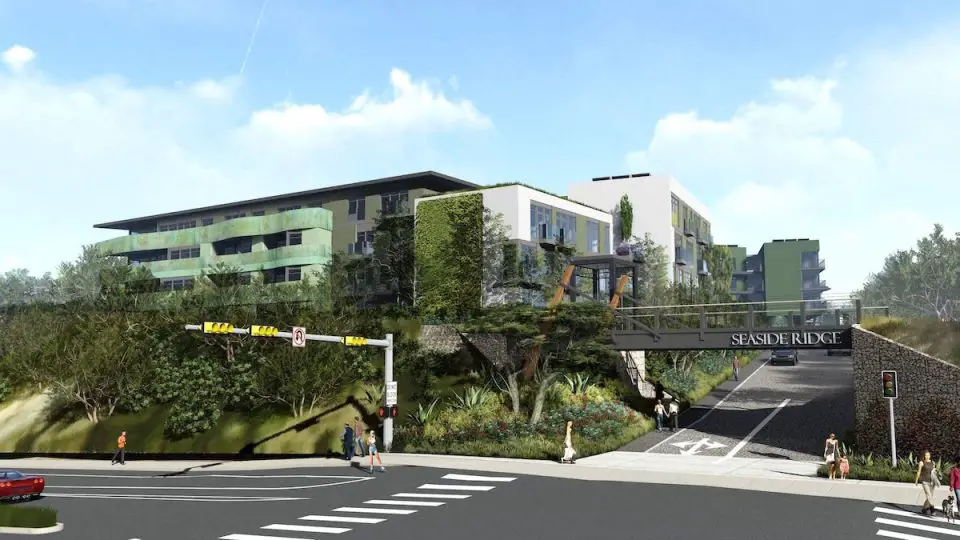
DEL MAR — The Del Mar City Council formally rejected the proposed 259-unit Seaside Ridge project in a hearing on Tuesday, months after receiving a warning letter from the state Attorney General’s Office demanding that the city process the project application.
The 259-unit Seaside Ridge project at 959 Border Avenue on the city’s North Bluff was first proposed by landowner Carol Lazier in 2022. The city has repeatedly found the application to be incomplete due to several missing materials, including a rezoning application, a Local Coastal Program amendment, a coastal development permit, and conditional use permits.
Lazier has insisted that she does not have to submit these materials and is currently suing the city to compel approval of the project. She argues that the city is required to process the project under the builder’s remedy law, which allows projects with affordable units to bypass zoning requirements if the city in which they are proposed lacks a certified Housing Element.
After a judge told her she had to exhaust all administrative remedies at the city level before proceeding with a lawsuit, Lazier asked the city for a de novo hearing to appeal the incomplete determination. The City Council rejected this request in September.
A few months later, in a December letter, California Attorney General Rob Bonta told Del Mar officials that they must provide the Seaside Ridge developers with a straightforward process by either approving or denying the project.
The city appeared to take that step on Tuesday, although city leaders did not mention the AG letter during the meeting.
Principal Planner Matt Bator reiterated that city staff still consider the project application incomplete and recommended that the City Council deny the project on that basis. Council members unanimously agreed to deny the project without any discussion.
“It’s been staff’s position that the proposed project is inconsistent with the certified Local Coastal Program, community plan, and municipal code,” Bator said. “The applicant has continually refused to submit the required planning applications as stated by the city, as well as the materials, fees, and deposits necessary for the city to process a Local Coastal Program amendment, to change the land use density, and rezone the property.”

Seaside Ridge representative Darren Pudgil said a final decision on the project was long overdue, and they will continue their lawsuit against the city.
“Under threat from the California Department of Justice, the city of Del Mar has finally taken action on Seaside Ridge after three and a half years of avoidable delays. By denying this affordable housing project, though, the city council has violated not just one state law, but several, which further exposes the city’s taxpayers to millions of dollars in legal fees and state fines,” Pudgil said in a statement to The Coast News.
Arguments continue
Seaside Ridge proposes nine structures ranging from two to five stories in height. Due to a density bonus inclusion, Seaside Ridge requests waivers of city standards for building height, floor area ratio, and slope grading, and concessions for increased lot coverage, decreased parking stall depth, and reduced setbacks.
At Tuesday’s meeting, California Coastal Works principal Joseph Smith, who is representing the project, denied that the application is incomplete and said the project has many merits.
Smith noted that the project includes 85 affordable units (ranging from moderate to extremely-low income), which could help the city to meet its affordable housing requirements under its 6th Cycle Housing Element.
He also shared the plans for public access along the bluff-top, parking that exceeds state requirements, and the thoughtful design.
“This project is about affordable housing and public access. In fact, I would say it’s a first-of-its-kind project, especially in the coastal zone of San Diego County. It’s an attempt to balance state laws in the government code and with the Coastal Act and the public resources code,” Smith said.
Because Del Mar’s 6th Cycle Housing Element was still uncertified when the Seaside Ridge project was submitted in the fall of 2022, Seaside Ridge argues that the builder’s remedy law requires the city to ministerially approve the project.
However, the city argues that builder’s remedy does not apply, citing state law stating that a preliminary application will be voided if the project size changes by more than 20%.

Bator said the preliminary application measured the project at 308,968 square feet, while the subsequent Coastal Development Permit application listed a square footage of 396,259, representing a 28% increase.
“The city is not required to process the submitted housing project as a by-right, builder’s remedy project, and despite the applicant’s arguments, the project lost its vested rights when the additional level of underground parking was added to the project,” Bator said.
Seaside Ridge claims the original square footage of 308,968 square feet was a clerical error and that the design actually started at 338,264 square feet, representing growth of around 17%.
“It is unfortunate that this continues to be a point of contention when it could have been cleared up a long time ago, as confirmed by a simple comparison between the submitted plans,” Smith said.
Seaside Ridge also alleges that the project is allowed to move forward under another law known as the Permit Streamlining Act, which is unrelated to the builder’s remedy.
According to a letter from attorney Brooke Miller of law firm Sheppard Mullin, when Seaside Ridge appealed the city’s determination that the project application was incomplete, the city was required to provide a final written determination within 60 days of the appeal hearing.
She said that because the city failed to issue this determination after the September hearing, the application was automatically deemed complete.
Pudgil said the city could be forced to pay $2.6 million or more in fines if they continue to refuse to approve the project.
“We are optimistic the court will rule favorably,” he said.
Future North Bluff development
While Del Mar leaders have made it clear they don’t accept the Seaside Ridge project as proposed for the North Bluff, they recognize that some form of development on the bluff is inevitable.
The city agreed on Tuesday to initiate a rezoning process for the North Bluff that would create a new zone known as RM-North. It would affect the Lazier property, an adjacent 5.5-acre site owned by Delfina Del Mar Development LLC known as the Whalen property, and potentially a four-acre site owned by 101 Border LLC.
These sites have a current density of one dwelling unit per acre. Under the city’s plan, these lots would be able to have affordable, multi-unit housing at a base density of 20 dwelling units per acre — a much lower density than what Seaside Ridge proposes.

Principal Planner Amanda Lee said that on the Lazier property, the 20-dwelling-units-per-acre zoning would allow a base density of 125 units, which could increase to a maximum of 188 units if a developer proposed a project with a 50% density bonus.
Del Mar leaders said they want to get a head start on rezoning the North Bluff in preparation for the 7th Housing Element cycle, which begins in 2030. The Lazier and Whalen properties are identified in the 6th Cycle document as contingency sites for affordable housing, if the city cannot reach an agreement with the Del Mar Fairgrounds to place affordable housing on their property.
Lee emphasized that, at this point, the North Bluff properties remain a backup plan.
“The city did not go in on the North Bluff development plan for the 6th cycle. This was always considered something we would need to do for the 7th cycle, so it would be initiating that,” she said.
However, the city may need to rezone these properties in the current cycle if it cannot reach a ground lease agreement with the Del Mar Fairgrounds by November to develop affordable housing on its property.
State law requires 50% of the city’s lower-income units to be located on vacant property, and the city is planning to build at least 61 units on the Fairgrounds property to meet its affordable housing production requirements.
Consultants for the Fairgrounds and the city completed pre-development studies in March and identified three sites on Fairgrounds property that are feasible for housing development, ranging from 1 to 1.5 acres.
Conceptual plans for these sites will be presented to both the city and the Fairgrounds in the coming months.
Del Mar leaders said that before they can rezone the North Bluff for multi-unit housing, the city needs to complete extensive studies regarding impacts to coastal resources, public access, circulation, public safety, and utilities.
A major concern is the North Bluff’s fragility and its ability to withstand extensive grading and construction.
The North Bluff is affected by direct wave action and erosion and features several sea caves that appear as fissures at the base of the bluff and burrow as deep as 30 feet.
“The really important thing in this location is consideration of the separation from the edge of the coastal bluff and the access easements,” Lee said.
Seaside Ridge developers say their project sufficiently accounts for bluff conditions and that setbacks are based on a worst-case scenario of sea-level rise. However, Bator noted that the proposed project would require 90,000 cubic yards of cut grading, including excavation to create a new street from Camino Del Mar.
Preparing for constructing affordable housing on the bluff will require amendments to the General Plan, zoning code, and LCP, Lee said. Additional environmental studies may be needed to supplement the Environmental Impact Report adopted for the city’s 2020 Housing Element.
The council directed city staff to begin these efforts for the Whalen and Lazier properties. Councilmember Terry Gaasterland said the North Bluff is a beautiful coastal asset valued for its views, but she understands the site may be needed for affordable housing development.
“When our community plan was first created, it acknowledged the beauty of North Bluff and also the fragility of the North Bluff. That’s why it’s one unit per acre, and that’s why it’s a tiny street to get in there,” Gaasterland said.
During public comment, Carol Lazier accused the city of unnecessarily delaying housing development on the North Bluff, despite the city having already identified her property as a potential site for housing in the 6th Cycle.
“My only intention is to build affordable housing. This has been denied. Now, instead of allowing housing to move forward under the commitments the city made in its current Housing Element, this recommendation pushes development out into the 7th housing cycle,” Lazier said.
Editor’s note: This story was updated to correct the spelling of Brooke Miller’s name.