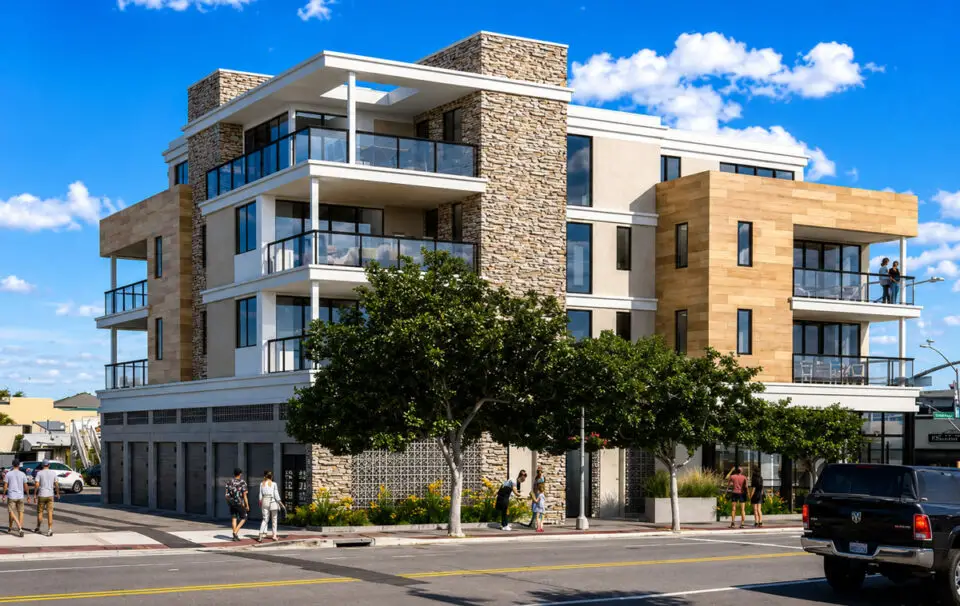
CARLSBAD — The latest version of a mixed-use housing development in Carlsbad Village, nearly 10 years in the making, has cleared another hurdle, with the city’s Planning Commission voting to recommend the City Council approve the project.
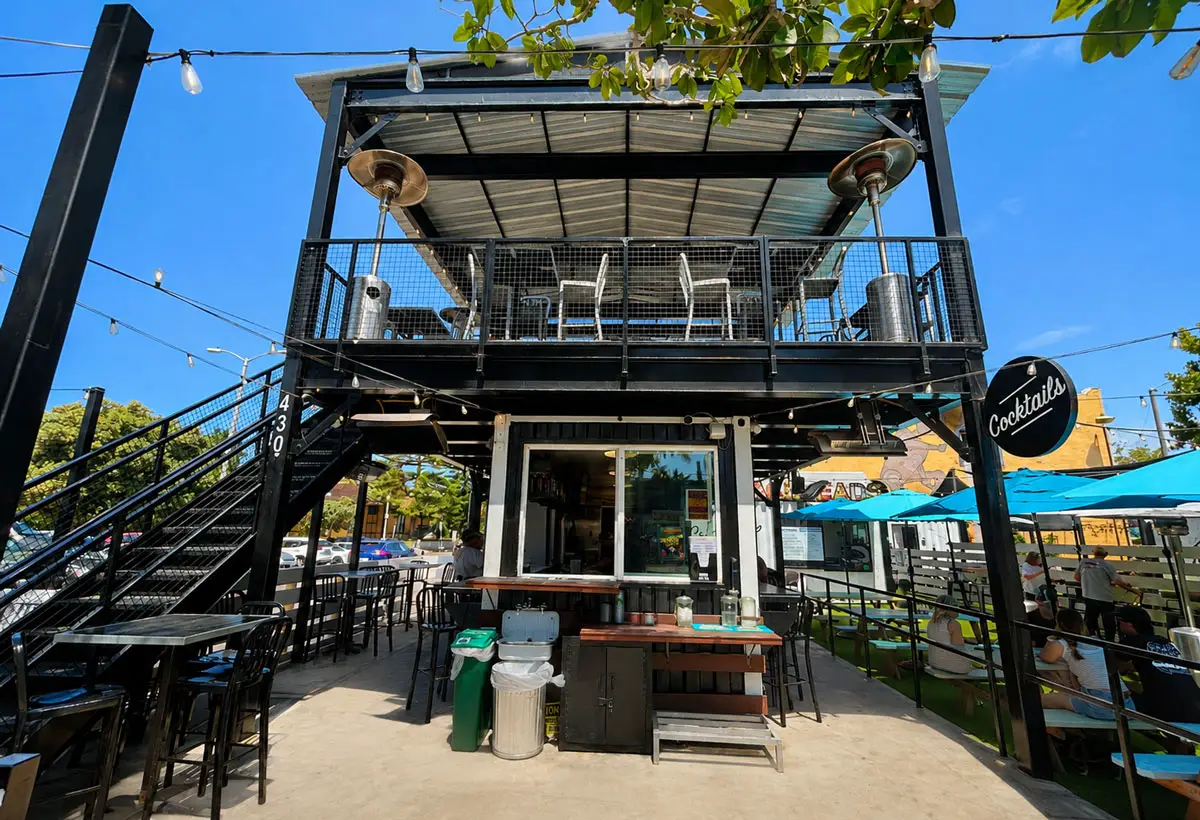
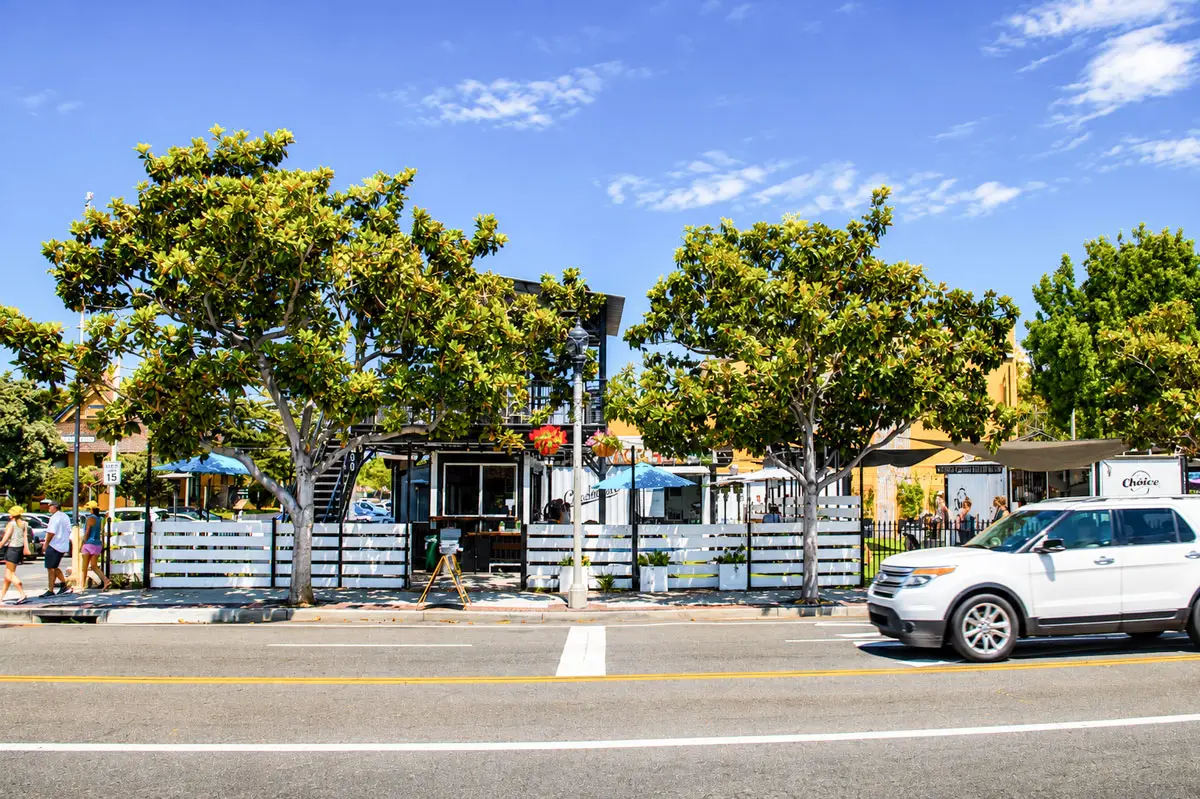
The site at 430 Carlsbad Village Drive, at the corner of State Street, currently houses two restaurants operating out of shipping containers with a second-level dining deck.
The proposal, Carlsbad Village Square, would replace them with a 19,225-square-foot, four-story building containing seven condominiums — four one-bedroom units, two two-bedroom units and one three-bedroom unit — along with 2,978 square feet of ground-floor commercial space on the 0.172-acre site.
The plans call for nine residential parking spaces, including four one-car garages equipped with mechanical lifts to accommodate eight vehicles and one ADA-accessible space.
The project’s proposed density is 40.7 dwelling units per acre, above the Village Center district’s standard maximum of 35 units per acre. One of the seven units would be reserved for a low-income household earning up to 80% of the area median income, allowing the project to use provisions of the state’s Density Bonus Law.
Under those provisions, the developer is seeking five waivers from city development standards involving setbacks, the amount of commercial space along the ground-floor street frontage, commercial parking requirements, garage dimensions and upper-story stepbacks. City staff said state law limits the city’s ability to deny the waivers unless specific findings can be made involving public health and safety, state or federal law, or historic resources.
Kirk Moeller, an architect who spoke on behalf of the project, said his team tried to minimize the number of waivers and comply with existing standards as much as possible, but that accommodating the residential portion of the project while meeting an 80% commercial frontage requirement was untenable. The project proposes 51% commercial frontage.
“There was just physically no way to do it,” Moeller said. “And that’s when we went the route of the density bonus.”
He added that plans for what business would occupy the commercial space have not been finalized, but said the team envisioned potentially maintaining the site’s current use with a restaurant or cafe.
The first version of a similar project on the site was submitted to the city in 2016, according to city documents.
At a March 2018 hearing, the City Council “expressed concerns with bulk and scale, citing that the project was not consistent with the character of the Village.” The council voted to deny the project the following month.
A new application was submitted in 2023 after several changes to state housing laws altered the development landscape and limited the grounds on which municipalities could reject certain housing projects, according to Mike Strong, Carlsbad’s community development director.
“The new application was submitted in 2023,” Strong said, “demonstrating that the rules of reviewing and considering land use development applications are different than what was in place in 2018.”
The proposal comes just days after the City Council approved another mixed-use condominium project less than a mile east along Carlsbad Village Drive. On July 28, the council voted 4-1 to approve a five-story development at 840 Carlsbad Village Drive with 50 for-sale condominiums and 3,801 square feet of ground-floor commercial space.
Carlsbad Village Square has undergone its own changes under an evolving housing landscape. A 2025 revision increased the number of residential units from five to seven.
“We didn’t increase the square footage, we didn’t increase the shape of the building,” Moeller said. “We simply made the units a bit smaller. We were trying to be cognizant of the massing and look of the building when doing that.”
Some residents raised concerns during public comment about how the project would affect the character of the Village, saying its size and appearance would be out of proportion with the surrounding neighborhood.
Kris Wright, a board member of the Equitable Land Use Alliance, gave a presentation on the history of the site using historical photographs and documents. She said the property was first developed in the 1920s as a gas station before serving as the location of several other automotive businesses.
Joe’s Transmission was the last such business to occupy the site and closed in fall 1983, according to Wright’s research.
“For 62 years, this property was subject to no environmental regulations as the California Environmental Protection Agency was established after the close of business of Joe’s Transmission,” she said. “There were no regulations to monitor fuel storage or to officially clean up spills. Contaminants just leached into the ground.”
Wright called on the commission to deny the application over health and safety concerns, one of the grounds available under state Density Bonus Law for denying a waiver under certain circumstances.
City documents show the former gas station had three underground storage tanks that were removed in April 1998 along with contaminated soil. A limited Phase II environmental site assessment completed in 2000 found very low levels of contamination in groundwater and very low to nondetectable levels in on-site soils, concluding that additional remediation was not required at the time because most of the contamination had been removed.
Strong said more recent testing at six boring locations to depths of 16 feet also did not find contamination at levels requiring additional cleanup.
“There were elevated levels of contaminants, but it did not elevate to a level that required remediation at that time,” he said.
However, the project would be subject to additional environmental safeguards. According to the staff report, the engineer who conducted the earlier assessment reviewed the current proposal and recommended soil-vapor sampling beneath areas where occupied portions of the building would sit directly over soil. The project is conditioned to complete that sampling before grading begins and prepare a soil management plan addressing the possibility of encountering contamination associated with the site’s former automotive uses.
Commission weighs in
The commission voted 6-1 to recommend approval of the project to the City Council.
Commissioner Kiley Fitzgerald cast the dissenting vote, citing health and safety concerns over the lack of dedicated commercial parking.
City standards would otherwise require commercial parking, but the applicant is seeking a density bonus waiver eliminating that requirement. The project is also approximately 0.1 miles from the Carlsbad Village train station, meaning Assembly Bill 2097 generally prohibits the city from imposing minimum parking requirements because of the property’s proximity to a major transit stop, with exceptions including certain accessible and electric vehicle parking requirements.
Fitzgerald noted that while the arrangement may be “de facto” legal, it could create problems of a “de jure” nature.
“While on its face value might not be creating any discrimination for those that have access and functional needs or disabilities, it would create an environment in the local downtown area where we’re setting a precedent for commercial businesses not to create an ADA spot,” she said.
City staff also raised the accessible-parking issue during its review. A traffic consultant hired by the applicant identified four existing ADA parking spaces within roughly 110 to 250 feet of the primary commercial entrance and found accessible pedestrian routes connecting those spaces to the project. Based on that analysis, staff said that eliminating the project’s dedicated commercial parking would not adversely affect public health and safety.
Moeller said the existing restaurants do not have on-site parking and that the proposed mixed-use structure would occupy a smaller ground-level footprint.
Commissioner Alicia Lafferty said she viewed the affordable unit as “a real benefit to our community” and said the project presented planners with a “challenging situation.”
“As this project continues to develop, I think we’re getting something that is sympathetic, albeit not maybe what everybody wants,” Lafferty said. “I do see that there’s a lot of good faith in this process right now. And I also see as these housing laws continue to ramp up over the years, we may not get a better shot of getting this as right as maybe this one could be.”
Commissioner Dave Hubinger said that while he was “a little disappointed our hands are tied so much” by state laws, he also recognized that housing has not kept pace with employment in the city. He added that he felt projects like this pay a compliment to the city.
“I think we lose sight sometimes that it is a positive for the City of Carlsbad that developers are willing to invest in the community,” Hubinger said. “We have a community that is so vibrant and so positive that they see it and say, ‘This is a good return on our investment.’”