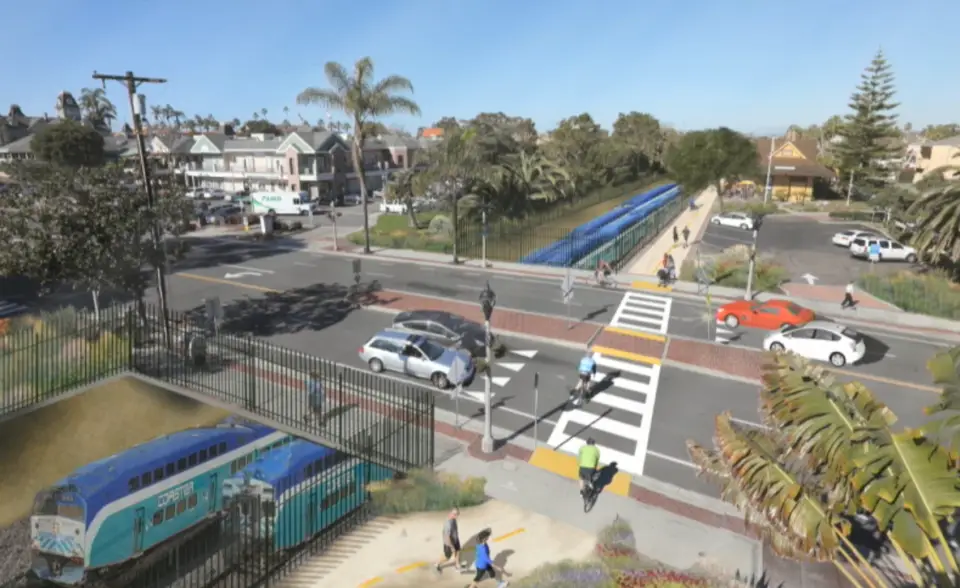
CARLSBAD — The city of Carlsbad advanced a project with regional partners to trench a portion of the rail line as it passes through the downtown Village and Barrio neighborhoods.
The City Council unanimously voted at its Oct. 6 meeting to enter into a memorandum of understanding with the San Diego Association of Governments and North County Transit District to conduct preliminary design work and environmental reviews on a 1.1-mile stretch of rail line extending to just south of Eaton Street in Oceanside, according to city documents.
SANDAG appropriated $20.8 million to lead the project, with Carlsbad agreeing to contribute up to $5.22 million and NCTD supporting the design and environmental phases, according to the agreement. The work is expected to take three years.
Carlsbad’s contribution is capped at $1.74 million annually over the project’s duration.
In addition to trenching the rail line, the project aims to add a second track to increase capacity and build a bridge over Buena Vista Lagoon, according to city documents.
At the meeting, Mayor Pro Tem Priya Bhat-Patel asked Carlsbad Intergovernmental Affairs Director Jason Haber about the timeline and likelihood of completing the project, given that total cost estimates could reach $500 million.
“It’s a good question, it’s a fair question,” Haber said. “I don’t have a great answer for you … One thing that this does do for us is put us closer to a shovel ready status. And so as funding may or may not become available, we’ll be in a good position to know whether we qualify and go compete for that.
“Whether or not it’s realistic and what the timing is like is unknowable at this point.”
Bhat-Patel later said that given how “heavily utilized” the corridor is, she wished the project had started years ago, “prior to when I was born.”
Mayor Keith Blackburn addressed high school students in the audience while discussing the project’s potential benefits, including eliminating nighttime train horns and lengthy traffic delays caused by passing freight trains.
“There’s a huge economic benefit to our downtown village shopping area and a huge safety consideration,” Blackburn said. “If you talk to any first responders – police or fire – they’ll tell you that there’s an unreasonable amount of people getting hit by trains every year.”
The rest of the City Council agreed that the potential benefits outweighed the uncertainties.
“It would be good to at least analyze the feasibility of what the next steps would look like and not look back and say we just hum and hoed this idea,” Councilmember Kevin Shin said.
“I’m very pleased we’re taking a step forward to determine what this project might look like and what it would cost – which is a big number – should it ultimately be something that the city, SANDAG and NCTD want to collectively pursue,” Councilmember Melanie Burkholder said. “None of these agencies, including the city council, can make a final decision until we know the very specific pieces of information that SANDAG’s study will provide and I certainly look forward to those findings.”
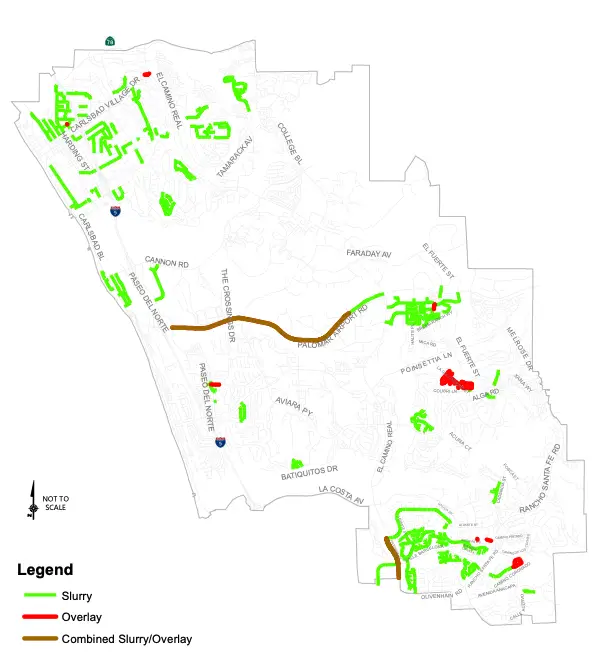
Roadway improvements
At the same meeting, the council also unanimously voted as part of its consent calendar to award a $9.8 million construction contract to Eagle Paving for various roadway improvements.
The contract includes six miles of arterial and collector streets that will be restriped and resurfaced, with new or enhanced bicycle lanes. Those include El Camino Real from the Encinitas border to Levante Street and a portion of Palomar Airport Road near Paseo del Norte, the city said.
The contract also covers approximately 39 miles of residential streets throughout the city.
Synthetic turf
Another city project on the consent calendar drew opposition before passing 4-1.
The council awarded Byrom-Davey a nearly $5.7 million contract to replace synthetic turf fields at Aviara Community Park and Alga Norte Community Park, city documents show.
Councilmember Teresa Acosta cast the dissenting vote after two public speakers opposed the use of synthetic turf.
Charles Rilli, deputy chapter director of the Sierra Club’s San Diego chapter, said the environmental impacts of synthetic turf extend beyond the fields where it is installed.
“Synthetic turf is an environmental justice issue because its impacts extend beyond the playing fields,” Rilli said. “It’s production relies on fossil fuels and chemicals, placing pollution burdens on communities near the extraction sites, refineries and factories. Those communities bear the costs that are often overlooked when cities purchase plastic products.”
“I will be voting no on this item in accordance with my continued opposition to installing more plastic in our city,” Acosta said. “Plastic turf, we all know it’s unhealthy and I listened closely to the public comment speakers.”
The staff report cited strong demand for the fields and maintenance concerns as the main reasons for choosing synthetic turf over natural grass.