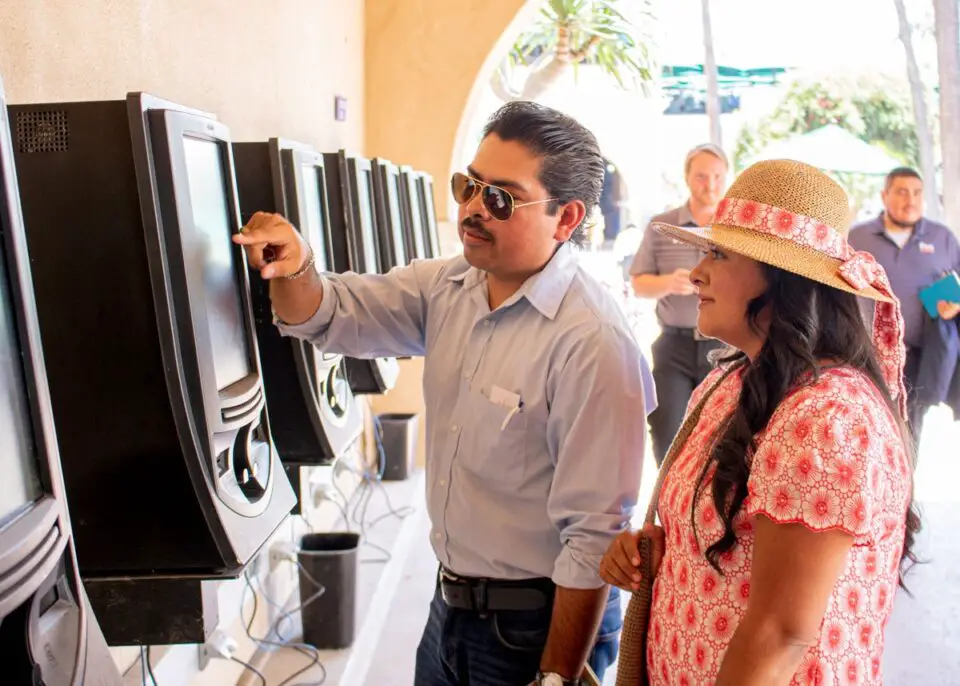
The grandstand at Del Mar fills up every summer the way it has since 1937. Bing Crosby’s old track still draws the Friday crowd down from Encinitas and Carlsbad, still runs the win-place-show windows, still smells like every other July at the coast. What’s changed is the conversation happening in the parking lot afterward. People aren’t just talking about the third race anymore. They’re asking why they can’t just tap an app and bet on the Chargers the way their cousin in St. Louis can.
California has been circling legal sports betting since 2022, when Proposition 26 offered tribal casinos and licensed racetracks like Del Mar the chance to run in-person wagering. Voters rejected it. A competing, tribe-backed measure aimed at the same goal qualified for that same ballot and went nowhere too. Since then, nothing. No kiosks. No app. Just a track that still books more handle on a single Pacific Classic day than most casual bettors will wager all year, sitting next to a state government that can’t get out of its own way.
Missouri didn’t have that problem. The state legalized sports wagering in November 2022 and spent roughly two years building licensing, tax structure, and platform approval from a blank page. For a look at how a state builds this out from zero, the analysis of Missouri online casinos breaks down licensing timelines, tax rates, and which operators moved fastest. It’s the closest thing to a live rehearsal for what a California rollout could eventually look like, minus the coastal real estate and the tribal gaming compacts that make our situation messier.
Del Mar’s Wagering Culture Isn’t Going Anywhere
Here’s the thing. Del Mar doesn’t need sports betting to survive. The Del Mar Thoroughbred Club pulled in strong handle numbers again this summer meet, and on-track wagering has always been its own self-contained economy. Simulcast wagering, advance deposit accounts through TVG and similar platforms, the whole apparatus already exists for horse racing specifically.
But that’s exactly why the sports betting gap feels so strange locally. You can bet legally on horses from your phone sitting in the Del Mar parking lot. You cannot legally bet on the Padres game happening forty miles up the freeway that same night. Track regulars have gotten used to explaining this to out-of-town guests, usually with a shrug.
San Diego County’s tourism board has leaned on Del Mar as a signature summer draw for decades. The track pumps money into local hospitality, restaurants along Camino Del Mar, and the fairgrounds calendar generally. A regulated sports betting market, whether kiosk-based at tracks or app-based statewide, would likely add another revenue stream on top of that. It wouldn’t replace horse racing. It would sit next to it.
What Missouri Actually Did
Missouri’s rollout wasn’t smooth in every respect, but it was fast by regulatory standards. The state’s gaming commission set licensing fees, established tax rates on operator revenue, and opened applications to both retail casino partners and standalone mobile platforms. Multiple operators launched within the same general window rather than staggering in over years, which is the opposite of how some states have handled this.
Nationally, the scale of what’s at stake here is hard to ignore. Legal sports betting hit a record $16.96 billion in revenue in 2025, and combined commercial gaming revenue across casino, sports betting, and iGaming crossed $78.7 billion with $18.1 billion in gaming taxes flowing to state governments. California is one of the largest population states in the country still sitting outside that number entirely. That’s not a small gap to leave on the table.
Missouri’s tax rate on sports betting revenue landed lower than several neighboring states, which is part of why operators moved quickly to get licensed there rather than wait around. Lower tax rate, faster operator onboarding, faster market maturity. It’s a simple equation and it played out about as predictably as you’d expect.
The California Holdup
California’s problem was never really about demand. It was about who gets to control the market. Tribal gaming interests, which hold enormous political weight in Sacramento, wanted exclusivity. Commercial operators like DraftKings and FanDuel wanted in. Racetracks wanted their own carve-out. Everybody sued everybody, ballot measures got written to favor one side or another, and voters ended up rejecting both major 2022 proposals because the messaging turned into mud.
Missouri sidestepped a lot of that by keeping its retail casino partners in the tent from the start. Casinos got licensing priority, online operators partnered with them rather than competing against them, and the political fight that’s dragged California down for four years never really materialized there in the same way.
I’ll be honest, I don’t think California solves this in the next legislative session. The tribal-commercial standoff is too entrenched and there’s too much money already spent defending existing positions. But kiosks at tracks like Del Mar are a smaller, more contained ask than a full statewide mobile market, and that’s probably the more realistic near-term outcome if anything moves at all.
What Track-Goers Should Actually Expect
Nobody at the Del Mar rail this September is getting a betting kiosk installed by Thanksgiving. That’s not how this works. Even a fast-tracked Missouri-style rollout took close to two years from legalization vote to first legal wager. California hasn’t even gotten past the legalization vote part yet.
What’s more likely is incremental. A renewed ballot push in 2028, maybe. Continued lobbying from the Del Mar Thoroughbred Club and other tracks angling for a racetrack-specific carve-out similar to what failed in 2022. Political appetite tends to follow the money, and with commercial gaming tax revenue hitting record numbers elsewhere, that pressure isn’t disappearing.
For now, the Friday crowd at Del Mar keeps doing what it’s always done. Simulcast screens, win tickets, a Modelo at the rail. Missouri gets to be the test case the rest of the country watches, whether California wants to admit it’s watching or not.