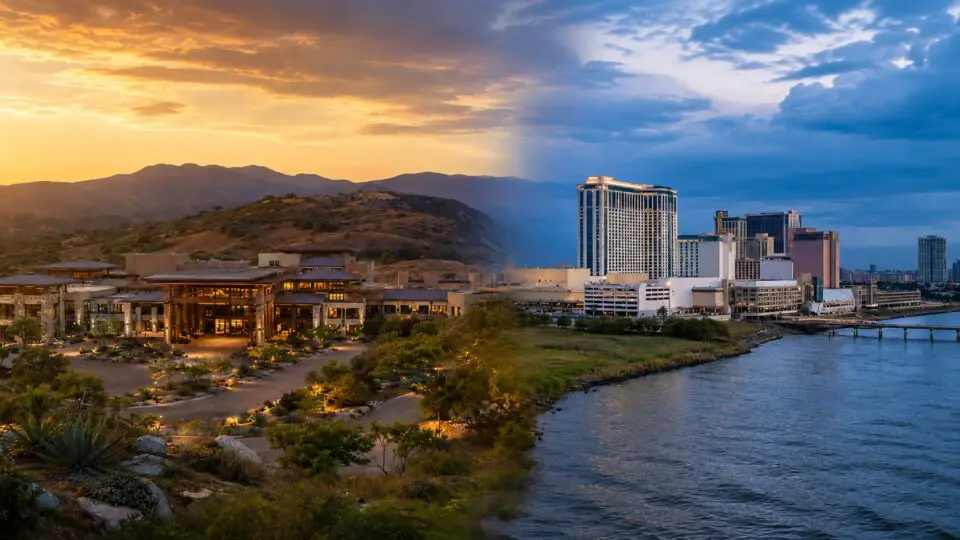
Drive inland from the coast and you pass through one of the densest concentrations of tribal gaming in the United States. Valley View, Harrah’s Rincon, Pala, Pauma, Barona, Viejas, Sycuan, Jamul. San Diego County has more tribal casinos than most states have casinos of any kind.
None of them are commercial. Not one is owned by a public company or licensed the way a Nevada or Mississippi property is. That distinction is written into the California constitution, and it produces a market that looks nothing like the one operating on the Gulf Coast.
Mississippi did the opposite thing at almost exactly the same time. It licensed commercial operators from 1990, let them compete, and built a Gulf Coast industry on it. Same federal law, same decade, two frameworks with almost nothing in common.
How the Mississippi side is structured, including which operators hold licences and how the commercial framework is organized, is documented at https://www.newgamenetwork.com/casinos/mississippi/. Read alongside California’s arrangement, the divergence is the useful part: one state licensed corporations, the other wrote exclusivity into its constitution.
How California Got Here
The structure dates to 2000, when voters approved Proposition 1A and amended the state constitution to grant federally recognized tribes the exclusive right to operate Class III gaming, meaning slot machines and house-banked table games.
Exclusive is the operative word. No commercial operator can hold that licence in California at any price. Card rooms exist and are legal, but they cannot bank games, which is a genuine structural limit rather than a technicality.
Two attempts to change the arrangement reached the ballot in 2022. Proposition 26 would have authorised sports betting at tribal casinos and racetracks. Proposition 27 would have authorised online sports betting through commercial operators. Both failed, in what became the most expensive initiative fight in California history.
So the position today: dozens of tribal casinos, no commercial casinos, and no legal sports betting of any kind. A resident of Encinitas can drive twenty minutes to a full casino floor and cannot legally place a wager on a football game anywhere in the state.
Mississippi Chose the Opposite
The Gulf Coast took a route California specifically foreclosed.
Mississippi authorized dockside gaming in 1990, licensing commercial operators to run casinos on water in counties that approved them locally. Biloxi and Gulfport built an industry on it through the 1990s, alongside a separate river corridor around Tunica serving the Memphis market.
The Mississippi Band of Choctaw Indians operates tribal facilities under federal law as well, so the state runs both models simultaneously. That combination is unusual and it is precisely what California’s constitution prevents.
The state also permits sports betting, legalized after the federal ban fell in 2018, though only in person at licensed casinos rather than through statewide mobile apps. Different restriction, different reasoning, same practical result of tying the activity to a physical location.
The Storm That Changed the Rules
The part of the Mississippi story with the most relevance to a coastal readership has nothing to do with gambling policy.
The original 1990 framework required casinos to be on water. That produced floating structures moored along the shoreline, which worked adequately until August 2005, when Hurricane Katrina destroyed them. Barges were pushed inland. Several ended up across highways.
The legislative response was to permit construction on land within a defined distance of the shoreline. What had been a floating industry became a built one, on elevated structures designed to different standards.
Twenty years on, that decision reshaped the Gulf Coast more than any zoning debate would have. Whether it was the right call is genuinely arguable, and both arguments are serious: the properties rebuilt stronger and stayed, or a coastline absorbed permanent large-scale development in a hazard zone because the alternative was losing the employment base.
For anyone following coastal development questions in North County, it is a worked example of how a single event can reset land use rules that had seemed settled for fifteen years.
What Each Model Actually Produces
Setting aside which is preferable, the two structures generate measurably different outcomes.
Revenue flows differently. Tribal gaming revenue goes to sovereign tribal governments, with a share to the state under compact terms. Commercial gaming revenue is taxed directly and flows to state and local budgets on a conventional basis.
Competition works differently. Commercial licensing creates competition between operators, which shows up in amenities, promotions and eventually consolidation. Exclusive arrangements produce fewer, larger properties with less pressure to differentiate.
Local control differs. Mississippi required county-level approval for dockside licensing, so the industry only exists where voters permitted it. California’s arrangement was decided statewide and applies uniformly.
Expansion works differently. Adding commercial capacity in Mississippi is a licensing question. Changing anything in California requires a constitutional amendment, which is why 2022 became a ballot fight rather than a legislative one.
Why It Matters Locally
The obvious question for a San Diego County reader is whether any of this changes.
Probably not soon. Tribal operators here have consistently opposed commercial entry and have both the constitutional position and the political resources to defend it. After the 2022 result, nothing comparable has reached the ballot, and the tribes have signaled that 2028 is the earliest realistic window for revisiting sports betting specifically.
Which leaves the county in an unusual position: substantial casino infrastructure, no commercial competition, and a neighboring state, Nevada, where the opposite model has run since 1931.
Three casino states within driving distance, three completely different legal architectures. The buildings look similar enough that most people assume the rules are too.