
VIVA SOPHIA
INTRODUCTION
This Chapter is about wisdom and how to acquire it, for the individual seeker as well as for society as a whole. Wisdom has to evolve and be nurtured in a personal quest of introspection and learning from life’s experiences. This aspect gives it a highly personal, subjective quality, difficult to define in objective terms. Our scientific learning and technological know-how are of limited help when it comes to making our lives more meaningful and peaceful.
A cursory review of human history provides ample proof for this. We cannot point to a single instant in time when humans all over this planet were at peace with each other and with nature. Scientific and technological advances have been utilized routinely to conquer, to exploit, and to kill. Terrestrial societies have failed miserably in their efforts of governing themselves and providing more meaningful living conditions that promote health, peace, joy, and tranquility for everyone. The competitive streak in Earth humans and their predisposition for violence and physical gratification do not provide much hope for a utopian future. Only when the common level of perception can be raised significantly above the present stratum, so that poverty of consciousness can be overcome and wisdom allowed to rule, can Earth humanity be saved from itself.
Large sections of our population place their hopes for humanity’s salvation upon divine intervention, expecting a god or king of wisdom to descend from the heavens and establish a wisdom society that will banish all evil intent. My firm belief is that human society must take independent responsibility on its own behalf for saving itself, or otherwise face self-extinction. More highly evolved life forms in the cosmos have a moral obligation not to interfere with the evolution of emerging intelligent societies. They would also recognize that a collection of learned fools with deficient consciousness cannot govern themselves benevolently. Conversely, fools cannot be governed benevolently by even the wisest entity, except by domination and subjugation. Such a totalitarian reign would be highly distasteful for any spiritually advanced god-like being.
Earth humans must therefore strive to establish their own wisdom society. This is an arduous task. Because of wisdom’s subjective and spiritual nature, it cannot be taught in schools or be transferred by biogenetic transfusions. Collective group wisdom cannot logically exist, only a group containing a few enlightened individuals. The combined average wisdom in a group will always be less than the individual wisdom of its most enlightened sage. Yet this may be sufficient, if all members of society can put their arrogance aside by respecting wisdom and by letting the wisest and most qualified rule. Thoughts on how we may achieve this are discussed later in this Chapter, which treats the road to wisdom as a process of learning from life and thereby raising our spiritual consciousness.
Knowledge is not the same as wisdom. It is not even close. Knowledge may be power, but wisdom makes life meaningful. Highly knowledgeable people are often not the ones most deserving of reverence for their wisdom. Rather frequently, the opposite seems to be true. The 19th century German philosopher, Friedrich Nietzsche [1844-1900], said it this way:
Empirical knowledge has the same relationship to wisdom as righteousness has to holiness: It is cold and dry; it is loveless and knows no deep feelings of humbleness or desire.
Unlike knowledge, wisdom cannot generally be found in academic institutions or theological seminaries, nor is it a prerequisite for rising to high positions in politics, industry, religion, or the military. Being clever, competitive, scheming, deceiving, and kowtowing may get an ambitious person elected to political office, or promoted to an influential position in business, but it does not make that person a respected leader who is able to enrich the lives of those who follow. The application and appreciation of wisdom require a high state of consciousness that must be cultivated in the individual and must be valued by society at large. A wise person leads by example, and wise followers recognize wise conduct in the leader.
Sages have long recognized the intangible aspects of wisdom throughout human history. They have also expressed their frustration, felt when trying to explain the attributes of wisdom in readily understandable terms. Friedrich von Schiller [1759- 1805] wrote:

They would need to be already wise in order to appreciate wisdom.
When a person makes a conscious decision to seek wisdom, he/she is passing a critical milestone on the path of spiritual evolution. Friedrich Nietzsche passed that milestone in 1878, when he confided so in a letter to his friend, Mathilde Maier:
I am immeasurably nearer the Greeks than before. Now in every way I live striving for wisdom, whereas before I only idolized wise men.
Such a realization is a necessary step in every person’s destiny. Striving for wisdom is hard work; being committed to seeking it means taking responsibility for one’s life. It means accepting responsibility for living in harmony with others, with society, and with nature. It means embracing the responsibility that comes with every newly found personal freedom. It means learning from one’s mistakes and making suitable corrections in one’s attitude, in one’s philosophical outlook and conduct of life. The Danish scientist/poet, Piet Hein [1905-1996] summarized it in a down-to-earth way:
The road to wisdom? – Well,
It’s plain and simple to express: Err and err and err again,
But less and less and less.
In this Chapter, the human struggle to build a stable civilization is viewed from a higher perspective; including Earth human’s cosmic connections. Prehistoric origins of human culture, shrouded in myths, legends, and folklore, are presumed to have a basis in truth, even though civilizations may have been periodically destroyed and rebuilt.
Presently, our corrupted national, social, and religious structures are slowly being recognized as the root causes of conflict, confusion, disharmony, and death in our world. We live in an era of transition. Now, as never before in recorded history, human societies are again faced with an urgent need for awakening and transforming their ways. Rapid advances in science and technology have brought people of Earth into more intimate communication and physical contact, exposing them to cultural conflicts. These conflicts induced by religious and ethnic differences and misconceptions, as well as by narrow national interests, are becoming ever more critical.
Our current civilization stands before the prospect of total collapse, or alternatively at the crossroads of opportunity for raising human culture into a new era of understanding and peace. The alternatives depend on how quickly we can evolve into a higher human consciousness, which would place spiritual victory above material conquest. Only by transcending to an exalted spiritual level can we hope to prevent global nuclear holocaust and reverse the destruction of Earth’s ecology that supports us. New visions are needed to usher in an era of understanding and wisdom that will permit human society to transcend her self- serving national interests and initiate a transition from vainglorious competition to constructive cooperation.
Indeed, as the old social and religious orders are increasingly recognized as being inadequate in this post-modern world, and as the old structures are being dissolved in this new millennium, a new awareness is dawning, an awareness that humanity is not only rooted in planet Earth, but is mysteriously anchored to the entire universe, biologically and spiritually. Vaclav Havel, dramatist and former President of the Czech Republic, made a plea for transcendence two decades ago:
In today’s multi-cultural world, the truly reliable path to peaceful coexistence and creative cooperation must be rooted in self-transcendence: – Transcendence as a hand reaching out to those close to us, to foreigners, to the human community, to all living creatures, to nature, to the universe; – transcendence as the only real alternative to extinction.
Transcendence by and of society, initiated by self-transcendence of avant guard individuals, is only possible when some of our cherished, but stale beliefs and convictions are discarded. Everyone can help bring about a new dawn, but one must be open to new concepts and be ready to replace old beliefs. Be aware in this connection that many ideas expressed in this book are heretical and dangerous to an average person’s complacent lifestyle. Certain new ideas and visions will be violently resisted, but will become self-evident when viewed from a higher perspective. The human potential for creative transcendence is virtually unlimited. The time to wake up to new visions and to make quantum leaps in understanding is overdue.
A CRISIS OF PERCEPTION
On his way home from the field, a farmer passes an old monastery garden and sees a group of monks huddled together and displaying solemn faces. “What is it you are doing?” he asks. We are praying for a good harvest in our orchard, they replied. You can pray all you want, says the farmer; but I can tell you, what this garden needs is a good load of horse manure.
Are we facing a similar problem in regard to our evasive world peace? We can pray and hope all we want, if we are not willing to investigate the root causes of our problems, conflicts, destitution, and violence. To discover what needs to be improved, we must first look at ourselves and on how we treat others and the environment. Do we harbor something in our inner nature, in our upbringing, in our culture that is in disharmony with the will and destiny of Creation? Is our evolutional level of consciousness lacking? Why are we the most immoral predator on Earth, destroying ourselves and the ecosystem that supports us? Or are we ourselves, as a destructive and disruptive element, destined to destroy the old world order, including ourselves, as a prelude to a new era of understanding, concord, and peace? If all of us truly wanted concord and peace, they would manifest instantly.
We need to ask the painful question: Are our sciences, our organized religions, our politics, our education, and our culture capable of saving us from ourselves? Looking back at our dismal historical performance, the answer can only be a resounding no. We need a good load of remedial horse manure to stimulate our spiritual development and raise our level of consciousness. This can only be accomplished through personal effort with the goal of becoming wiser human beings.
Those among us who are more enlightened must teach those who are still groping their way through the darkness. Wiser individuals must come out of seclusion, group together, and act as nuclei for inspiration. Then we might, little by little, raise the consciousness level of entire communities. Eventually, when the movement has reached a critical mass, as in the story of the hundredth monkey, a shift in perception and understanding will put Earth’s human society on a new course. But it must begin inside each one of our most sapient men and women, as an act of will directed toward broadening our perspective and perception. The wisest among us must become servants to all, serving the lowest, the unwise, the ignorant, and the foolish.
Throughout history, only a handful of wise humans could be found at any given time to provide guidance for thousands of people. And quite often even those were ignored, neglected, ridiculed, and opposed. That small ratio of wise men and women among common masses has never changed much over millennia of cultural and technological evolution on Earth. Thus, we have neither seen any progress in prudent coexistence among humankind at large, nor in the average quality of life of individuals. Nations arose, based on what seemed to be lofty
principles; such as personal freedom, human rights, equality, justice, family values, the common good, peace, and civility. However, these principles were soon corrupted through personal greed and envy; through ethnic and racial differences, and through lust for power, fame, and control. While this deterioration occurred among the general population, it also took place more devastatingly among the elite ranks of the ruling class. Thus, great empires lasted only for a few centuries before sinking into obscurity.
General causes of social decline are the primal sins of ignorance and poverty of consciousness. These deficiencies are portents of dearth of wisdom, scarcity of unconditional love, and neglect of logic; which in turn have further consequences in creating all our social ills. Noteworthy among those are: Lust for power, control, and exploitation; domineering, oppression, and tyranny; greed, envy, possessiveness, and selfishness; rudeness, hate, violence, revenge, and war; dishonesty, deception, and injustice; murder and destruction. The end stages on the road of degeneration of once successful nations is accelerated by an accumulation of unsavory psychopaths in their political establishments, and by the lack of wisdom in populations that have handed over their power to corrupt and perverted systems. Sadly, Western victors emerging from the most evil warfare in recorded history (WWII) are now themselves degenerating into darkest depravity by using technological superiority in the service of global exploitation, eternal warfare, enslavement, deception, injustice, destruction, mass murder, and cowardly assassinations with remotely controlled drones. Indeed, all life on this planet is in peril. We are living in a reality, where greed is god; where lies, illusions, and deceptions are truth; where wisdom is shunned; where cleverness of the physical mind is praised, but intelligence of the heart is despised.
Human existence on Earth is threatened, because humanity’s group mentality has not fully understood that destroying Earth’s biosphere will not only destroy our bodies but also our spiritual home. Whereas we would survive as spirits with our individual spiritual consciousness intact, we would lose our possibility to reincarnate on this world for thousands, if not millions of years, while putting our spiritual evolution on hold.
Man did not weave the web of life. He is only a strand in it.
What he does to the web, He does to himself.
Suquamish Chief Seattle
WISDOM AS THE HIGHEST FORM OF INTELLIGENCE
Just what is wisdom? How is it different from knowledge? When discussing the subject of wisdom with friends and acquaintances, I have always been amazed with their first reaction: Aren’t knowledge and wisdom the same? In truth, an immense chasm exits between the two, and it cannot be bridged unless one is already wise. Whereas a wise person may also be very knowledgeable, we cannot assume that all knowledgeable and learned people should also be wise. Quite often the contrary is true. The same process of learning that makes humans knowledgeable cannot simply be extended to make them wise.
Wisdom is not a higher form of knowledge. Wisdom must ripen slowly in the spiritual consciousness of an individual through conscious analysis of personal experiences, whereas loveless knowledge just fills the physical mind. Wisdom is the art of utilizing knowledge for the benefit of personal growth; for making life more meaningful, pleasant, rewarding, and beautiful; for promoting peace and good will; for becoming more aware, while gaining an understanding about one’s proper relationship with other beings, with the Spirit of Creation and Its natural laws.
Wisdom cannot be taught in school. If it could, our world would be a better place. A good teacher can however plant the seeds of wisdom in a person’s mind, opening it up to an inner desire for spiritual growth in consciousness. Although wisdom can be enhanced by knowledge, it must be carefully nurtured in each individual. Wisdom conquers fear by lighting up the darkness in a person’s heart and mind. Wisdom is spiritual light.
Wisdom aspires to perfection. Wise men and women follow only those of higher wisdom by observing their wise actions and words. Wisdom also practices the power of distinction, thus recognizing the paths that lead to enlightenment and perfection, while avoiding those that lead to pain and suffering, to damnation and destruction. The wise must illuminate the path for others, guiding those who dwell in spiritual darkness.
Wisdom cannot exist in isolation. Love, logic, and wisdom have to work together to become a beneficial creative force. All wisdom relates to life in one way or another. The wiser we get, the more we regard and honor the living Omniverse as divine. Wisdom is nurtured by positive insights and loving energies. Be open to receive them. Be receptive to the gifts of Creation.
No direct path leads from knowledge to wisdom. Knowledge is fertilized by objective truth of what exists. Wisdom is nurtured by subjective experience in life. To understand how intelligence, truth, and knowledge differ from wisdom, it helps to investigate their intrinsic aspects.
INTELLIGENCE
Intelligence brings knowledge and wisdom together. The Universal Intelligence in and of the Creational Realm, often referred to as the Mind of God, is personified in the Spirit of Creation. Intelligence in individual life forms is an innate ability, a prerequisite mental/spiritual potential for learning from experience, for acquiring, absorbing, and accumulating knowledge. Intelligence does so by extracting useful insights from life’s experiences. It intuitively knows right from wrong. It knows how to separate the wheat from the chaff, the truth from the falsehoods. Through intelligent evaluation of true insights a person’s wisdom level becomes enriched. Whereas a person can enrich his/her wisdom, the power of that person’s intelligence will increase only slightly during a single life time. An individual is generally born with a high or low Intelligence Quotient (IQ) and cannot significantly change it during a single life time.
Intelligence is part spiritual and part physical. The spiritual part expresses itself in wisdom, which is accumulated over many life times. Wisdom becomes a permanent virtue of an evolving spirit entity and is only diminished through neglect. The material part is retained in the physical mind as knowledge. That knowledge is mostly lost when a person dies. However, it can be retrieved from separate records in the Akasha Chronicles in dissimilar ways. Knowledge related to previous life times of an evolving spirit entity is always available and can be accessed directly by a reincarnating spirit because such vital historical knowledge is the personal Akasha memory bank of that individual spirit.
The situation is quite different when it comes to knowledge, wisdom, and abilities that the incarnating spirit may inherit from maternal and paternal family lines represented in the embryonic life form merging with the spirit. Certain amounts of such intelligence passed down from biological progenitors is encoded in the DNA and can be absorbed directly into the physical subconscious of the new life form, where they remain as potential abilities until actualized later in life. Other knowledge from biological antecedents, not encoded in the DNA, can be retrieved from their Akasha Chronicles by the incarnating spirit,
using embedded codes in the DNA as a key to gain access to such knowledge. In this way, the incarnating spirit, who is in total control at the time, can reawaken inherited knowledge, wisdom, tendencies, and abilities passed down from the maternal and paternal blood lines immediately at birth. To the incarnating spirit, knowledge retrieved from biological progenitors may clash with the intended mission in life of the spirit. Unwelcome knowledge and tendencies can be blocked from entering the spiritual consciousness and/or the physical awareness by filters between the corresponding subconscious levels and their conscious counterparts. In order to avoid any such conflicts, spirit entities often reincarnate within their previous genetic family lines.
LIMITATIONS OF KNOWLEDGE
Let us examine how knowledge is generated in a logical manner. To see this most clearly let us consider the process leading to scientific knowledge, the methodical path taken by the scientific method. The sequence in this progression is from
- DATA to INFORMATION, then
- INFORMATION to KNOWLEDGE, then
- KNOWLEDGE to MENTAL
The first two steps are purely objective and methodical. They can be performed by computer processing of data and information.
In Step (1), Data derived from experiment, observation, or from archival information are organized and sorted into related groups. An individual datum is usually without meaning. It can simply be a number or attribute. For non-scientific data, this step is referred to as connecting the dots. Once a pattern emerges, it is considered Information. The process is analogous to building a meaningful statement from individual words.
Information can be protected, stored, kept secret, bought, sold, and transferred.
In Step (2) bits of Information are analyzed and integrated into a coherent concept that shows a relationship to other information and/or to an already existing body of knowledge. This step is what may be called building upon a recognized pattern after the dots have been connected. But for the informational pattern to become practical knowledge, it must also be true. We recall that truth is absolute and eternal. Truth does not change with time, with any New Age, or new philosophy.
For knowledge to be of value, it not only has to be true forever, it must also be meaningful. Take for example a historical statement like: Napoleon invaded Russia in the summer of 1812 and withdrew from Moscow by the end of that year. This is just useless information with no lasting value. However, when there is a lesson to be learned, such a lesson becomes useful knowledge. Consider for instance: Napoleon’s incursion into the far-flung expanses of Russia, with the intent of conquering and subduing the Russian population, was doomed from the beginning because of logistical problems. This sentence conveys valuable knowledge that is true in general. Sadly, Russia had not retained this knowledge when it tried to occupy Afghanistan in the 1980s. Neither had the USA when occupying Vietnam in the 1960s, and now with her extended presence in Iraq and Afghanistan.
In everyday conduct of life no sharp separation of knowledge from information is apparent. The boundary is often blurred. In the context of this book, information becomes knowledge only, if it conforms to all of the following:
Knowledge has a close association with the rational (physical) part of the human mind, where the keys to that knowledge can be stored for long-term recall on demand.
Knowledge can be acquired through personal observation and experience; or it can be learned from teachers and from archival sources of written text and images.
Knowledge can also be generated by rational thought processes and analysis of previously known information and knowledge.
Knowledge, as we define it, has an objective existence of its own, whether it resides as written words on paper or as memory in someone’s mind.
Useful knowledge must be based on truth and must be verifiable. It must be harmoniously consistent with what is. Authoritative Knowledge and Asserted Knowledge may or may not have any relation to truth. Only true knowledge can withstand the tests of verification throughout all time. So-called facts are not true knowledge, unless they can be validated under all possible
circumstances. If today’s facts are different from last year’s facts, both are suspect and have to be treated as mere assertions. This should be central to all subjects taught in school, to our sciences, to our historical records, to our economy, to our politics, and to our value system. It should also be fundamental to any religious or spiritual belief system.
The flippant saying, don’t bother me with facts, my mind is made up, is doubly humorous and tragic: (1) because the facts may not be consistent with eternal truth; and (2) because a person whose mind is made up is exhibiting an utmost arrogance by his/her unwillingness to test those facts.
Knowledge consists of relationships. The purest forms of knowledge can be expressed in logical (mathematical) relationships, such as F = ma, which is Newton’s 2nd Law of Motion, relating force, mass, and acceleration. Another example is E = mc2, which is Einstein’s mass-energy relationship.
Unverified knowledge is speculation. Yet even speculative knowledge should be considered and subjected to verification. If it can be proven true, then it becomes true knowledge. If it stays unverified, it is not of much use. If it can be proven false, then it must be discarded. If a scientific theory is falsified, it must be dropped or amended. Amendments must be based on true verifiable knowledge and must not be based on more speculation. Arguments used in verifying a theory must not be based on the same unverified postulates on which the theory rests. Circular arguments may seem logical, but they are deliberate, or at best, unintended deceptions. This applies also to amendments that seek to rectify a falsified theory. Certain modern and postmodern theories, such as the Special Theory of Relativity, the Big Bang Theory, and String Theory are being upheld by illogical circular reasoning.
In Step (3), the process of gaining a Mental Understanding means analyzing bits of knowledge and letting them simmer in our physical awareness and subconscious. This often leads to an aha-moment, when the proverbial light bulb goes off in our mind. Suddenly, certain relationships between bits of knowledge start to make sense. Such moments may be triggered by an unexpected perception, by an impressive event, or by just finding the missing piece to a puzzle.
Mental understanding provides a new clarity, which opens up a wider picture of how certain bits of knowledge fit in with related concepts and ideas. Insights gained illuminate the correct interconnections between happenings, processes, and ideas.
Misconceptions become evident and can be eliminated from our subjective knowledge base, allowing us to refine our worldview.
Mental understanding transmutes objective knowledge into subjective recognition, enriching our physical awareness. Understanding exists only in our mind and not in the objective world. It becomes a valuable asset that guides our conduct of life and our thoughts. It improves our power for making responsible choices and decisions.
In this age of high technology and rapid scientific progress, most people on Earth know a lot but understand little. The consequences of a lack of understanding lead to overpopulation and to a precipitous decline in educational, cultural, social, and ethical values; culminating in political corruption, war, and destruction.
THE TREE OF KNOWLEDGE
Parables of Adam and Eve in the Garden of Eden, and of associated allegories of Paradise Lost, do not only show up in the Hebrew/Christian religious traditions. They are also a theme in many other ancient epics. In the Biblical story of Adam and Eve, early humans were given a choice between:
- Living innocently in harmony with nature in a protected environment, or
- Becoming more powerful and independent by acquiring knowledge, but risking loss of the loving connections with nature (paradise).
In the allegory, the Garden of Eden had a Tree of Knowledge and a Tree of Life. For their own protection, Adam and Eve were forbidden to eat from the Tree of Knowledge. As we all know, and as the story goes, the lure of power and freedom was irresistible to them. Giving in to temptation of acquiring material power, they ate of the forbidden fruits and lost their paradisiacal lifestyle. With unaccustomed knowledge gained, they became aware, albeit somewhat too late, that enjoyment of freedom is associated with having to take responsibility for the conduct of one’s life. The latter requires a certain amount of wisdom, which was lacking, because Adam and Eve had not yet been given the personal experiences needed to develop wisdom.
The Garden did not have a Tree of Wisdom. The lack of such a tree speaks itself for the wisdom of the gods. Wisdom cannot be instilled in a human. It must be gained through personal experiences in living, often through a laborious process of learning from mistakes.
Knowing that Adam and Eve were not ready to acquire wisdom, the gods reserved wisdom for themselves. The power and the glory of sky gods lie in their wisdom. They have been referred to as Kings of Wisdom in ancient texts. But they warned Earth mortals that knowledge can become a danger to themselves and others. In wrong hands, knowledge unrestrained by wisdom can be abused to control, subjugate, and kill others, along with destroying the ecosphere; a most objectionable sin against Creation and against nature.
Knowledge without wisdom is dangerous.
Wisdom without knowledge is lame.
Western society has chosen the quest for subjugating nature out of greed for power and material wealth, – and has lost paradise. No angel with a sword drove Western denizens out of paradise. It has been a deliberate choice of Western men and women. In our overpopulated, highly industrialized, biosphere-destroying, nuclear civilization, we have summoned the genie out of the bottle. We now have no way of constraining it without transcendence into a higher level of wisdom.
Science and technology are not bad or evil, but growth in knowledge has to go hand in hand with growth in understanding and wisdom, so that power gained through knowledge can wisely be applied for making Earth a better place;– a return to paradise. Acquiring knowledge and banishing ignorance must go together with raising our level of consciousness. The latter is the more important process. Knowledge is like a load of building materials. Wisdom inherently knows how to assemble them into functional configurations that benefit life and foster harmony.
Certain primitive indigenous tribes of Australia and South America have made a conscious choice to forgo technological means of wielding power; not because they were ignorant, but because they chose to live in harmony with nature. They resisted the lure of controlling nature with mechanical machines. For example, the historical Maya and Inca people chose not to use the wheel for transportation, even though they were familiar with its mechanical advantages. We know this because small toy carts with wheels were found at their ancient sites by archaeologists.
TRANSCENDENCE TO WISDOM
No direct road and no linear process from knowledge to wisdom exist. We have shown what it takes for information to become knowledge and mental understanding. From that level of understanding to wisdom, we need to outstrip the knowledge train altogether, because wisdom is something entirely different, no matter how advanced our knowledge is. Most importantly, our mental understanding must become second nature to our way of thinking and acting. Rational understanding in our physical awareness must ripen and produce fruits in our spiritual consciousness. Then our mental understanding of knowledge begins to mature into spiritual understanding, thus becoming an intuitive resource in our spiritual consciousness. Intuitive comprehension of newly acquired knowledge and its connections to life are essential for making a person wiser.
The light of wisdom emanates from spiritual understanding.
In summary, wisdom is entirely subjective, whereas knowledge is impersonally objective. Knowledge can be learned, compiled, stored, distributed, taught, written down, transferred, sold, and patented. Wisdom is not amenable to any of these processes. Wisdom recognizes meaning, purpose, harmonious relationships, good judgment, beauty, joy, and love. Words of wisdom can be written down and passed on. But at that point the words of wisdom are just knowledge hinting at mental understanding. Wisdom includes the personal ability to apply these words of wisdom daily in the process of living, as we exercise our freedom of will by prudently choosing better alternatives. This ability is itself evolving, as our spiritual consciousness is awakening toward an inner sense of integrity, fearlessness, love, compassion, and truth.
FAITH
At this point it is instructive to discuss the role of faith and religion on our path to higher wisdom. Religious faith is rooted in unverified, authoritative knowledge, as in religious dogma. Faith has its good sides in personal development, but must eventually give way to hardened truth. Faith is often based on hope that a desirable action or result may occur against better knowledge of realistic probabilities; or that mind power will affect reality favorably in producing and fulfilling certain miraculous expectations. Mind power is real and faith relying on it is justified, provided we use it prudently. The variable element is Earth human’s independent free will, which defines our freedom, but makes future predictions uncertain. Every time free will is exercised the future changes. We should keep that thought in mind and marvel at our personal power, a creative power that can destroy as well as enhance. It is our responsibility to think, speak, and act wisely!
Faith is often defined as unquestioned belief. But belief is not knowledge. So, is knowledge stronger than faith? – Yes and no. Reliance on untested knowledge is no better than faith in unquestioned belief. It can be altogether treacherous. But reliance on proven knowledge and truth surpasses blind faith anytime. If we can heal through unquestioned belief, how many more miracles could we perform for the utmost good of humankind, if we acted out of certainty and truth?
Faith, like other commonly used concepts, may need to be separated into distinct categories, depending on what they rely on, and how they are applied. We can qualify our notions of faith by dividing them into at least four categories. Wisdom helps us decide whether a certain act of faith is foolish or prudently justified. Prudent faith relies on our proven ability for obtaining intuitive and reliable knowledge from higher sources, often experienced as coming from within. Blind faith is foolish. It has been said that having faith, hope and charity is the way to live successfully. This saying has truth in it, as it relies on the power of positive thought. But hope refers to future events and is uncertain, whereas successful faith must be built on wisdom.
PRUDENT FAITH (P) VERSUS FOOLISH FAITH (F):
- Religious Faith (F) is based on assertive beliefs relating to dogmas of organized religions
- Spiritual Faith (P) relies on the intimate bond of personal spirit power with the omnipotent power of Creation
- Personal Faith or Confidence (P) relies upon the power of one’s own mind and spirit, including one’s power of distinction. Remember that truth is impersonal and immutable, that wisdom is personal, and that faith is variable.
- Social Faith (F or P) is faith in the good will of other people. Whether this is foolish or prudent depends on our wise evaluation of implicate characters.
UNREWARDING PATHWAYS
As mentioned earlier, the pathway to wisdom is different from physical efforts leading to advanced knowledge. Gaining wisdom requires taking a spiritual path. Milestones along that path are measured in terms of abstract values like love, intuition, logic, harmony, ethics, virtue, compassion, and the like. This difference is not being properly recognized in this technological information-processing age. We live in an era, in which electronics, photonics, high-speed information transfer, ether net communications, and digital computer technology are at the forefront of what is mistakenly viewed as progress in intelligence and as a benefit toward raising mankind’s civilized lifestyle. In reality this progress in high technology is detrimental to cultural values.
It is being abused to satisfy and exploit the uncultivated, and often sordid, desires of a corrupted power structure. It is being abused by profiteers to promote consumer products that most people don’t need. It is being abused by dictatorial and oligarchic government agencies to dumb down, desensitize, and enslave the working class. It is being abused by the military-industrial complex to build spy-satellites, assassination drones, and high- technology killing machines for use in undeclared wars. It is being abused by corrupt governments for spreading propaganda, lies, and deceptions via state-controlled media networks. It is being abused by the entertainment industry to dump savory visual and verbal garbage, designed for low-class couch potatoes, into our living rooms via commercial television programs. The promotion industry and spectator-sports industry have become most lucrative sectors of the economy. Health care has become illness care, because it is more profitable to keep people sick. Music and art classes are being removed from public school curricula. All these abuses and more have been made possible by our high level of technological knowledge and by a severe scarcity of wisdom. Imagine what a wonderful world we could have if we used our knowledge wisely.
Instead, this imbalance of knowledge versus wisdom has greatly and negatively affected the cultural, moral, educational, spiritual, and ecological levels in our post-modern society. People are spending an inordinate amount of time watching empty-headed soap operas, spectator sports, and worthless promotions on TV. Youngsters watch violent and demonic motion pictures. In their spare time they play violent and gory video games. The average family is seeking fun and entertainment, instead of enjoying cultural and educational activities. Baby-boomers and the younger generations are staring at their cell phones and smart phones, talking and texting instead of enjoying the scenery around them, enjoying quality time with each other, or being engaged in creative activities.
The importance of wisdom’s role in healing this world’s ills has been well recognized by at least a select group of concerned academics and pedagogues. Among various proposed ideas for generating more wisdom is the concept of knowledge integration, a process in which experts from many fields of science, philosophy, and spirituality come together and, through their collective brainstorming, arrive at methods conducive to fostering wisdom. Most of these so-called Think Tanks have failed to come up with any workable procedure for increasing wisdom. Their goals of using knowledge integration for finding methods applicable toward deep learning and teaching wisdom, in the pursuit of wisdom in educational facilities, are by themselves wildly unrealistic.
This is not surprising, because only similar items, concepts, or processes can be integrated. Knowledge and wisdom are different in kind and unrelated. They have nothing in common, even though both can enrich our intelligence. We already mentioned that knowledge is objective and that wisdom is strictly subjective and personal. Knowledge is highly focused, whereas wisdom is holistic in nature. Knowledge stays in the physical awareness of our mind, whereas wisdom becomes part of our inner spiritual being. Knowing recognizes truth, wisdom lives it. Knowledge can be abused, wisdom cannot. Knowledge can be taught, wisdom has to grow in our spiritual consciousness. Wisdom cannot be pursued; just like happiness cannot be pursued, contrary to claims made in the US Declaration of Independence. Wisdom and happiness have to be cultivated and generated from within a person.
A significant factor involved in creating the severe imbalance between knowledge and wisdom must be attributed to the rapid development of digital computer technology over the last few decades. It has radically changed industry and personal life styles, and it is searching for ever new ways of bringing automated computer control into all areas of human activity. One such aspiration is the creation of robotic mechanisms with highly advanced computing and decision making abilities.
Ideally, such robots would have artificial intelligence. Apart from whatever level of artificial intelligence could be achieved, any robotic machines could at best rival only the physical awareness of living beings. They could never attain spiritual consciousness, and hence no wisdom. They could only simulate rational thinking, but not intuitive impulses. Wisdom cannot be digitized, added, and multiplied. Without being spiritually conscious, machines cannot express emotions, such as love, fear, sadness, or joy.
COLLECTIVE WISDOM
Wisdom grows out of spiritual understanding, and there is no direct route from knowledge to wisdom. Insights, intuition, and imagination are the primary components that lead to better understanding. They evolve only in the individual spirit-mind complex. The latter is spiritually connected to a higher resource, which has been identified under various names, such as Collective Unconscious (Carl Jung), Morphogenetic Fields (Rupert Sheldrake), Noosphere (Teilhard de Chardin), Gaia Consciousness (James Lovelock), or Akasha Chronicles (Vedic Philosophy). Help is available from these higher wisdom sources of the Superconscious to guide us via synchronisms toward new insights and understanding. Like those series of lights along landing strips that guide an airliner arriving at an airport:
Thousands of lights will guide humans along their paths, provided they observe and follow them. [TJ32:31]
The wise person sees all things in the light of direct intuition.
Because wisdom lives in the individual person, group wisdom does not exist in the physical realm. The combined level of wisdom in a group is always less than that of the wisest member. Intuition and wisdom cannot be modeled within a material framework, such as a computer. Wisdom cannot be averaged, as though it were a physical quantity, because it is an unbounded, absolute quality instead of a quantity.
Knowledge integration in Think Tanks cannot lead to more wisdom. Decisions made in group processes are always questionable, because truth about anything cannot be determined by popular vote or by consensus. Truth is independently true; otherwise it is only an opinion. Any consensus reached by a group or committee is by necessity a compromise, and is at best neutral and ineffective. It is better than the worst opinion, but is always worse than the most enlightened opinion of the wisest member of the group. As a saying goes: A horse designed by a committee turns into a dysfunctional camel. Thus it is best to let only the wisest person make decisions that affect a larger group.
TOWARD A WISDOM SOCIETY
The above arguments speak against democracy and for meritocratic sophocracy, in which only the wisest should rule. Ideally, we want government by the wisest people in our system. The challenge then lies in how we identify the best qualified and wisest persons, and how we endow them with power to rule. Prospective rulers, whether selected or elected, must adhere to the highest moral principles for assuring that they do not fall prey to corruption and let their authority degenerate into a tyrannical, elitist cabal. Whereas a so-called Wisdom Society should be a collection of the wisest human beings, we must also recognize that the whole is not necessarily greater than the sum of its parts. It will easily be diluted by those who are less evolved than the wisest.
Ideas of a wisdom society are not new. Many concepts endorsed here were already foreshadowed in Plato’s Republic [380 BCE], specifically by his commendations for a society where philosophers are kings and where kings are philosophers.
Before we can suggest a workable model for a wisdom society, it makes sense to review social systems that have not worked well. History has shown that Monarchies could be benevolent or tyrannical, depending on the ambitions and morality of the ruler. Often the most celebrated monarchs were empire builders who established themselves through influence and physical force, through brutal warfare and subjugation of the conquered. Power was taken, never earned or bestowed. Hence royalty had no associated connection with wisdom. Monarchs stayed in power by dominating the populace and by demanding loyalty from those under their yokes:
Loyalty unquestioned is the servant’s lot, a virtue grown eons ago by tyrants, kings, and jealous gods to feed their greed and fame.
Soldiers, loyal underlings were crucial to a ruler’s quest for power and control. To cries of war fools raged, beguiled, deluded and deranged.
They fought for god, for country right or wrong, for honor, liberty, and peace. They gave their lives but saved the flag – enslavement won.
Most monarchies deteriorated through inbreeding and lust for domination and control, leading to tyranny and corruption. Their dominions were eventually conquered by stronger tyrants, or were fragmented by internal dissension.
More recently, various forms of statehood evolved, in which power was in principle shared with the citizenry. In short time, their governing bodies became influenced by special interests and deteriorated into self-serving bureaucracies, usurping power and control away from their citizens. Though many political systems were tried, like socialism, communism, nationalism, capitalism, fascism, democracies, and republics, all of them degenerated back into new forms of master versus slave relationships between ruling elites and the ruled. Enslavement, moral decay, deception, and endless wars against their neighbors are typical signs for the decline of once powerful nations.
None of the political systems mentioned are all bad. Some of these ideologies have beneficial aspects, as long as they are applied wisely and in moderation. For example, social services are needed in any functional society. Nationalism, however, can lead to snobbishness, dictatorship, and global isolation. In severe forms it can progress into megalomania, ethnocentrism, supremacy, racism, conquest, and war.
Historically and presently, we are familiar with nationalistic regimes such as Napoleonic France (national, dictatorial, megalomania, and conquest), Third German Reich (national- socialist, dictatorial, megalomania, racism, war, and ethnocide), Post-modern USA (national-socialist, supremacy, and war), and Zionist Israel (national-socialist, religious intolerance, apartheid, war, and ethnocide).
Many nations proclaim to have a democratic system of government, as though this were an optimal and desirable regimen. Democracy, government by the people, is however a recipe for mediocrity by design. It suppresses, and even punishes, success, excellence, and perfection. It strives to make everyone and everything equal, to wash out creative differences.
- Originally fascism referred to strength through unity, exemplified by the fasces, a tightly bound bundle of sticks, the strength of which greatly exceeds the strength of separate sticks. The term fascism is now used in a derogatory sense, referring to any dictatorial
- Note that the political/national earmarks assigned here are not necessarily
what the corresponding national Constitutions of these countries proclaim.
- as in high taxation rates for successful people and businesses, and as in lack of recognition of the intelligentsia
Equality, like religion, is the opium of the masses. To rule at the lowest level of democracy is mob rule, dragging intelligence down to the lowest common denominator. Communist regimes (extreme forms of socialism) also tend to follow that path in their democratic versions. The cry for equality in mob-incited revolutions is counterproductive, making life in the surviving society worse.
Strive not for equality, but for unity tempered by honoring our differences. Viva la Difference!
A Capitalist Democracy, as in the USA, leads at best to free enterprise, at worst to economic exploitation, greed and corruption. A Socialist Democracy, as in post-WWII East- European countries, easily ends in an oligarchy with self- proclaimed leaders, who rule through hierarchical layers of unwieldy groups of bureaucratic officials. Their primary goals consist of exploiting the country’s resources and its unwilling slave labor.
Capitalist and Communist regimes must eventually fail, because they are based on negative human cravings of greed and envy, respectively. Greed or envy cannot harmoniously coexist with love, wisdom, and logic, and hence are not in alignment with Creation’s laws.
Widespread confusion about the true meanings of Republic versus Democracy appears to be common. Specifically in the US, citizens believe the two concepts are integrally related, because the US Constitution endorses both forms of government. A simple distinction is as follows: A Republic is ruled by law; a Democracy is ruled by majority. A Republic recognizes the inalienable rights of the individual. It is representative as in French and the Russian Revolutions government ruled by law (the Constitution). Rule by majority vote often deteriorates into mob rule. Right versus wrong, innocence versus guilt, cannot be determined by democratic vote. To do so is a recipe for injustice.
A Wisdom Society should probably not be called a Republic, because such a designation would refer to presently existing dysfunctional Republics operating under that name. Nonetheless, a wisdom society should be ruled by laws. But these laws should rest on the divine principles of wisdom, logic, and love. These laws should respect the dignity inherent in every spiritual being. These laws should respect the natural freedoms of the individual, provided these freedoms are consummated along with associated responsibilities. A responsible citizen observes the laws that ensure the wellbeing of neighbors, of society, of the ecology, and of the planet. Absolute and unbridled freedom cannot be tolerated, because it would result in uncontrollable chaos, which would conflict with the precepts of a wisdom society.
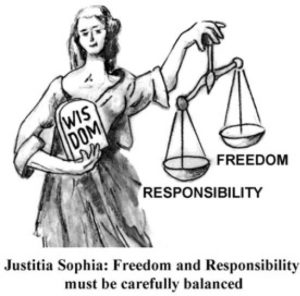
Personified pictures and statues of the principles of law and justice are familiar to us. We can find statues of a sober looking Lady of Justice in front of every court house and in front of legislative assembly halls. This lady, often adorned with a blindfold, holds a balance in one hand and a sword in the other; symbols of righteousness and punishment.
In analogy with religious idols of vengeful gods, who have to be feared and obeyed, people view justice with awe over the power of the State, over guilt versus innocence, over life and death. They view the symbol of the balance metaphorically as an instrument for determining an appropriate punishment for a suspect of a crime.

The scales are expected to weigh decisively one way or the other, proving guilt or innocence. If proven guilty, the sword will exact an eye for an eye, a tooth for a tooth, following the old Code of Hammurabi, endorsed by his vengeful god. See sketch of State administered justice.
Justice in a wisdom society should not be focused on punishment, but rather on rectifying a disorder and on making things whole and harmonious. Laws should be enacted and endorsed with the highest degree of wisdom and logic. Laws should aim at retaining judicious amounts of personal freedom, tempered and balanced only by responsibilities needed for the common good. See sketch of Justitia Sophia.
REFLECTIONS ON A WISDOM SOCIETY
The difficulties facing any effort for establishing a society ruled by wisdom revolves around the problem of quantifying abstract spiritual intelligence. To find the wisest persons, we need to know how to determine if one person is wiser than another. Most people have difficulties distinguishing knowledge from wisdom. Because wisdom is a spiritual virtue, it cannot be measured with physical means. So the questions remain unresolved: How do we find the most qualified and wisest humans for higher office? and How do we motivate wise humans to become leaders?
The process of resolving the first enigma has to be performed in two stages. An important recognition is that an effective leader should also be knowledgeable. He/she should have acute mental reasoning qualities and should have demonstrated practical problem-solving abilities, besides being spiritually wise. A second realization is that a person has to be already wise, in order to understand wisdom and recognize it in another person. The process is analogous to pulling ourselves up by our bootstraps. Before discussing the intricacies in each of the two stages, we need to define a workable governmental hierarchy.
We will assume a hierarchal structure of no more than four levels of government as follows:
|
District |
Max.
Population (in 1,000s) |
Intelligent Core Group (% of District) | No. of Representatives Sent To Higher Level (% of Core Group) |
| Local | 10 | 2% or (200 max.) | 2% or (4 max.) |
| Regional | 1,000 | 400 max. | 2% or (8 max.) |
| National | 100,000 | 800 max. | 2% or (16 max.) |
| Global | 10,000,000 | 1,600 max. | – |
Each successively higher District serves a population a hundred times larger. But the number of selected legislators relative to the population in a District decreases sharply as we go from lower to higher district levels. At the Local level it is 1 in 50; at the Regional level it is 1 in 2,500; at the National level it is 1 in 125,000 citizens. This kind of distribution may be similar to current republics. The difference lies in the way legislators are elected or selected. The most important part of the selection process occurs at the Local level. Size of a Local District is purposely kept small at 10,000 people, so that local concerns will get proper attention.
In each District at the Local, Regional, and National levels a carefully selected/elected Core Group of legislators are responsible for making, maintaining, and enforcing the laws needed to provide and protect optimal living conditions for the population in their District. Each Core Group would meet at regular intervals to debate issues relevant to their District level. It would provide solutions for resolving conflicts and would make plans for prudently developing and using human potentials and natural resources. Each Core Group in a District would consist of an appropriate number of delegates, who are specifically competent in one or more of approximately eight different fields of interest, represented by corresponding regulatory Departments. Typical Departmental objectives may be:
Dept. of Life: Food, water, and air; Farming, livestock, and fishing; Ecology; Natural resources and preserves.
Dept. of Culture: Education; Art; Communication.
Dept. of Social Needs: Welfare and health; Land management and housing; Wealth and finance.
Dept. of Spirituality: Wisdom and understanding; Ethics and morality; Spiritual organizations.
Dept. of Science and Technology: Exploration; Research; Energy; Technical devices, processes, and services.
Dept. of Industry and Trade: Industry; Free trade; Industrial resources; Transportation.
Dept. of Law and Justice: Legislation; Law enforcement (Police);
Dept. of Peace: Protection against disruptive forces, manmade or other (can have a presence at all District levels). With respect to Law and Justice, a separate legal system should be created as a balance to the political Departments at all levels. Courts of Law systems should also be based on wisdom and should prevail over the political Departments of Law and Justice.
How then do we select/elect up to 200 legislators representing the needs and concerns of the people in the Local sphere of influence. We had noted that this should be a two-stage process:
Stage 1: Identify the best qualified candidates, who excel in both knowledge and wisdom, out of the most basic level of a civilized population? To start, we need to have established prerequisites, to sift out the golden nuggets from the common sand. Assuming we have a well functioning and creditable educational system in place, we could demand that any prospective candidate should have at least one advanced university degree in one or more fields of interest, without being overly specialized. We could demand that this person be older than 35 years, have at least 10 years of practical experience in problem solving, and is well recognized as being most knowledgeable among his/her peer group. An appropriate test could be created that would certify the candidate’s abilities. Having applied all these prerequisites for office, we have eliminated about 95% of the general population. If we would do just this step in identifying the most qualified candidates, our present democratic republics would be able to run much smoother. But now we want to extract the wisest from among this small group of knowledgeable experts. This next step is most important for a potential Wisdom Society. How do we recognize wisdom?
Stage 2: Make a list of distinctive characteristics of wise persons:
They admit their mistakes, learn from them, and do not repeat them.
They know their strengths and limitations. They are neither arrogant nor meek.
They use their knowledge and perceptions to make prudent decisions.
They instinctively find the best path toward solving a problem.
They have loving relationships with relatives and friends.
They honor spiritual values, such as love, compassion, truth, joy, beauty, serenity, gratitude.
They are in control of their emotions.
They make good teachers and peacemakers.
They have high moral strength and integrity.
They aim to be free from the dark places of the heart, free from attachments, negative emotions, and evil passions.
They are fearless. They respect all life, but do not fear death. They seek wisdom and seek to live in harmony with Creation’s laws.
A list of virtues like these should become the touchstone for determining a person’s level of wisdom. After Stage 1, we should have in each Local District less than 500 possible candidates for office. Testing each one of them to determine how well they conform to items in such a list of wise characteristics will be challenging. We cannot assume that all candidates have high integrity, and that they would provide honest answers in self-evaluations. We have to assume that a majority in this group have at least some level of wisdom. A procedure then has to be developed for letting each group member be evaluated by his/her peers in the group for possessing any number of wisdom traits in the above list. This is only possible if each group member has been observed by all other members under trying conditions. Perhaps the group of 500 or less could be forced to live in an isolated community for two months, organizing and regulating themselves. Then the group could elect the 200 wisest members, strictly on the basis of who have exhibited the most wisdom. These 200 wise legislators at the Local level will then elect four of their wisest to proceed to the next higher level, the Regional District. Then the 400 or fewer legislators at the Regional level will elect eight of their wisest to go to the National District. The 800 or less legislators at the National level will then elect sixteen of their wisest to the Global Assembly. Frequency of selection/elections and term limits will need to be determined by the individual Districts.
This is only one possible structure for a wisdom society. Wiser people than the author may come up with better schemes. The most practical system will need to evolve through experience and performance.
Proper incentives should be implemented for the wisest to give their services to their communities. Their service should be appreciated by the general public. Civil servants at all levels should be bestowed with high honor, respect, and more than adequate remuneration, but any type of lobbying and bribery should be absolutely outlawed. Once a wise, honest, and law- abiding government has been established and maintained, wise people will naturally be attracted to service in leadership roles.
THOUGHTS AND QUOTES ABOUT WISDOM
Fools will always look to the greatest fool for their leader. This is the scourge of democratic societies. There is no cure for the common fool.
Lack of wisdom is not the result of ignorance but of poverty of consciousness. Only wisdom and love can save humanity from itself.
The wisest among us must be guides and servants to the lowest. This should be written into Law for any Wisdom Society.
The increase in wisdom can be measured precisely by the decrease in bile. [Friedrich Nietzsche, 1844-1900]
Knowledge complicates. Wisdom simplifies.
[Mason Cooley, 1927-2002, paraphrased]
The invariable mark of wisdom is to see the miraculous in the common. [Ralph Waldo Emerson, 1803-1882]
Genius unrefined resembles a flash of lightning, but wisdom is like the sun. [Franz Grillparzer, 1791-1872]
A spoon does not know the taste of soup, nor a learned fool the taste of wisdom. [Welsh Proverb]
There exists in this Earth nothing more sanctifying than wisdom.
[Paramahansa Yogananda, 1893-1952, in Man’s Eternal Quest]
Root cause of the world’s troubles is selfishness born of ignorance and lack of wisdom.
The path from poverty of consciousness to wisdom, from fear to love, is also the road from bondage to freedom.
SOURCES & REFERENCES
Selected quotations and referenced ideas within this chapter include works and writings associated with:
• Friedrich Nietzsche
• Friedrich von Schiller
• Piet Hein
• Vaclav Havel
• Biblical references including Matthew 23:11, Mark 9:35, and Luke 22:26
• Indigenous teaching attributed to Chief Seattle
Additional concepts and interpretations are drawn from the broader philosophical framework presented throughout Evolving With the Infinite by Dietmar E. Rothe.