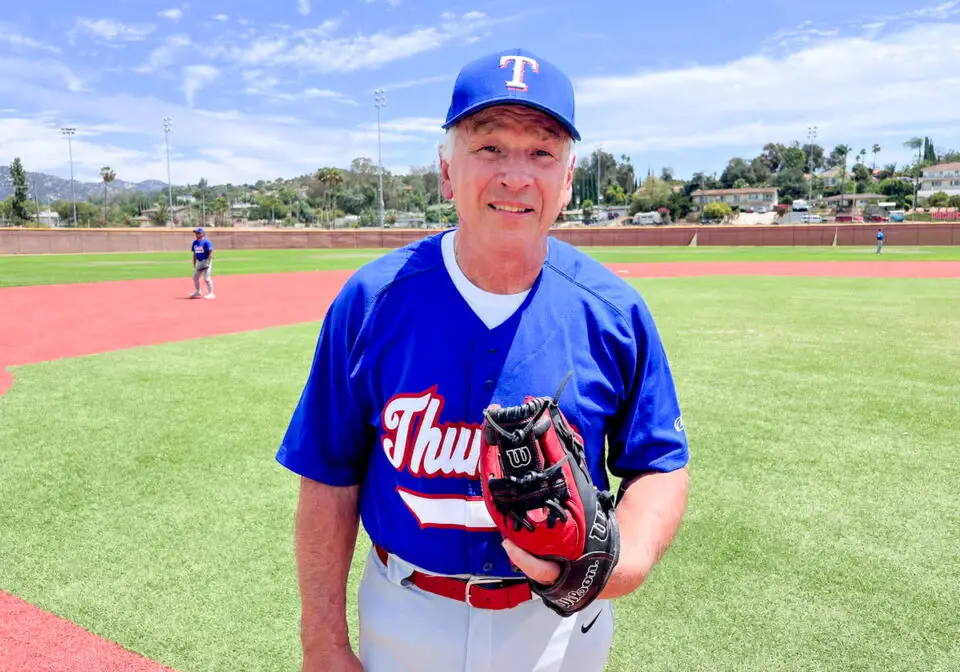
Carlsbad resident Joe Tarka, 78, remembers April 17, 1960, like it was yesterday.
The day the Cleveland Indians traded right fielder Rocky Colavito to Detroit for Harvey Kuenn, the 1959 American League batting champion. Colavito was coming off back-to-back 40-home-run seasons, and to the young Tarka, a native Ohioan, the trade was devastating.
“I cried — literally,” Tarka told The Coast News. “I still remember the newspaper, the Cleveland Press, and they made a big splash about it. Rocky’s gone. Harvey Kuenn fizzled out in about two years, and Rocky went on to have a brilliant career.”
More than six decades later, Tarka still has the same enthusiasm for baseball as he did the day Rocky went West.
Tarka started playing around age 10 in Ohio, eventually joining a traveling league and playing some American Legion and high school baseball. But he gave up the game as a teenager to work for his father, an electrical contractor.
He missed baseball.
So when Tarka moved to California in 2006, he found his way back to the diamond.
At 58, he began playing adult hardball in the Men’s Senior Baseball League in North County. What started as a return to a childhood passion has become a 20-year second act in the sport.
Tarka plays second base, the position he considers his strength. He’ll also play third base or the outfield. He practices three times a week and plays on weekends, with a season that typically runs from late February through September. Then come tournaments in places such as Phoenix and Fort Myers, Florida.
He doesn’t play every tournament. He picks the ones he likes.
At 78, Tarka is still playing against men considerably younger than himself. That’s the part that would have been difficult for the 10-year-old boy in Ohio to imagine.
It’s also why, when prostate cancer entered his life, Tarka wasn’t willing to simply step away from the game. In 2019, at age 70, he was diagnosed with an aggressive form of prostate cancer.
Tarka had no symptoms, but his primary care physician, Dr. David Ko of Scripps Coastal Medical Center Encinitas, noticed his PSA level had risen and encouraged him to have it checked.
Tarka initially waited three months, hoping the number would fall. It did — by about half a point. His doctor remained concerned.
An MRI didn’t find the cancer. Further testing, including a CT scan, eventually revealed three cancerous areas. Their Gleason scores were 7, 8 and 9, putting Tarka in a high-risk category.
“I didn’t have any symptoms of prostate cancer,” Tarka said. “So what I did find out, it was kind of a surprise.”
Tarka underwent surgery to remove his prostate and some lymph nodes. Then came the first comeback.
He followed his doctors’ instructions, doing light exercise during his recovery. Once he was ready, he began rebuilding his baseball routine: working out, taking ground balls and going to batting practice.
Eventually, he was back in games. But two years later, the cancer returned. His PSA was rising again, although scans couldn’t identify visible disease.
Dr. Ramdev Konijeti, Tarka’s surgeon at Scripps Cancer Center and medical director of the center’s genitourinary oncology program, said the pattern of the rise led doctors to suspect the cancer had returned in the pelvic area where Tarka’s prostate had been.
Tarka underwent radiation therapy along with hormone therapy, which suppresses testosterone. The radiation itself wasn’t particularly difficult.
“The actual procedure for radiation was like three minutes,” Tarka said.
The hormone therapy was another story. He experienced hot flashes, fatigue and weight gain. At times, it made exercising difficult.
But he kept moving.
“I try to fight that,” Tarka said. “I continued exercising, even though sometimes it was in moderation.”
He kept working out and playing baseball whenever he could.
Konijeti said that commitment mattered.
“I would be lying if I said that it’s entirely because of our abilities that he is able to do that,” Konijeti said. “I think on some level, it’s his own baseline functional status and his own degree of motivation that keeps him that active.”
For someone in his late 70s, Tarka’s level of activity is unusual, Konijeti said. Baseball, with its sudden movements and changes in body position, is not typically the kind of sport people continue playing as they get older.
But Tarka did. And baseball gave him something else during his cancer battle: perspective.
When he eventually told teammates he was going to be away because of cancer, he discovered he wasn’t nearly as alone as he thought.
One player had been through it. Then another. And another.
“I was amazed how many guys had it, survived it,” Tarka said.
Many had kept their experiences to themselves. Tarka understood why.
“Cancer is a funny effect that people, they maybe want to treat you differently and all that because they think you’re real sick,” he said.
He didn’t want that.
There were moments in the dugout when he would look out at the field and think about the strange reality of his situation.
“I’m playing baseball,” he remembered thinking. “I have cancer.”
When the cancer returned, Tarka was initially reluctant to undergo another round of treatment. His wife and daughters pushed him to reconsider, and he sought a second opinion.
The doctor offered him a different way of looking at what was ahead.
“Joe,” Tarka recalled the doctor telling him, “you have an opportunity to live again. You’re getting a second chance.”
Tarka knew what he wanted to do with it. He wanted to keep playing.
Today, Tarka is cancer-free. He continues to be monitored because recurrence remains possible. But the treatments have not stopped him from doing what he loves.
Konijeti said Tarka’s story illustrates an important part of prostate cancer care: treatment isn’t simply about eliminating the disease. Doctors also have to consider a patient’s age, health, goals and the life he wants to continue living.
“You work with them to understand, OK, what are your goals?” Konijeti said.
For Tarka, the answer was never particularly complicated.
He wants to stay active. He wants to compete. And he wants to keep playing baseball.
“Our objective always is not only to treat your cancer and keep you alive, but it’s to help you live,” Konijeti said.
He still practices three times a week. He still plays on weekends. He still travels to tournaments. He still plays second base and takes ground balls.
The boy who cried when Rocky went West is still on the field.