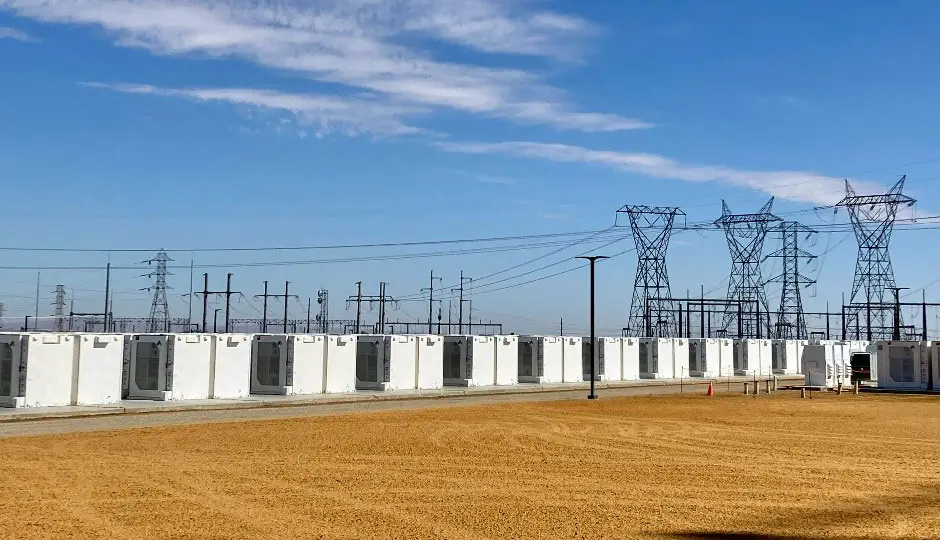
REGION — The San Diego County Board of Supervisors recently agreed to develop safety-related standards for battery energy storage facilities in the county’s unincorporated areas.
On July 17, the board directed County Administrative Officer Ebony Shelton to establish standards for battery energy storage system projects, including where they can be located, design, fire and explosion risk mitigation, emergency response protocols, hazardous materials, toxic gasses and noise.
Staff must also work with energy storage applicants to ensure their project aligns with the board’s recommendations.
Supervisor Jim Desmond, who brought forward the recommendations, cited recent fires at existing battery energy storage facilities in Otay Mesa and Valley Center.
Desmond also noted that the county does not currently have standards in place for battery storage facilities and feels the relatively new technology needs to be reviewed “a little more thoroughly” before more are approved for construction.
“To date, there have been three projects approved in unincorporated county areas, and two of those have caught fire,” Desmond said. “Two out of three is not a good way to go. This product unfortunately still needs some work.”
Desmond also said he wanted to avoid building battery energy storage facilities in or near residential neighborhoods, schools, daycares and hospitals, preferring instead to see them in industrial or commercial areas.
County staff has worked to use comparable land-use definitions on new applications, which “gets us close on capturing the scope and scale of the battery storage projects … but it doesn’t necessarily account for their unique operating characteristics or public safety hazards,” Desmond said. “I think it’s important to pump the brakes a little bit here and work to establish specific definitions for development and safety standards.”
Vice Chair Terra Lawson-Remer thanked Desmond for proposing “long overdue” development standards.
“There’s no question in my mind that we really have to do something about some of these battery facilities that have caught fire,” or ones that spew toxic fumes or are proposed for residential neighborhoods, she said. “They present a threat to many people in our community, to our environment.”
Several county residents who favored setting new standards live in or near the Eden Valley community just outside Escondido, where the proposed Seguro Energy Storage project is planned.
AES Corporation, a global energy company focused on developing green energy solutions, has proposed constructing the project on 925 Country Club Drive, a 22-acre former horse reining arena.
Originally, the proposed lithium-ion battery storage facility would have stored 400 megawatts or 1600 megawatt hours of energy generated from renewable resources like solar and wind. It would have been one of the largest in the state, powering up to 300,000 homes for four hours.
After hearing concerns and frustration about the project’s size and potential safety issues from neighboring residents, AES downsized the project by 20% to 320 megawatts or 1,280-megawatt hours, which is enough to power 240,000 homes for four hours.
The battery storage facility would connect to the local power grid via a new substation built on site that would connect to the existing nearby 30,000-kilowatt SDG&E Escondido Substation through a transmission line.
Escondido resident Andrew McSparron said the projects shouldn’t be placed where there’s no possibility of emergency evacuation. While companies will claim the projects are safe, “my family and neighbors shouldn’t be guinea pigs for them,” he said.
Representatives of the energy industry and environmental groups told supervisors that while safety standards were needed, a moratorium wasn’t a good idea.
Jen Lebron, spokeswoman for San Diego Community Power, said it was important to ensure that guidelines don’t have unintended consequences.
“A blanket moratorium on battery storage could have a chilling effect on the potential projects that are necessary to reduce the cost of power procurement, which could have a significant impact on families and businesses in the region,” Lebron added.
Developing new standards could be a lengthy, few-year process. However, the board directed Shelton to come back sooner with options to incentivize safety while those standards are developed, which may but not are limited to a temporary 60-day moratorium of any new battery storage project applications from being accepted, mandatory review of projects by the board, interim standards within the next six months and any other options for stopgap measures.
If a moratorium is enacted, it would not affect the Seguro project.
City News Service contributed to this report.