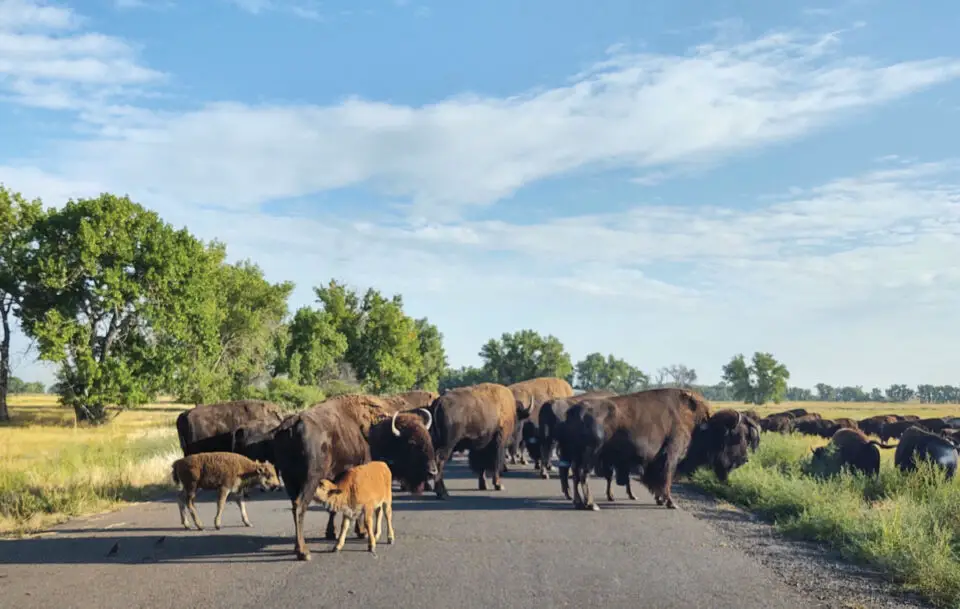
We are driving the one-way, circular Wildlife Drive that lets visitors explore much of the 15,000 acres northeast of Denver that is the Rocky Mountain Arsenal National Wildlife Refuge.
Our eyes are peeled for buffalo, and I’ll be happy if I see one or two — which we do. Our friend and longtime Denver resident Chuck Robinson has wisely brought binoculars that give us a faux up-close look at these magnificent creatures.
I feel lucky to have seen this pair of buffalo, but just around the corner, we come upon a herd of about 20 — a sight I never expected to encounter, especially only 10 miles from downtown Denver.
The co-existence of these buffalo (also called bison) with a metro area of 3.3 million didn’t just happen. And it’s not often you hear the words “arsenal” and “wildlife refuge” in the sentence, but the dichotomous title tells the story about the refuge’s past, present and future.

Until the mid-1800s when White settlers began arriving in Colorado’s High Plains, the Apache, Comanche and Ute tribes lived here, sustained by the massive herds of buffalo. These settlers homesteaded, farmed and raised cattle.
Then, in late 1941, the Japanese attacked Pearl Harbor, which prompted the United States to enter World War II and confiscate the farms of 270 settlers to build a munitions factory and chemical warfare plant. A storyboard at the refuge visitor center says that some farming families felt it was their duty to give up their land to help with the war effort; others were quite bitter.
This location was chosen for munitions manufacturing because space was abundant, as was a nearby workforce.
The consequence of this endeavor was severe pollution; more than 600 chemicals saturated the groundwater and High Plains soil. This disastrous situation earned the property a Superfund designation. The $2.1 billion cleanup began in the late 1980s and was mostly completed by 2010.
According to the Environmental Protection Agency, the methods of decontamination included removal of contaminated soil down to 10 feet. What couldn’t be removed was covered with material that “prevent(s) intrusion by humans or animals…and further contamination of groundwater,” which was “pumped and treated at the site.”

End result: What once was a place not fit for habitation by any species has been returned to its original High Plains ecosystem that supports not only buffalo, but 330 additional species of birds and mammals. They include deer, coyote, raptors, songbirds, waterfowl and innumerable prairie dogs.
Chuck was quick to spot these adorable little guys whose burrows dot the sparsely vegetated landscape, but apparently local homeowners are not so enamored. These “squirrels of the prairie” are considered pests because they destroy landscaping and undermine foundations.
If you go: Admission is free. A stop at the visitor center is a must. Pick up a map, see the once-real buffalo, and peruse the excellent exhibits that tell the history of this land with ample photos and text. Visitors also can see the black-footed ferret enclosure, part of a reintroduction program of the once nearly extinct animal that weighs about 2 ½ pounds and whose favorite food is prairie dog.
For more photos and discussion, visit www.facebook.com/elouise.ondash.