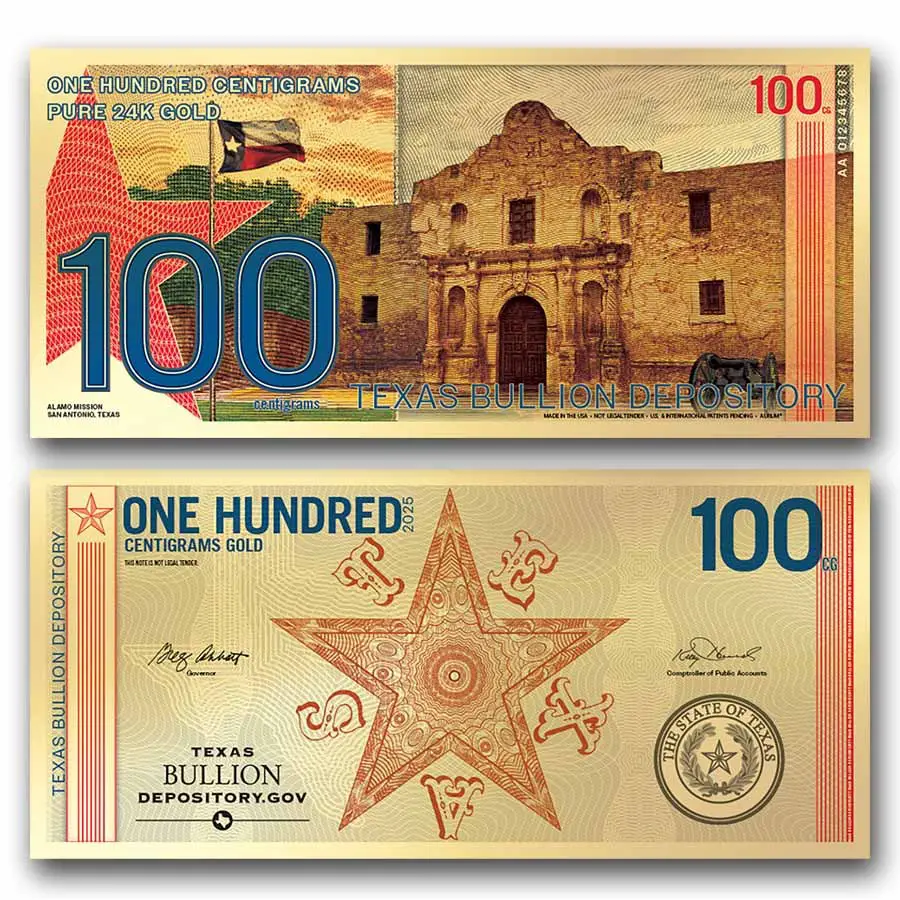
Goldbacks, Silverbacks, and Texas’s bullion-backed payment initiatives represent emerging experiments connected to sound money principles associated with Austrian economics. In an age of ongoing fiat expansion, supporters view these as tools individuals may use to hedge against inflationary erosion.
Goldbacks, originating in Utah and now spanning states with editions like the 2025 Dallas-Fort Worth Texas series, are polymer notes embedding minuscule amounts of 24-karat gold (typically 1/1000th ounce per “1” denomination). They provide lightweight, divisible, portable fractional gold designed for voluntary barter transactions among willing participants, addressing the “small change” challenge associated with physical precious metals.
Silverbacks, from the same Goldback Inc. innovators, mirror this format but use .999 fine silver (1/1000th troy ounce per note), as seen in releases like the 2026 Hades Silverback from the Legends of Olympus series. While Silverbacks emphasize collectibility, artistry, and storytelling more than everyday spending (due to higher relative production costs for silver), they expand access to hyper-fractional precious metals. Both reflect characteristics commonly associated with commodity money: scarcity, durability, and resistance to arbitrary supply expansion, unlike fiat currencies whose supply is managed by central banks.
Austrian economists such as Ludwig von Mises and Murray Rothbard argued that fiat monetary systems can contribute to credit-driven boom-bust cycles and inflation acting as an indirect tax. Advocates of commodity-based alternatives believe they encourage savings and price stability through market signals rather than policy intervention. Supporters also point to the long historical use of gold and silver as stores of value under commodity monetary systems.
Texas has moved in a related but distinct direction. Rather than issuing circulating gold notes, the state has developed infrastructure around the Texas Bullion Depository allowing individuals to hold precious metals and transact using payment systems linked to stored bullion.
Legislative efforts have sought to clarify the legal treatment of gold and silver in certain transactions, expanding their potential use alongside traditional currency rather than replacing it. No official state-issued circulating gold paper currency currently exists, and private bullion products like Goldbacks operate independently of government issuance.
From an Austrian perspective, proponents argue these developments align with constitutional interpretations favoring commodity money, while critics note federal courts have long upheld the legality of fiat currency. The result is less a replacement of the dollar than a widening of monetary choice in parallel systems.
Ultimately, these experiments revive long-standing debates about money: voluntary exchange, protection from inflation, and the role of markets versus institutions in determining value. Whether they remain niche collectibles or grow into broader financial tools will depend on public trust, practicality, and economic conditions — but the conversation itself has clearly returned.
For informational purposes only. This column does not constitute investment advice. Special support provided by First National Bullion.