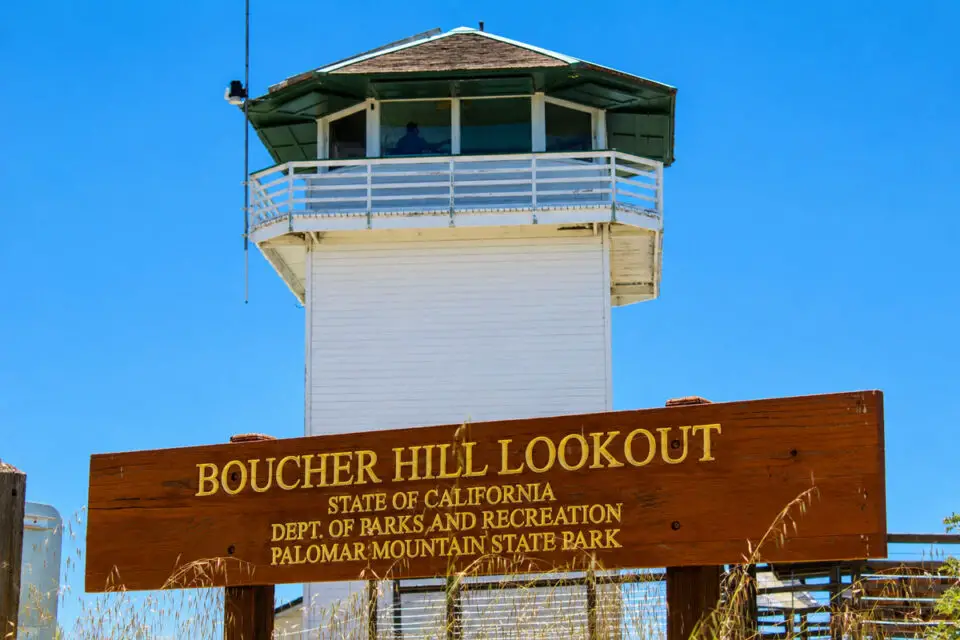
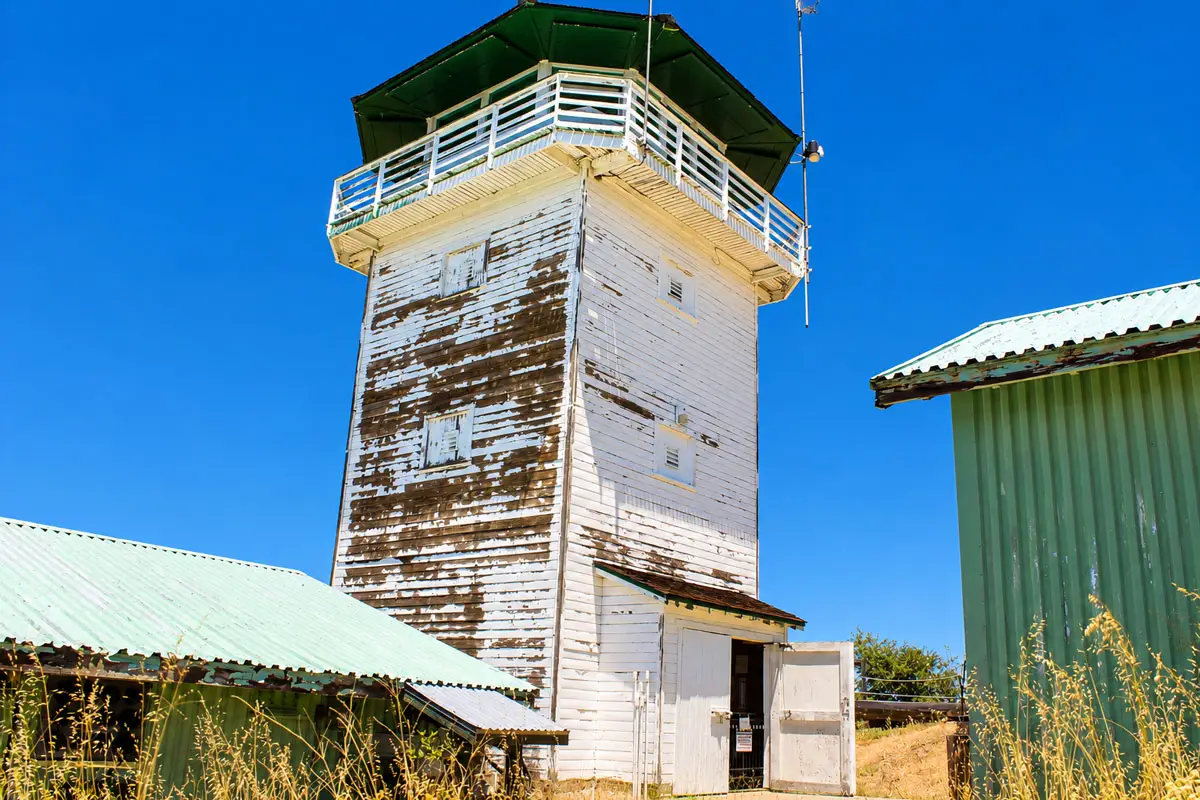
PALOMAR MOUNTAIN — Atop a mountain more than a mile above sea level, overlooking a large swath of North County, stands a historic fire tower that is now the only operating fire lookout in San Diego County.
Once home to at least six fire lookouts, the county now has only Boucher Hill (pronounced like “booker”) in Palomar Mountain State Park.
For the past decade, three separate fire lookouts served as watchful eyes for smoke across the county. One was on Los Pinos Mountain, just south of Interstate 8 in East County in the Descanso Ranger District of Cleveland National Forest. The other two were on Palomar Mountain in North County: Boucher Hill, which belongs to the state park, and High Point, located within the Palomar Ranger District of Cleveland National Forest.
High Point, which features a 13-by-13-foot CL-30 series steel cab atop an all-steel, L-1600 series, 67-foot tower, is the U.S. Forest Service’s tallest fire tower in California.
Three other inactive, historic lookouts remain on Hot Springs Mountain, San Diego County’s highest peak at 6,533 feet near Warner Springs; Lyons Peak, a 3,741-foot mountain near Jamul; and Red Mountain near Fallbrook.
Volunteers with the Forest Fire Lookout Association have staffed the Palomar fire towers, while the U.S. Forest Service provided paid staff at the Los Pinos tower.
All three towers reported smoke activity to the Cleveland National Forest Emergency Communications Center, which is co-located with Cal Fire in El Cajon.
Two towers close, one remains
In March, volunteers learned that both High Point and Los Pinos, which are owned by the Forest Service and regulated by the Federal Aviation Administration, failed inspections last year. Both towers required repairs to continue operating, but neither received them, leading to their indefinite closure earlier this year.
Because Boucher Hill was constructed differently from the High Point and Los Pinos towers and sits on state property rather than under FAA jurisdiction, it remains open.
Bob Littlejohn, a Valley Center resident and volunteer with the Forest Fire Lookout Association, has spent several years watching the horizon for smoke from Palomar Mountain. He said the inspection failures at High Point stem from bolts embedded in the concrete at the tower’s base that do not fully penetrate a steel plate at the bottom.
“Because of the concerns raised during the inspections, we have closed the lookouts,” said Forest Service spokesperson Daniel Lanari via email. “Safety for firefighters, volunteers and the public is our top priority.”
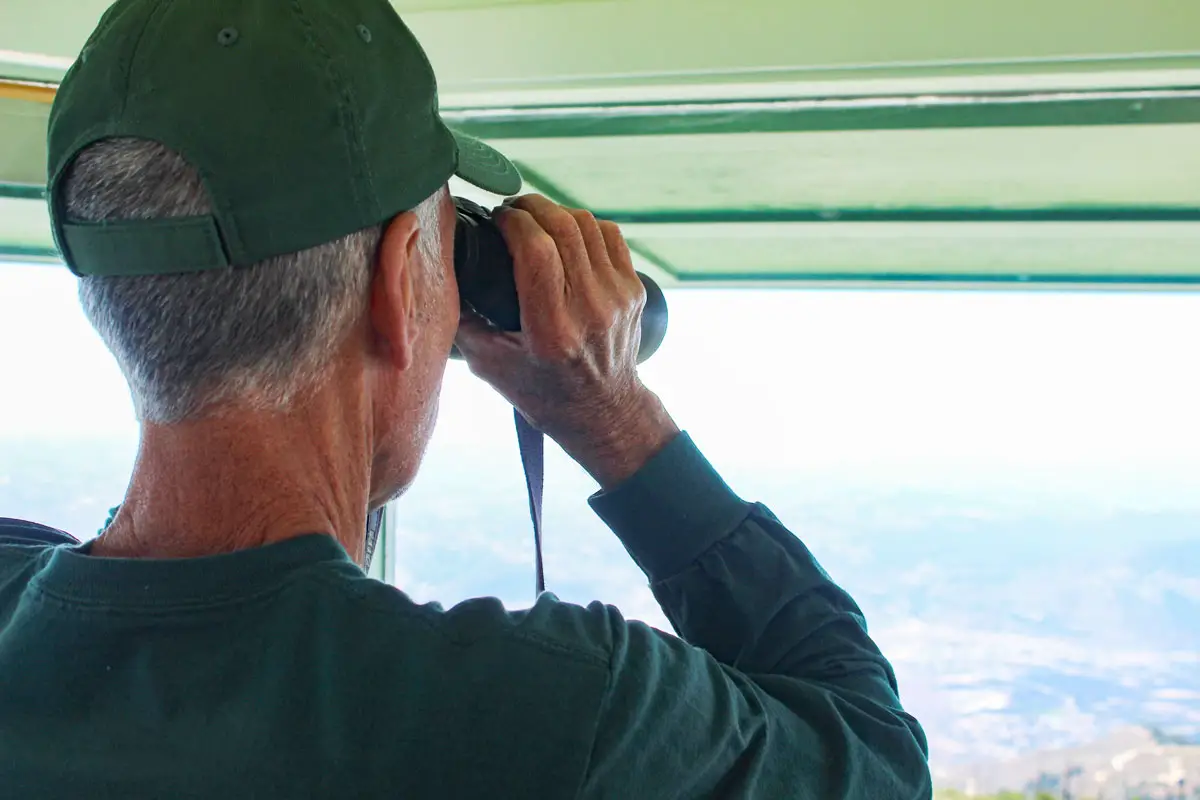
“It wasn’t broken metal, but the concrete had decomposed a bit, so they were worried about its strength,” Littlejohn said.
The Forest Fire Lookout Association is working with the Forest Service to determine what repairs are needed to reopen the towers, particularly High Point. Repairs to High Point alone are currently estimated at $142,000.
“They don’t have a repair plan as of yet that we’re aware of,” Littlejohn said.
FFLA volunteers have considered fundraising, but they are also unsure how such donations could be used to fund a federal government contract for the repairs.
Lanari said the Forest Service is “exploring funding options for the repairs and is working with the Forest Fire Lookout Association to assess the next steps.”
A lack of view
With fire season well underway, the loss of High Point’s and Los Pinos’ views is a major concern for FFLA volunteers, who worry about what could happen if a large fire ignited in East County and spread toward the coast without a set of human eyes to spot it first.
Los Pinos and High Point each offer a different view of the county than Boucher Hill, which looks south and northwest across North County, spanning Valley Center, Camp Pendleton, Oceanside and Encinitas — and, on particularly clear days, San Diego and Tijuana.
According to FFLA volunteers, High Point provides a nearly 360-degree view of the county, including the remote East County backcountry and the approaches along state Routes 79 and 76. That vantage point could help first responders if Santa Ana winds pushed a fire west into Valley Center.
When all three towers were operating, they would occasionally work together to triangulate the location of smoke visible from multiple towers.
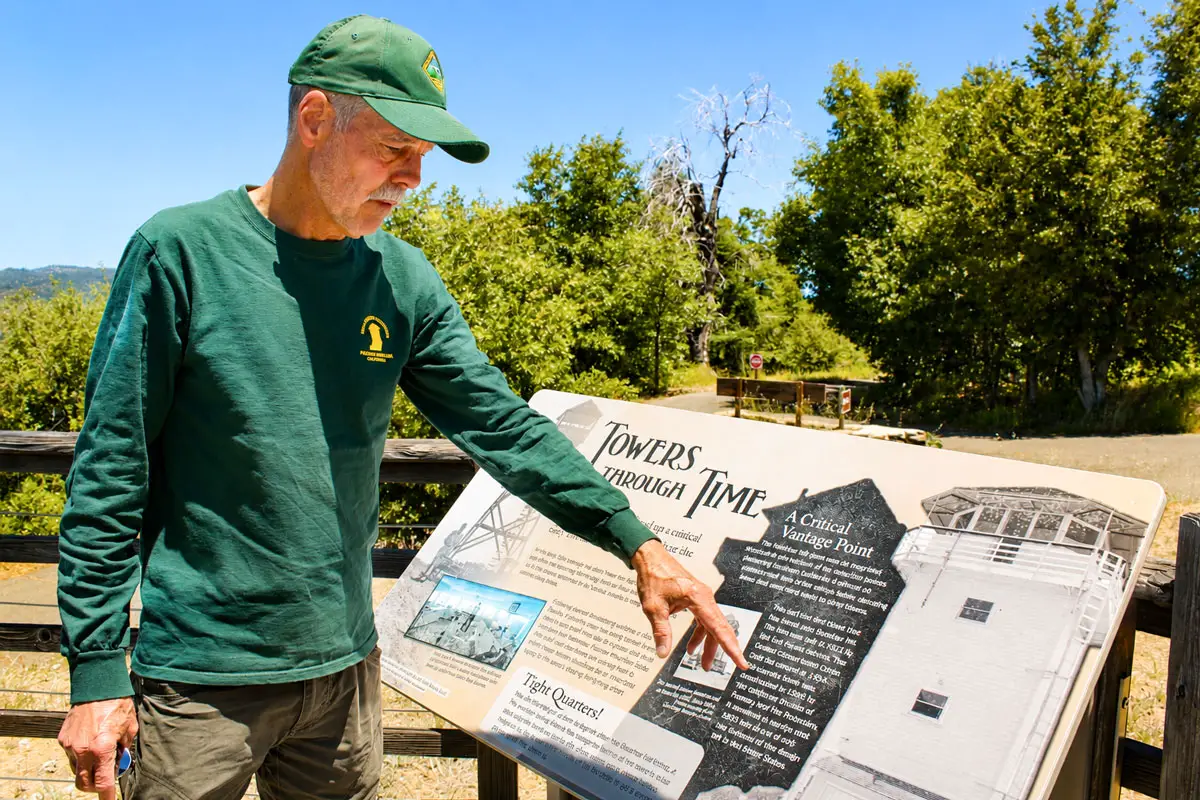
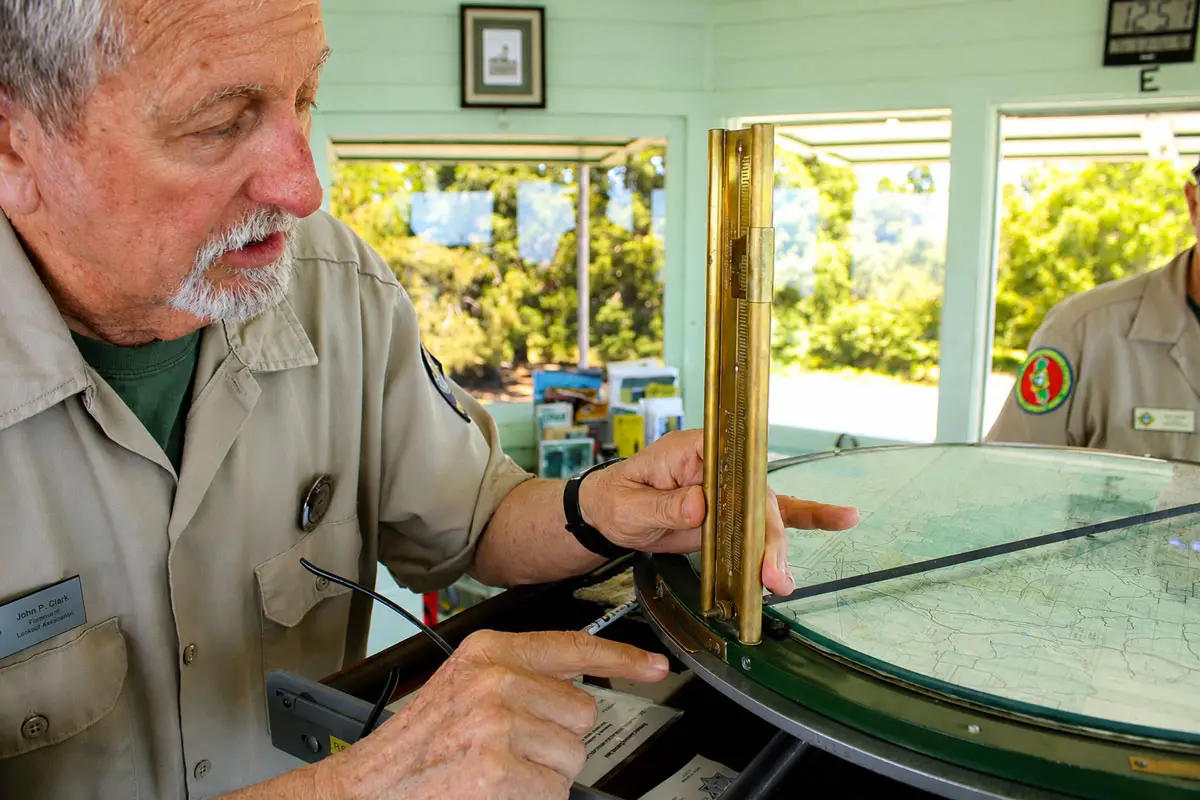
Although volunteers in the towers are rarely the first to report smoke, they provide a perspective that is not always captured by camera systems and evolving artificial intelligence technology.
The towers are often the first to report weather changes that could affect an active fire. Volunteers also watch for lightning strikes on the mountain, a particular concern during the late summer.
Some technology still falls short. Littlejohn said experimental AI smoke-detection systems can struggle to distinguish between smoke, smog, dust devils and other atmospheric conditions that resemble a fire.
Fire agencies also frequently call the towers to “glass” an area of interest after an initial report through 911 or another source.
“They’ll call us for amplifying information,” Littlejohn said.
If a lookout is the first, or among the first, to report a fire, they can help direct first responders to the correct location.
“All it takes is seeing that initial puff,” Littlejohn said.
Volunteers also generally know where to watch for fire activity, such as Camp Pendleton, where smoke is an almost daily occurrence.
“There’s a certain area where we expect stuff to happen,” said John Clark, another FFLA volunteer who drives from his Oceanside home to Boucher Hill for his shifts.
Towers of the past and present
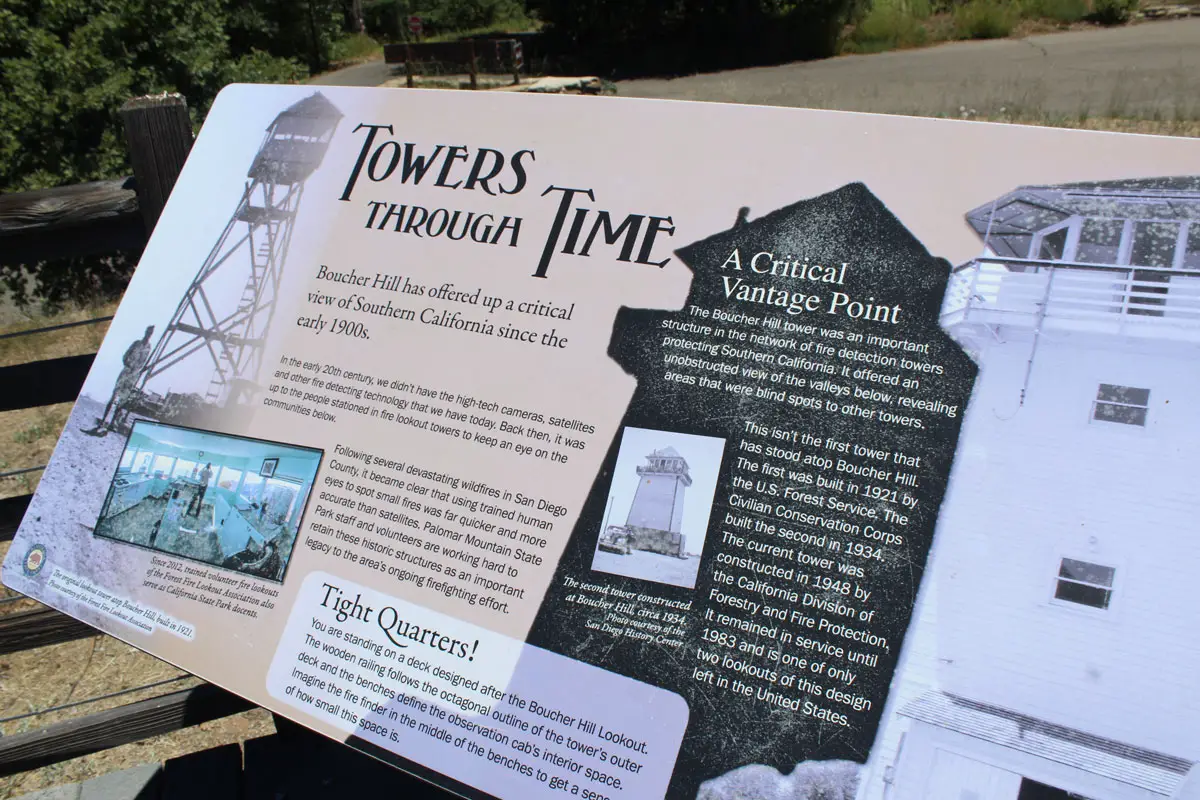
Fire towers began appearing across the United States in the early 20th century.
At one time, more than 8,000 fire lookouts stood across 49 states, according to a national inventory completed by the Forest Fire Lookout Association and the Forest Service. Today, fewer than 2,000 remain, and only about 500 are staffed by paid observers or volunteers.
Three different towers have stood on Boucher Hill over the past century. The first was built in 1921, replaced in 1934, and the current tower was constructed in 1948. It was fully refurbished in 2013 by the San Diego-Riverside chapter of the Forest Fire Lookout Association.
Decades ago, lookouts could live in the tower for extended periods. Today, volunteers spend about nine hours a day scanning the horizon for signs of smoke.
Many fire towers remain active throughout California, particularly in the northern part of the state. While some, like Boucher Hill, are easy to reach, others require off-road vehicles or hiking due to their remote locations.
According to Clark, that remoteness is another reason a human presence remains essential.
“Even now, up in the northern states and Northern California, there are a lot of towers that are manned where people are staying out there for two weeks at a time,” he said. “That’s the human touch — how do you get electricity or AI out there? That’s not going to happen in the really remote areas.”
Now, 13 years after the tower was refurbished, volunteers hope the state will help spruce up the historic lookout — specifically with a new coat of paint — which attracts significant numbers of visitors on summer weekends.
For volunteers, ensuring the tower remains operational and welcoming to visitors is essential, especially as fire season intensifies.
Related Articles:
- Oceanside considers launching park ranger program July 21, 2025
- Great waves and results from WSA season opener August 11, 2025
- Comment period extended on Cleveland National Forest… July 30, 2026
- Olivenhain neighborhood lights up decades-old… December 18, 2025
- Coastal Commission OKs Camino Del Mar bridge project December 16, 2024
- Family continues search for missing Oceanside woman July 28, 2026