Vista Irrigation District has taken a sensible first step toward governing artificial intelligence before deploying it widely. But the most important test of an AI policy is not whether a public agency has one. It is whether the people using the technology can recognize an error, challenge it, and remain accountable for decisions made in the public’s name.
In an October 14 report in The Coast News, Jim Trageser described the district board’s Sept. 9 adoption of an AI policy. The district’s director of administration, Shallako Goodrick, said the agency had not deployed AI operationally, although employees might use freely available writing tools. She identified confidentiality, discrimination, employee training, and potential vendor use among the district’s concerns.
That is a constructive starting point. It also reminds us that AI governance cannot end with a policy announcement.
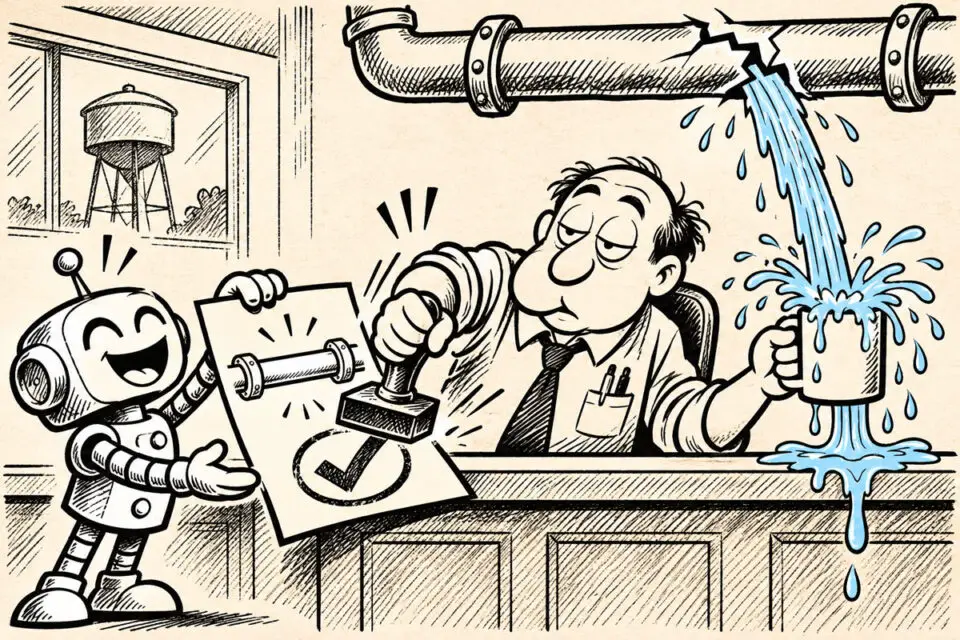
Imagine a district employee using AI to summarize a complex customer complaint. The system produces a clear, professional response. Unfortunately, it overlooks an exception in the applicable rules. A supervisor reads the draft and approves it because it sounds reasonable.
Who is responsible? Not the software.
The employee and the agency remain responsible for checking the facts and applying the rules correctly. Yet responsibility on paper has little practical value if nobody has the time, evidence, training, or authority to question an AI-generated answer.
This is the gap local governments must close.
First, agencies should define where AI is allowed and where it is not. Drafting a public notice is different from deciding on a customer’s service, payment, eligibility, or complaint. The higher the stakes, the stronger the requirements for independent review.
Second, agencies should protect confidential information. Employees need clear instructions about what may be entered into an outside AI service. Vendor contracts should address what data is processed, where it goes, who can access it, and what happens when a tool or contract changes. The public deserves more than a general assurance that information will be handled responsibly.
Third, employees must learn how to challenge AI output rather than simply recognize that AI can make mistakes. A practical exercise can start with an answer that sounds authoritative but contains an unsupported conclusion. Ask employees to identify the claim, inspect the underlying evidence, consider a competing explanation, and decide what they can defend without relying on the system’s phrasing.
That is a test of judgment, not a test of prompting skill.
Fourth, agencies need an escalation path. If the evidence is missing or contradictory, the employee should be able to stop, ask a qualified person, and document why they did not accept a recommendation. Human oversight should mean more than clicking “approve.”
Fifth, the public should have a way to understand how AI affects agency work. Agencies could report the categories of AI use they authorize, which decisions remain strictly human, how staff is trained, and how significant errors are identified and corrected. They need not expose sensitive systems or private records to explain their accountability standards.
Vendor use matters just as much as direct employee use. As Goodrick noted in the newspaper’s reporting, AI could enter agency services through third parties. A district may never purchase a stand-alone AI system yet still encounter AI-generated communications, vendor recommendations, or automated customer interactions.
The distinction between policy and proof is essential. Adopting a policy shows that an agency has formally addressed the subject. It does not, by itself, establish that training works, that every vendor complies, or that errors are caught before they affect residents. Those questions require evidence.
Vista Irrigation District deserves credit for addressing AI before racing into deployment. The next step for public agencies throughout North County is to make oversight observable: defined boundaries, trained people, documented decisions, and the ability to stop when an AI answer cannot be verified.
Artificial intelligence can help government work more efficiently. But efficiency is not the same as accuracy, and a plausible answer is not the same as a justified decision.
The guiding principle should be simple: use AI to assist public servants, never to excuse them from exercising public judgment.
Glenn Broder lives in Oak Park, California, and is the founder of Human Judgment in the Age of AI and Learn AI Like a Pro.