
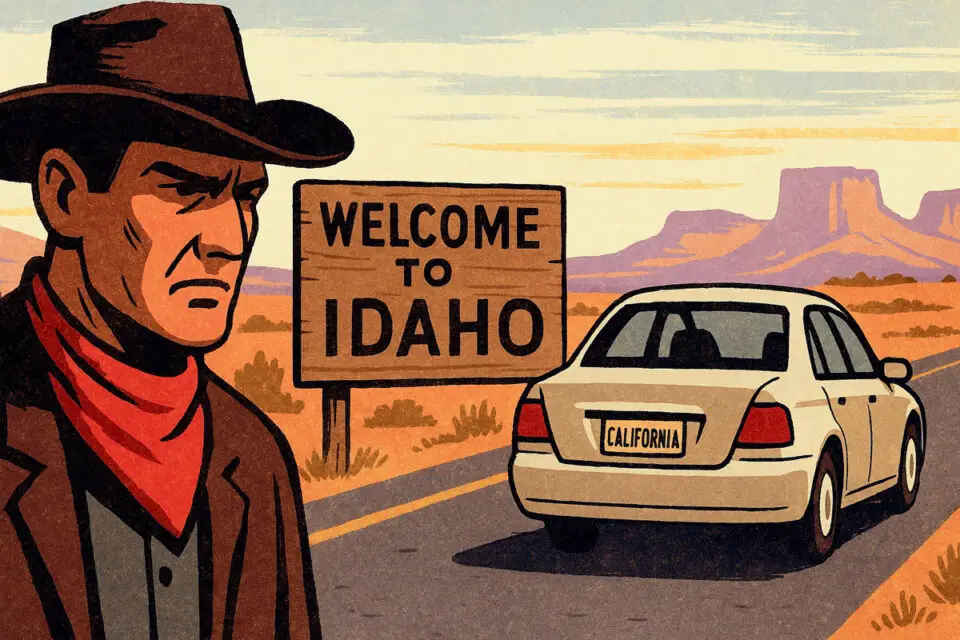
If you are a Californian planning a road trip through one of the other western states, here’s a heads-up: You may encounter some hostility from the locals. No need for alarm. It rarely expresses itself with anything more than a sidelong glance, an awkward pause, or a certain flintiness in the eyes.
Should this happen to you, you may wonder whether it was prompted by something you said or did. It’s possible. The rules of grammar and etiquette are adhered to unevenly in the country, and even the most basic guidelines of taste, style, and fashion are subject to regional variation.
As a result, committing the odd faux pas while exploring the hinterland is all but inevitable. Even a traveler familiar with the local customs may occasionally slip up and violate some parochial taboo, raising a hackle or two.
A few personal examples: (1) while those who drive at the posted speed in California are generally considered to be rude, in New Mexico, exceeding the suggested limit by as little as ten miles per hour will get you a sermonette from a trooper and an annoying fine, (2) if you are in Laramie and it occurs to you that Wyoming’s interpretation of the Second Amendment could use a few common sense tweaks, best to leave that thought unvoiced, and (3) addressing the gentleman in the broad-brimmed hat at the end of the bar as “dude” is ill-advised.
It is also possible, however, for such an episode to be triggered simply by who you are, i.e., a Californian. Once, in a small store in a remote town in Idaho, I was having a perfectly pleasant conversation with the proprietor about the sad state of the produce when he asked, “Where’re you from, anyway?”
I replied, “San Diego.”
The effect was immediate: the glance, the pause, the flintiness.
He then said, “My brother was stationed there. Here’s your receipt, sir. Have a nice day.”
And there it was. Not only had I hit the animosity trifecta, I had been “sirred.” (Note to foreign readers: In this country, honorifics can be repurposed as insults.) I was puzzled and asked myself what was at the root of this hostility.
The following will excavate that root and suggest a few ideas to keep it from sprouting.
Let’s say you live in Phoenix. It’s August. It’s 115 degrees in the shade. There is no shade. You trudge down the skillet-like sidewalk to your car. In the car, you sniff the air, scorching your nostrils. You try to put your hands on the steering wheel. Youch! “This is ridiculous,” you think.
And then your thoughts turn to California, where, at that very moment, a jogger has paused on a breezy, bluff-top boardwalk to watch a pod of passing dolphins put on a show.
Or suppose you live in Great Falls and you’re out trying to start your car in January. It’s twenty below. As your starter slowly grinds and your nose slowly freezes, your thoughts turn to California, where, right then, a guy in shorts and a t-shirt is laughing with friends over coffee after their morning surf.
And you ask yourself, “What am I doing here? I could be that jogger! I could be that surfer! I could live in California!”
But you don’t dwell on this hypothetical. You don’t because you are bound to your inhospitable home by the seemingly unbreakable ties of job, friends, spouse, and family. And you don’t because you fear the effect of contemplating the shimmering light at the end of that palm-lined road not taken.
For you, to dream of California is to invite madness.
So, what do you do instead? Why, you rationalize, of course. Your mind offers up a list of allegations meant to tarnish the image of the Golden State: the fires, smog, crime, traffic, earthquakes, riots, bizarre cults, homelessness, poor governance, fiscal mismanagement, and so on — any plausible-sounding excuse for staying put.
Clutching this list, you can ask, “Who would want to live there?”
And yet. Beneath this thin surface of rationalization lies the enduring truth that you really do want to join those lotus eaters out there having fun in the warm California sun. And soon a tiny crack appears on that thin surface. And from that widening crack sprouts the weed of envy, which produces the flower of resentment, which bears the fruit called hostility.
Then, whenever the Beach Boys sing, “Fun, Fun, Fun,” you grind your teeth.
But all of the above is in the superstructure. The more fundamental source of antagonism is in what Marx called the “economic base,” where the law of supply and demand still holds some sway.
Consider.
A cruise ship offers a variety of staterooms. On the upper decks, some of them actually comprise several rooms and a private veranda overlooking the ocean. Others, lower down, will have a bedroom, a bathroom, and a porthole. Still others, nearer to the middle of the ship, will have the bed and the bath, but no porthole.
The price charged for each level of accommodation is determined by what people are willing to pay. Unsurprisingly, people will pay a great deal more for the suites with verandas and ocean views than the airless, windowless boxes near the waterline.
Similarly, the price charged for houses in each state is determined by what people are willing to pay. Unsurprisingly, people are willing to pay much more for houses in states that have endless beaches and marvelous year-round weather than those in the landlocked states where an off-season stroll outside the airlock can kill you.
Last month, Forbes reported that the price of the average house in California was more than $900,000. In Oklahoma, where there are no portholes, it was closer to $250,000. It’s simple, really: All other things being equal, most people would prefer to enjoy their cruise through life from an upper deck.
To put a roof over your head in California, then, you need a lot of money. Sometimes two lots. It follows that wages must be higher here than in the cheaper states. Higher wages mean the goods and services created by those wage earners will cost more, too. As a result, almost everything costs more.
For example, when the guy flipping the hamburger gets twenty dollars an hour, the Big Mac must cost eight. And the wages and the prices merrily chase each other’s tails, spiralling ever upward.
So it is more than job, family, and friends that tie down inlanders. While Californians could, theoretically speaking, cash in their equity, buy a place in Oklahoma, and have a tidy sum left over, an Oklahoman’s equity might just cover the down payment on a modest house in California, leaving a mortgage of $60,000 or so annually for the next thirty years.
To reduce this economic inequality and achieve equity, these unequal equities should be equalized, moving forward. But hold on, if houses cost the same in California and Oklahoma, who would live in Oklahoma? Life isn’t equitable.
The hostility, then, isn’t merely grumpiness about the weather. There’s something akin to a class struggle going on here, between the under-resourced proletarians trapped in the interior and the care-free, privileged bourgeois tourists flying in from the coast to frolic when the weather’s fair.
That may be a bit simplistic. I mean, who frolics in Oklahoma? The term “coastal elites” is being bandied about, though.
To successfully navigate this dialectic minefield: (1) fly to the interior, (2) rent an older domestic automobile with plates from a nearby landlocked state, (3) study how the locals dress, (4) go to a Goodwill store, (5) purchase a suitable mufti wardrobe, then, (6) do what the crew from Star Trek does – mingle unnoticed amongst the natives.
Oh, and if you’re asked where you’re from? Lie.
Scott Chambers is a cartoonist, author, editor and songwriter. He lives in Carlsbad.


