“Whales are like dogs,” says naturalist Marsha Devot, who is holding a large chart with dozens of pictures of whales and dolphins, illustrating the wide divergence of size among the species. “Over here you have your Great Danes and over here you have your chihuahuas.”
We are aboard the catamaran Lot a Fun, one of several in the fleet belonging to Dana Wharf Sportfishing & Whale Watching. Our craft is heading away from the Dana Point Harbor and the high bluffs to the northwest, its passengers on this perfect summer day hoping for an encounter with whales, dolphins, sea lions and sea turtles — any or all.
“We never know what we’re going to see,” Captain Emily Graves says over the loud speaker from the boat’s bridge. “We network with other boats up and down the coast,” increasing the chances of finding cetaceans (marine mammals).


And to augment the hunt, Devot also keeps a steady lookout for signs of sea life as we cruise off the Orange County coastline. About 20 minutes out, she lowers her binoculars and shouts to Captain Emily that she sees dolphins on the horizon at one o’clock. I see nothing for a good five minutes, but then… Suddenly, there are dolphins everywhere. And so are the smiles.
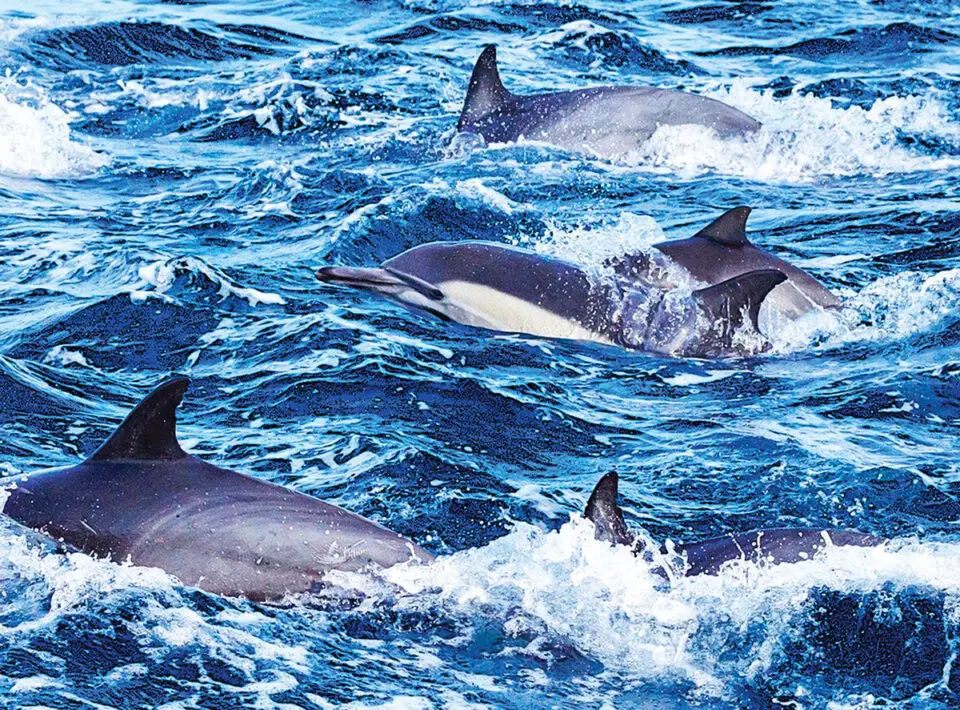
Passengers of all ages delight in this enormous pod of common dolphins, which surrounds the boat on three sides. As its name hints, the common dolphin is the most abundant cetacean in the world. Look in almost any direction and we see the dolphins running, leaping, diving. There are way too many to count.
The rest of the world fades away as Captain Emily drives the Lot a Fun in wide circles around this maritime mayhem. Common sense would tell us that these hundreds (perhaps thousands) of dolphins would at any minute collide with our catamaran, but chaos is avoided because dolphins use echolocation — bouncing sound waves off objects to steer clear of them, including our catamaran.
Among the hundreds of adult dolphins are many cows (females) with their calves (babies), cruising and leaping in tandem like synchronized swimmers. Their acrobatic prowess and speed are both mesmerizing and entertaining, especially for those experiencing this sight for the first time.

Captain Emily explains that the cameras on the bottom of the boat reveal that there is a bait ball below us — a tremendous number of swarming fish that form a large sphere to protect themselves from predators like dolphins. These bait balls occur in the open ocean where there are no crevices or reefs in which the fish can hide. For these dolphins, it’s a grand buffet.
“Dolphins eat their prey headfirst, so it slides down their throats easily,” says Captain Emily, who keeps the catamaran circling to take advantage of the dolphins’ visit — or rather, our visit into their environment.
“Seeing hundreds of dolphins is often overwhelming,” says photographer and naturalist Laura Lopez, who has led more than 500 whale-watching trips. “I never get tired of whale watching. Seeing larger baleen whales like blue, fin and humpback are often a once-in-a-lifetime experience. Passengers appreciate being educated and learning more about all these amazing animals.”
Whale-watching boats also go out daily from Oceanside. For video and photos, visit www.facebook.com/elouise.ondash.