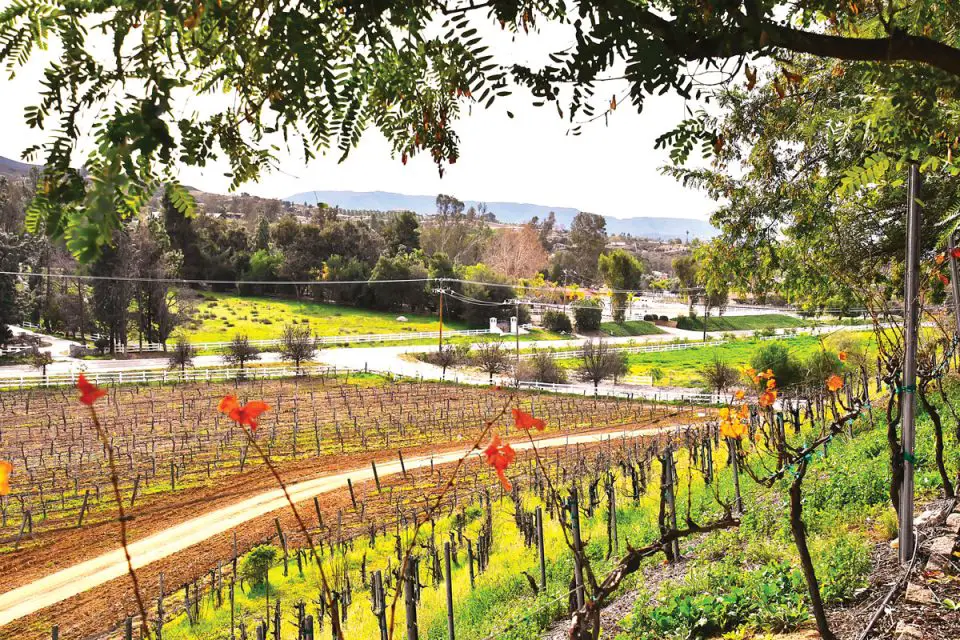
Eat. Stay. Love…the wine, the vineyards, the views.
I’m talking about Temecula Valley Wine Country, and though no more than an hour’s drive from any point in North County, it seems a world away. With its approximately 50 wineries and 2,500 acres of vineyards set against rolling hills and towering mountains, the valley calls to those who want a quick getaway and deep experience.
And now – the offseason — is a great time to go.
The winter and early spring in the valley are quiet, which means no lines for wine tasting and restaurants, special rates for some lodgings, starkly beautiful landscapes and dramatic skies. Daytime temperatures are comfortably warm and the nights brisk, perhaps even cold.
Naked, dormant grapevines on area hillsides appear to be lifeless, but they are storing energy and developing root systems that keep them hydrated during the summer. You’ll also see vineyard workers pruning vines and eradicating thick weeds that have sprouted since last year’s harvest.
Vast, quiet vistas of the valley are the reward for our midweek, 28-hour visit to Temecula Valley Wine Country. The two days are full but relaxed.


We begin with a guided tour by winemaker Hayden Thill at Masia de la Vinya on the De Portola Wine Trail. Masia is one of 11 family-owned vineyards on this route, also lined with white spilt-rail fences, tall oaks and picture-postcard horse farms.
At Masia, we learn about making wine “from grape to glass” and the uniqueness of Temecula Valley. (We’ve been to numerous wineries throughout the years, but never fail to learn more with each visit.) Then a wine tasting paired with amazingly artistic, multi-layered charcuterie bites from Grazing Theory.
Not far away on another scenic hillside: Gershon Bachus Vintners and a relaxed wine tasting on a patio perch with an expansive view. A bi-coastal team of proprietor Christina Falik, a New York City native, and winemaker Dakota Denton, a Temecula Valley native, join forces to mix pearls about winemaking, business and life in the valley.
It’s difficult to move on, but it’s time to check in and explore Europa Village, a property that offers tastes of Spain, France and Italy through architecture, food and music. Our comfortable, private casita in the Spanish section is dominated by a dark-wood, four-poster bed, and the generously large bathroom is luxurious.

Though the property appears quiet, the scene changes at Europa’s Bolero Restaurante, a one-minute walk away. The patio is buzzing with patrons and strains of live saxophone music. The restaurant is no less alive, and the menu makes it difficult to choose. Recommendation: sea bass in a luscious broth that includes a hugely generous portion of cooked-to-perfection artichoke hearts.
The first stop the next morning is Callaway Vineyard & Winery, the valley’s first (established 1974). Massive windows flood the epically long, contemporary bar with natural light, and the acres of vineyards that lie across the rolling hills appear vivid in the pre-noon sun. Cameras can’t adequately capture this commanding panorama, but we try.
Lunchtime brings us to Pinnacle Restaurant at Falkner Winery, aptly named for its location on a hilltop and an expansive view of the valley and surrounding vineyards. Lunch is a standout. Recommendation: sirloin steak and a fully loaded, boulder-sized baked potato, and the to-die-for mushroom risotto and salmon.
Yes, there were leftovers, as well as lovely, lingering memories.