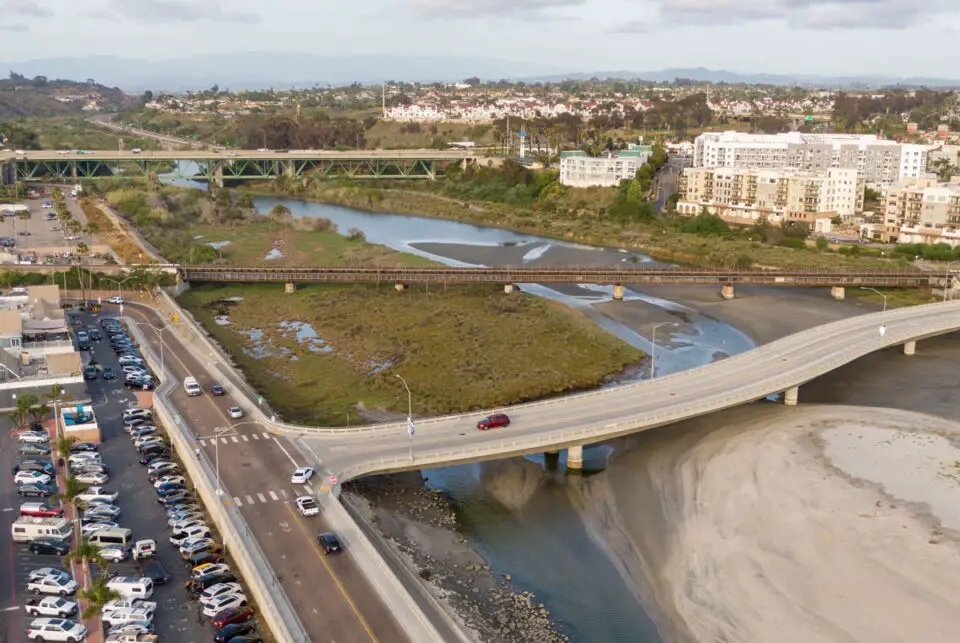
OCEANSIDE — The City Council agreed to pay $8.67 million to the U.S. Army Corps of Engineers as a partial payment toward the city’s required matching funds for the San Luis Rey River Flood Protection Project.
Congress first authorized the project in 1970 to provide 250 years of flood protection, and it was completed in 2000. Twelve years earlier, in 1988, the city of Oceanside agreed to pay 25% of the project cost.
Although the project was technically completed, the Army Corps could not turn it over to the city for final operation and maintenance because of environmental constraints, including the designation of critical habitat and the presence of protected species in the riverbed. As a result, the Army Corps does not consider it “complete,” according to city staff.
Over the years, changing engineering standards and environmental mitigation requirements have driven up costs, increasing the city’s required share without a cap or sunset clause on its financial responsibility.
When the city originally agreed to the 25% share, the project was estimated to cost $113 million. Now, the cost is approximately $230.6 million, bringing the city’s share to about $57.6 million.
The city had already contributed about $32 million of its share. With the latest payment, the city has paid approximately $40.6 million, leaving a $17 million funding gap.
According to Oceanside Public Works Director Hamid Bahadori, the project’s cost is expected to increase significantly by next year once the Army Corps completes geotechnical studies to determine which portions of the levee need reconstruction.
Congress also approved an $88 million contribution to the project six years ago. Those funds have been divided into appropriation cycles, with the latest allocating $26 million.
At the Oct. 7 council meeting, Bahadori said the Army Corps must first receive the city’s $ 8.67 million share before it can access the $ 26 million. Together, the approximately $35 million will fast-track sediment removal in the river.
Bahadori explained that although approximately 190 acres have been identified for sediment removal, the Army Corps can only remove sediment from about 90 acres because clearing the entire area would be too expensive. Additionally, the city needs to maintain another $50 million in reserves in case of a levee breach or flooding.
The project will involve removing the top 18 inches of sediment and transporting it to a landfill in Riverside County.
“We are doing all of these things in preparation for the Super El Niño,” Bahadori said.
The city has been preparing for a strong winter storm season as climate scientists predict a very strong El Niño this year, which is expected to bring excessive precipitation.
While the council unanimously approved the allocation, members expressed concerns about anticipated cost increases for the flood protection project.
“My position is that if they have to modify and or repair those levees, from what I remember the contract requires us to participate in the cost of construction, not modifications or repairs, so if that cost goes from $100-some to $250 million because they have to repair all those levees, to me, that should be a complete federal obligation,” said Councilmember Peter Weiss, a registered civil engineer who previously served as the city’s engineer and public works director.
Weiss predicted it would be five to six years before the city could finally take over operation of the flood protection project if the Army Corps determines the levees need to be rebuilt.