
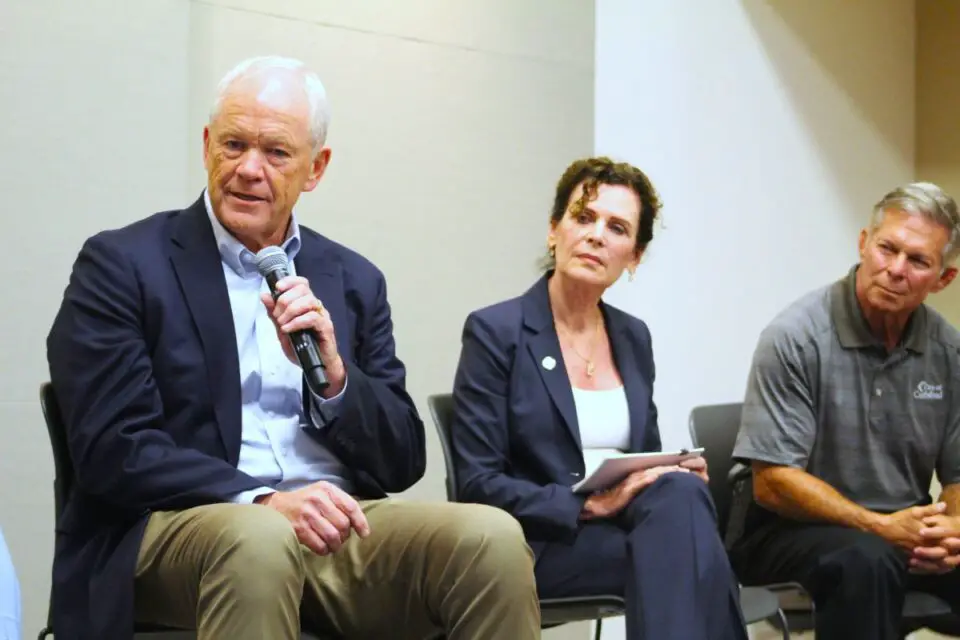
CARLSBAD — Mayors representing various North County cities participated in the second annual North County Mayors Forum at Pacific Ridge School last week, discussing the topic of state housing laws and the need for local control.
Participants in the Oct. 23 forum included Solana Beach Mayor Lesa Heebner, Encinitas Mayor Bruce Ehlers, Carlsbad Mayor Keith Blackburn, San Marcos Mayor Rebecca Jones, and Oceanside Mayor Esther Sanchez.
The mayors discussed the Regional Housing Needs Allocation (RHNA) process, which designates municipalities a certain number of housing units to build in a housing cycle, as well as recent housing development bills like Senate Bill 79, funding challenges, the Our Neighborhood Voices initiative, and more.
Questions came from the moderator, Voice of San Diego reporter Tigist Layne, and Pacific Ridge students regarding the mayors’ views on recent state housing legislation and the housing crisis.
Several mayors expressed frustration with the state’s one-size-fits-all approach to housing rules, which they said has led to a greater increase in market-rate housing than in affordable housing for low-income residents.
Blackburn noted that Carlsbad adopted a growth management plan around 30 years ago that sought to limit housing production according to what the city’s infrastructure can handle, but the state’s housing regulations overrule it.

“The state came in and said ‘no, you’re gonna violate it, and we don’t care if your infrastructure can handle it, figure it out.’ This is why we’re all very frustrated by the state taking away local control,” Blackburn said.
Jones San Marcos has made significant progress in providing affordable housing, ranking second among San Diego County cities for the percentage of affordable units, with 10% of the city’s total housing units deed-restricted affordable, per June 2025 data.
Carlsbad has the third-highest rate, with 5.87% of its housing units affordable.
Jones noted that even with the units they have, the city still needs to build more to meet its RHNA affordable housing quota for the 6th Cycle, which ends in 2029.
She said affordable housing projects often don’t have to pay property taxes, which means the city has to subsidize more of the services needed to support these units. She said building more affordable housing doesn’t mean the city should miss out on tax revenue.
“It’s a financial burden on the cities, so it goes even much deeper than just getting it built — it goes on the long-term cost of what it costs the city and all of your public services,” Jones said.
Around one-quarter of a percent of Solana Beach’s housing units are affordable, the second-lowest rate in the county, primarily due to the lack of buildable space in the 3.6-mile city.
Heebner said she would like the city to be able to preserve affordable housing stock that already exists.
She referenced the 198-unit Solana Highlands apartment building, where many low-income residents in the city had lived for years, which was demolished and replaced by a 260-unit complex. While 32 of the new units will be affordable senior units, many of the families that previously lived at Solana Highlands will not be able to afford most of the new apartments.

Heebner also described how a lack of funding impeded construction of the planned 100% affordable development, the Pearl, which was hampered by a lawsuit and not selected for county funding.
“We have a 100% affordable project called the Pearl. It’s all very low-income, very hard to come by, but we can’t get it built,” Heebner said.
Oceanside has already exceeded its goals for building moderate- and market-rate housing, but is still working to meet its affordable-unit goals, Sanchez said. Around 2% of the city’s housing units are affordable.
She noted that there are around 500 affordable units in the pipeline, but the city needs gap funding to build more.
Several mayors said the state’s dissolution of redevelopment agencies in 2012 led to the loss of much of this affordable housing financing, which they have struggled to recover elsewhere.
Cities rely on their inclusionary housing policies, which require developers to either include affordable housing units or allocate funds for future affordable housing, but these policies aren’t enough to fund all the units they need.
“It was horrible when the state got rid of redevelopment, because that’s how we were able to do that gap funding for these projects,” Sanchez said. “That gap funding, we’re down to zero, so we won’t be able to do these 100% affordable [projects].”
Several mayors urged community members to get involved in advocating for the passage of the Our Neighborhood Voices initiative, which seeks to restore local control over where and how much housing can be built.
“I really want to speak here to the young folks to say that in 2028, we are gonna have a constitutional ballot measure to bring back local control to our cities, and we’re gonna need every single person to help make this happen,” Sanchez said. “It’s going to cost a ton of money … we are going to have to be the grassroots.”
Ehlers said he would like to see more of the state’s housing mandates come with funding. In addition, he noted that Encinitas has been able to build affordable units that fit with the surrounding area, such as the Iris Apartments on Vulcan Avenue.
“It looks like it belongs right where it belongs. It’s darling, it’s great,” Ehlers said.
He compared it to the Goodson project along Encinitas Boulevard in Olivenhain, which brings 250 units, including 50 affordable units, but has raised significant concerns among residents about traffic congestion.
The Encinitas City Council approved the project following a years-long fight that included threats of litigation from the state Attorney General’s Office. Around 0.62% of the city’s housing units are affordable.


1 comment
Got a funding gap? Get a wealth tax, obvs.