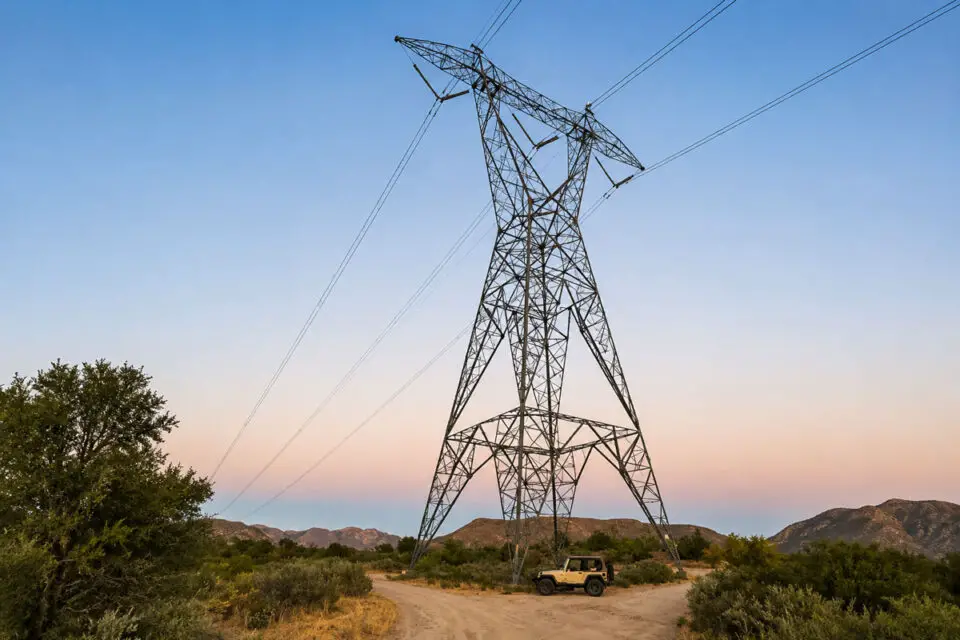
FALLBROOK — Fallbrook planners have joined a growing list of communities opposing San Diego Gas & Electric’s proposed Golden Pacific Powerlink project, which would cut through a portion of rural North County.
The project proposes building a 145-mile, 500-kilovolt electric transmission line from Imperial Valley to a substation near San Clemente in Orange County.
The transmission line would cut directly through Anza-Borrego Desert State Park, which covers a large swath of eastern San Diego County. The preferred route would run past Warner Springs and north of Palomar Mountain before cutting back through Temecula and the northern portion of Camp Pendleton.
There are three proposed alternative routes, including the South Mountain Alternative, which would curve south of Palomar Mountain around the La Jolla, Rincon and Pala reservations before heading north through Fallbrook near Interstate 15.
The project was originally identified through the California Independent System Operator’s transmission planning process in 2023. SDG&E assumed responsibility for building, owning and operating the new power line last year.
According to project officials, without new transmission pathways such as the Golden Pacific Powerlink, electricity cannot be delivered to major population centers with the highest demand. Constraints on transmission lines could also congest the grid, raise costs and reduce reliability during extreme weather or emergencies.
Several public and private organizations, as well as elected officials, have already opposed the project, including the Rainbow Planning Group, the Wildlands Conservancy, Temecula City Council and the Anza-Borrego Foundation.
On July 20, the Fallbrook Community Planning Group also voted unanimously to oppose the project.
“We are united against this proposed project, which if permitted by the California Public Utilities Commission, could significantly endanger the health and safety (especially in our high fire risk communities), economic vitality, community character and the overall well-being of our communities,” reads the group’s official statement.
Jeniene Domercq, a member of the planning group who chairs both its public facilities and power link ad hoc committees, said SDG&E and the state have left local leaders with more questions than answers about the project.
In addition to concerns about fire hazards, the project’s massive, 200-foot-tall towers that would hold the power lines also have raised questions about how they could affect aerial firefighting operations in the fire-prone, largely rural region.
The project’s potential environmental impact is also a major concern. Beyond running through California’s largest state park, it would also cross the Cleveland National Forest, come close to Palomar Mountain State Park and affect tribal lands.
“It’s a pristine area — it’s untouched,” Domercq said. “We’re concerned about sensitive species, we’re concerned about the impact to the local waterways — they don’t have answers as far as actual impacts, so we’re having to do a lot of research.”
Other concerns include the project’s potential noise pollution, both during construction and once the project is operational, as well as electromagnetic fields associated with the transmission line.
Domercq also said the power line may have a 1,000-foot-wide corridor.
“That’s a couple blocks for us in Fallbrook,” she said. “Once these areas are destroyed during construction, we can’t get that back.”
The planning group also states that the project would not provide any power grid benefits to San Diego and Imperial County residents, yet their residents “will bear the brunt of the environmental and safety consequences of this project.”
That runs counter to information on the project’s website, which states the project would support a stronger, more resilient statewide grid, improve the regional system, reduce grid congestion through additional transmission capacity and help maintain electric service during periods of high demand or emergencies such as heat waves or wildfires.
Additionally, according to SDG&E, the project would support electric vehicles, charging infrastructure, transit and electric-ready homes; create good-paying construction jobs; support long-term economic growth through a reliable grid; and meet increasing energy demand.
The project timeline estimates that if all state and federal permits are approved over the next three years, construction could begin as early as fall 2029, with the line entering service in 2032.
So far, affected communities have offered little support.
“There’s not one single community that this touches that is in favor — 145 miles of opposition is what they have,” Domercq said.
Supervisor Jim Desmond, who represents most of North County, is also a staunch opponent of the project.
“This is our backyard. That is our backcountry. That is our state park,” he wrote in an opinion piece published in the Escondido Times-Advocate in June.
For Desmond, the “Sacramento decision” is problematic because the California Public Utilities Commission isn’t “required to listen” to affected communities.
“The communities that take the impact have no vote in the decision. That is not how this is supposed to work,” he wrote.
Desmond also noted that San Diego County ratepayers would be responsible for roughly 9% of the project’s cost. According to Desmond, the project is estimated to cost $2.3 billion; however, the project website currently estimates the cost at $1.624 billion.
SDG&E will hold in-person open houses in communities directly affected by the power line. The first is scheduled for Aug. 25 from 4 to 7 p.m. at the Fallbrook Community Center, followed by another on Aug. 26 from 4 to 7 p.m. at the Embassy Suites in Temecula.
Two additional open houses will be held in October in El Centro and Borrego Springs.