
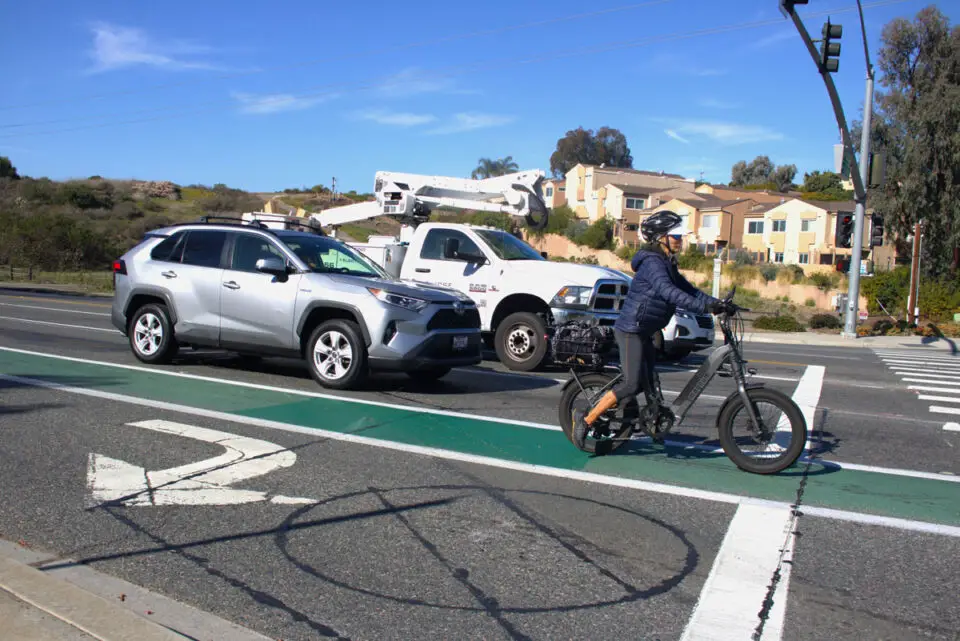
ENCINITAS — Encinitas has invested more than $58 million in roadway safety projects and doubled traffic citations over the past three fiscal years, but city leaders and residents agree that more work remains to achieve Vision Zero.
Dan Nutter, the city’s director of engineering, said during a special City Council meeting Aug. 26 that roadway safety comes down to the five E’s: engineering, education, enforcement, encouragement and evaluation.
From an engineering standpoint, the city spent more than $58 million between fiscal years 2024-25 and 2026-27 on a range of infrastructure projects, according to city documents.
Nutter called the financial commitment “extraordinary.”
“When I started putting these numbers together, I was actually amazed by all the money that we are putting towards the five E’s,” he said. “It’s not just talk here at the city. Really, it is a huge investment and extremely important to us.”
Nutter noted that the city’s use of state laws allowed it to reduce speed limits throughout Encinitas. A 2025 analysis found that overall vehicle speeds declined by 2.2 mph.
Rail crossing improvements are on the horizon thanks to a recent $33.6 million federal grant that is “going to help make these three projects a reality,” Nutter said.
Other city engineering initiatives include rectangular rapid flashing beacons, or RRFBs, which Nutter said improve communication between drivers and pedestrians while providing a “cost effective solution that we can deploy very quickly.”
He said the city is also installing more pedestrian refuge islands in the middle of crosswalks, which “really helps break long crossings into smaller, more manageable segments.”
Looking ahead, Nutter said the City Council would discuss red-light cameras at its Sept. 9 meeting.
The city’s education efforts include the “Know Your Limits” campaign and e-bike training and informational sessions.
Traffic Enforcement
Capt. Shane Watts of the North Coastal Sheriff’s Station said he would continue exploring ways to maximize his resources to “change driver behavior with maximizing enforcement,” but added that education was also a major point of emphasis.
“A lot of times the person that leaves with a warning comes away with just as much as someone who leaves with a ticket,” Watts said.
He emphasized taking a “whole-circle approach” and working with community partners such as Safe Streets Encinitas and the Mobility and Traffic Safety Commission.
Watts also presented data showing that enforcement had increased, partly because of maximum-enforcement “blitz” days that he said other sheriff’s stations have contacted him to learn about.
Between January and July, deputies issued 5,358 citations for all types of violations and made 118 arrests for driving under the influence, according to data compiled by the Sheriff’s Office.
During the same period in 2025, deputies issued 2,655 citations and made 75 DUI arrests.
“It’s only meaningful if the results are meaningful,” Watts said. “The real goal is to change driver behavior so that our roadways are safer.”
All types of vehicle collisions declined from 195 during the first seven months of 2025 to 172 during the same period this year. DUI-related collisions declined from 49 in 2024 and 45 in 2025 to 27 through the first seven months of 2026.
“I’m optimistic to think that we are changing that driver behavior,” Watts said. “I think people are paying more attention. They’re not on their cell phones like they were. They’re not speeding as much as they were.”
He added that reviewing such data and “heat maps” showing where violations or collisions are most likely to occur is a major part of his team’s evaluation process.
“I do not want to lose one life on our roadways,” Watts said.
Public voice
City Clerk Pete Weichers said 20 people signed up to speak at the meeting.
Some speakers offered suggestions for how the city could better deploy its resources to address roadway safety needs at specific locations. Some said RRFBs might not be as effective around sundown on east-west roads in certain parts of the city.
Others called for more public reviews of locations where fatal collisions have occurred, including ways to make motorists aware of those deaths.
Ron Medak, an Olivenhain resident and member of the Mobility and Traffic Safety Commission, called for a committee to explore how physical measures such as raised crosswalks, roundabouts or rumble strips could be used to slow drivers.
“Unfortunately, there’s a subset of drivers that are incorrigible and dangerous to all of us,” Medak said. “And we can’t stop them alone by trying to stop their behavior. We need to actually physically slow those vehicles.”
Fabian Gonell, an Encinitas resident and attorney, said action must take precedence over conversation. He added that while the city’s infrastructure investments were admirable, much of the money went toward maintaining existing roadway configurations rather than pursuing new, safer designs.
“It’s past time for real action to slow traffic and actually improve safety,” Gonell said. “Repaved roads do not actually slow traffic. If anything to the contrary, how about things that actually slow traffic and actually improve safety?”
Council weighs in
Mayor Bruce Ehlers directly addressed Gonell’s remarks, saying, for example, that declaring a state of emergency would not unlock many new avenues for the city to pursue solutions.
“I don’t know that words and declarations are the most important thing here tonight,” Ehlers said. “I think as Fabian said, actions – very particular actions. Let’s continue building better roads, safer roads where appropriate. Let’s continue the enforcement. Let’s add to the enforcement.”
He said solutions such as separated bike lanes are “not a panacea for perfect safety.”
“It’s all going to come down to driver behavior ultimately, so, we really need to change that,” Ehlers said. “My bottom line here [is] what we’re doing here is not one action. It’s a complete breadth of actions. And I think you heard tonight that that’s what we’ve been doing.”
Councilmember Marco San Antonio said he appreciated hearing from the community but acknowledged that more work remained.
“I’ve talked to you guys at Safe Streets enough about it and I believe in it. I believe that we are doing a lot, but can we be doing more? Of course,” San Antonio said. “That is what we’re here for. We’re here to continue the work. We’re here to continue to build on what we’ve done now into the future.”
Councilmember Luke Shaffer said countdowns on yellow traffic lights, similar to those used at intersections in Ensenada, Mexico, might be worth exploring. Shaffer also said he appreciated resident Judy Berlfein’s idea of having people cross busy intersections according to their mode of travel — by car, bicycle or on foot — to create fewer points of conflict among road users.
“I would say that slow is important,” Shaffer said. “I think that separate is better.”
Shaffer added that he believed the sheriff’s traffic enforcement blitzes had been effective and thanked law enforcement for its overall presence.
Councilmember Joy Lyndes also praised Watts and his team.
“I feel like our sheriff has done a really, really good job. Kudos to Captain Watts,” Lyndes said. “I’d like him and his team to continue to do a great job and be as well funded as we need. What I would like us to do here now then is to do as well as he’s doing.”
For Lyndes, protecting children was the throughline of any roadway safety discussion. Moving forward, she voiced support for road design changes intended to encourage drivers to slow down and behave more safely.
“When the roadway allows a driver to go fast, they will be invited to go fast. And so I will place a lot of my emphasis more on our roadway design and what we can do to make our pedestrians and our bicycles safer.”
Deputy Mayor Jim O’Hara said much of the city’s progress stemmed from council members, city staff and other city officials “meeting onsite more often than ever before.”
As an example, O’Hara said a team visited the chicanes along Saxony Road in front of the Magdalena Ecke Family YMCA to meet with residents who use the road and observe the “failed infrastructure projects” before moving ahead with plans to improve that stretch of roadway.
Later that evening, during the regular City Council meeting, O’Hara questioned the impartiality of a Mobility and Traffic Safety Commission member as the council assigned subcommittee work.
Commissioner Leigh Ratcliffe is also a founding member of Safe Streets Encinitas. Ratcliffe and the organization have both advocated for the city to reinstate red-light cameras.
O’Hara called for Ratcliffe to be removed from the task of exploring speed cameras as a city policy and gathering information about them.
“I believe Commissioner Ratcliffe is not capable of providing an unbiased opinion on this,” O’Hara said. “She’s outspoken – already told us what she thinks. She’s already said she’s done her research. This is an important matter. We need an unbiased report back .. I believe we need to remove this commissioner from that subcommittee for the best interest of the city.”
Lyndes pushed back, arguing that Ratcliffe should remain on the subcommittee.
“I feel like our deputy mayor has accused one of our commissioners of bias and I think that’s inappropriate,” Lyndes said.
Lyndes asked the city attorney for guidance, saying Ratcliffe’s removal from the subcommittee would “limit the commissioner’s ability to do the work that her commission has assigned to her.”
City Attorney Ajit Thind acknowledged that all commissioners bring their own experiences and perspectives. He said the work plan falls within the council’s purview but that, typically, after a subcommittee reviews an item, the matter goes before the full commission for review before a recommendation is made to the council.
Lyndes later noted that Medak, for example, had been tasked with investigating the use of bollards despite publicly opposing bollards as a bicycle safety tool.
O’Hara said the difference was that Medak’s subcommittee included another person.
“I also think that Commissioner Medak has not joined a group, opened up a social media account promoting a subject on any of these things,” O’Hara said. “And there’s a vast difference once you’ve done that.”
Ultimately, the council reached a compromise by adding another commissioner to the speed camera subcommittee. Ehlers said he appreciated the compromise and what it would mean for the commission’s discussion.
“I purposely wanted a mix of opinions on the commissions because I want the disagreement to occur there, not here or less here,” the mayor said. “I want the discussion to occur there. I have no problem with Commissioner Ratcliffe. I wouldn’t have put her on the commission if I thought she couldn’t do good work and bring it to us.”
Correction: An earlier version of this story incorrectly stated the type of camera to be discussed by the MTSC in the upcoming year.
Related Articles:
- Election Q&A with Oceanside City Council candidates October 22, 2024
- Election Q&A with Carlsbad City Council, city… October 23, 2024
- Election Q&A with San Marcos Unified school board candidates October 21, 2024
- The decades-long battle for Ponto reaches a crossroads July 7, 2026
- Election Q&A with Vista City Council candidates October 18, 2024
- Hundreds of new homes test rural Bonsall February 17, 2026



1 comment
I don’t like fraudulent goals.
“Vision Zero” “aims to achieve a roadway system with no fatalities or serious injuries involving road traffic”. Give me a break.
Taken literally, this is irrational and unachievable without banning people.
Cars, motorcycles, bicycles, skateboards, pogo sticks, and even walking can and have caused serious injury or death to people.
Why can’t “a well designed and maintained road system” be a goal- it’s an actual thing worth having!