ENCINITAS — In a letter to his wife Abigail dated July 3, 1776, future President John Adams laid out his vision for how posterity would celebrate the following day.
“I am apt to believe that it will be celebrated, by succeeding Generations, as the great anniversary Festival,” Adams wrote. “… It ought to be solemnized with Pomp and Parade, with Shews, Games, Sports, Guns, Bells, Bonfires and Illuminations from one End of this Continent to the other from this Time forward forever more.”
A Frenchman by way of Ireland, who had originally offered to provide fireworks for the war effort, would answer that call by illuminating the first anniversary of the signing of the Declaration of Independence.
The legacy of Jean Laugeay, who also went by John, has come to light through meticulous research published in a book by family genealogists — and longtime Encinitas residents — Denruth and Denis Lougeay, the latter a direct descendant of Jean.
Denruth, who goes by Denee, received a call from her son Gregg in 2009 after he discovered that someone sharing the family’s last name appeared to have been involved in the revolutionary hotbed of 1770s Philadelphia. Gregg asked his mother whether she had come across the figure in her genealogical research.
“After that, the search was on,” Denee told The Coast News. “It became more of a mission to find out his place in basically the founding of the United States. I call him a minor Founding Father only because he has been unknown for 250 years.”
Born Jean Baptiste Laugeay in the Bordeaux region of France on Sept. 28, 1736, and baptized in the Cognac region, his first trade was winemaking and grape growing. Jean later served in the French army, where he had “been brought up to the Art of Artificial Fire Works,” according to a letter he wrote to the Continental Congress in 1776.
He later appears in records at a Huguenot church in Dublin, Ireland, where he married Ann Boutin. The couple endured tragedy when four of their six children, all girls, died in infancy or toddlerhood. They eventually relocated to the American colonies, setting the stage for Jean’s future role in American history.
“We think he came over to the United States with his wife and the two boys in around 1771 — probably because of politics,” Denee said. “But also probably because, I mean, to lose four of six children over a very short number of years, probably prompted the move and a fresh start — at least that’s what we think.”
The family settled in Philadelphia, then the largest city in the colonies, with about 40,000 residents — smaller than Encinitas’s population today.
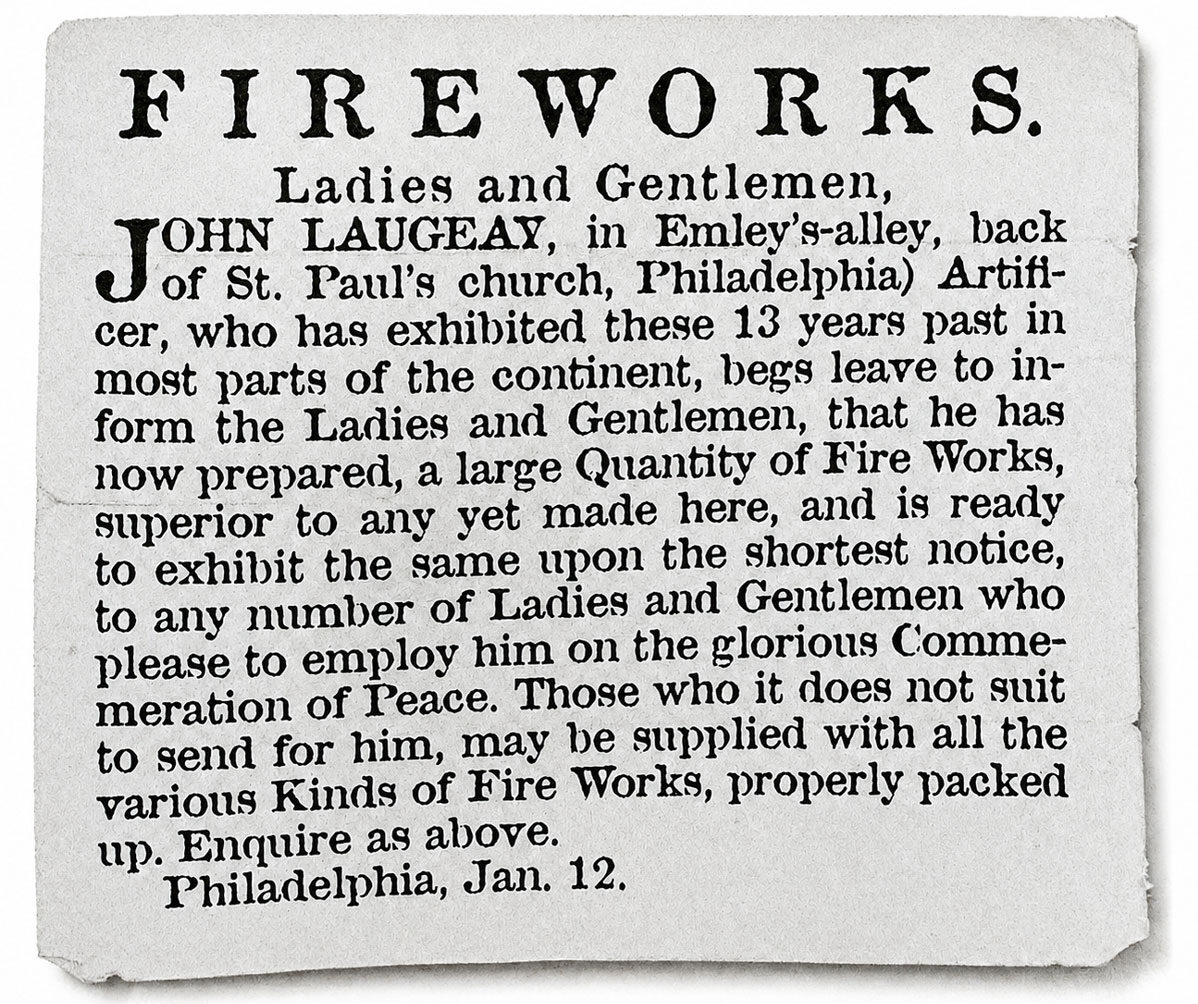
Records show Jean — who often advertised his services under the name John — owned multiple properties in the densely populated city, just blocks from the State House, City Tavern and the location where Thomas Paine wrote his famous pamphlet Common Sense. He also owned a warehouse along the waterfront.
Denee has uncovered more than a dozen references to Jean in newspapers and colonial records from the 1770s and 1780s.
In a 1772 edition of the Pennsylvania Gazette, he offered his services to prospective winemakers and grape growers.
In the June 23, 1773, edition of the Pennsylvania Journal, Jean advertised tickets for a July 14 display of “a very grand and magnificent FIREWORK, superior to any thing of the kind ever shown here.”
His advertisements frequently referenced events at City Tavern. Denee said that was significant because the tavern served as a gathering place for many of the Founding Fathers, including George Washington, Benjamin Franklin, Samuel Adams and other future signers of the Declaration of Independence.
“They go there for celebrations,” she said. “They go there for regular meals. There were other taverns they also went to, but this one was particularly well known. And this is often where Jean would let off his fireworks.
“I’m sure this is where he ate because that’s where he’s selling tickets, and I think he saw these Founding Fathers in and out for days and knew some of them, talked with some of them.”
Denee said that if she could have dinner with one historical figure, the choice would be easy.
“It would certainly be John,” she said. “‘What did you see? Who did you talk to? What was life like in the colonies at that time where the Declaration of Independence was signed?’”
In the first of three letters he sent to the Continental Congress, Jean wrote on Aug. 28, 1776, that he could use his “Artificial Fire Works” to “make signal and Render lights” to locate the enemy at night with the assistance of strategically placed spotters.
Military records indicate he later served at Valley Forge, about 20 miles from Philadelphia.
“He was a very patriotic person, very committed to the United States,” Denee said.
Jean wrote a second letter to the Continental Congress in 1779 offering to perform another fireworks display and a third requesting payment for his previous efforts. Military records also show he was “taken in” on July 4, 1777, which Denee said meant he was absent that day before returning to camp after participating in the first anniversary celebration of the signing of the Declaration of Independence.
Taken together, the historical records paint a vivid picture of the nation’s first Independence Day celebration.
“I imagine he got on horseback — maybe one or two days earlier,” Denee said. “I’m sure he had men that were helping him do these numerous fireworks, and they did — they executed them — and then he returned back to the Pennsylvania 5th regiment. That’s my scenario.”
She added that, unlike later displays featuring a wide array of colors and designs, the fireworks Jean launched would have all been yellow-orange.
The Pennsylvania Evening Post described the occasion by reporting “the city was beautifully illuminated” at night by “a grand exhibition of fireworks.”
“Everything was conducted with the greatest order and decorum,” the report continued, “and the face of joy and gladness was universal.”
Denee said she continues to uncover more about Jean and the remarkable role he played in the history of America’s Independence Day celebration.
An immigrant, soldier and inventor fighting for the American cause during the Revolutionary War, Jean left his post to help stage the first celebration of the Declaration of Independence. He lived among the Founding Fathers and helped bring to life their vision for how the nation would commemorate its birth.
“There’s still more to be found,” she said. “But no one’s ever been curious enough or known how to find this out in all these years, and that just is what surprised us — that he was related to us was even more of a surprise — but you know, you’d think people would have been able to discover this, but no.”