
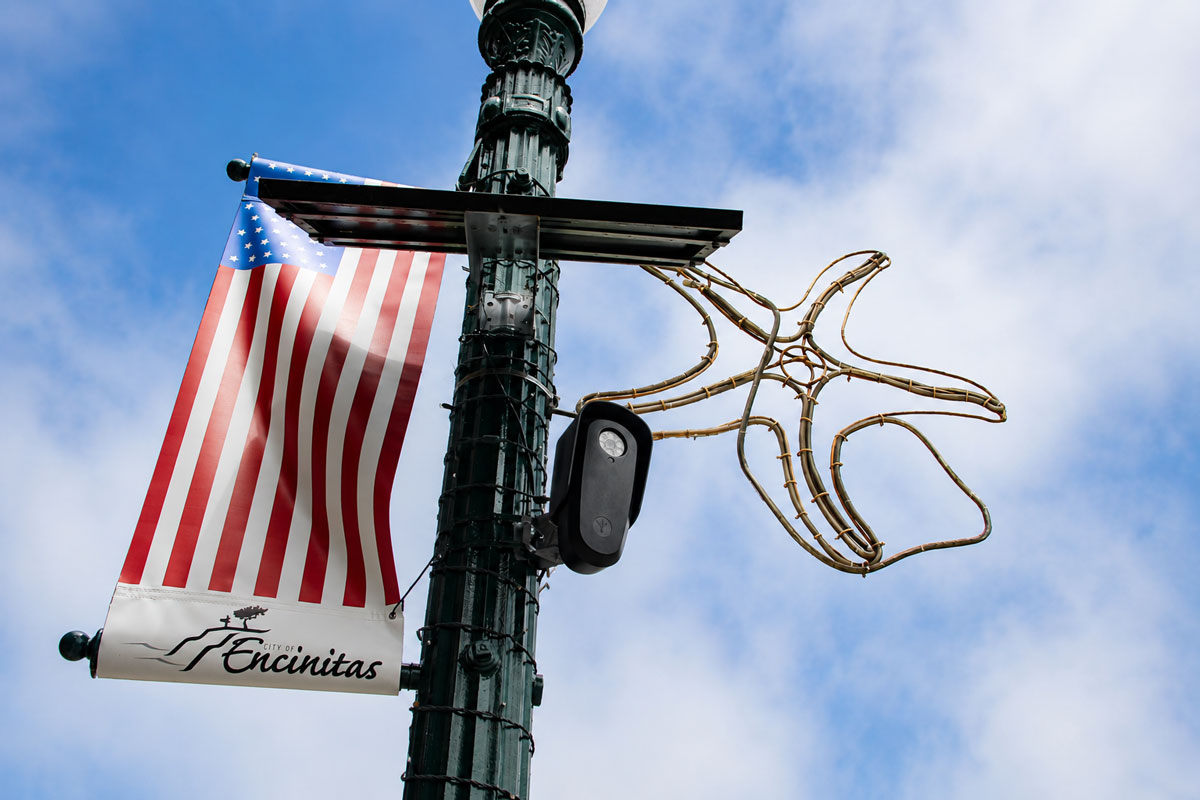
ENCINITAS — Thousands of motorists driving through Encinitas each day likely don’t notice the small black cameras mounted on light poles above intersections and major roadways.
Unlike red-light cameras that photograph violations, these devices catalog nearly every vehicle that passes beneath them. Within seconds, the cameras record a vehicle’s license plate, make, model, color and other characteristics — everything from roof racks and bumper stickers to paint scratches and dents.
The information can then be searched by law enforcement investigating crimes.
For the San Diego County Sheriff’s Office, the technology has become a valuable investigative tool.
For privacy advocates, it represents the expansion of a nationwide surveillance network à la George Orwell’s “1984,” capable of documenting the movements of millions of law-abiding Americans.
Those competing views of automated license plate reader, or ALPR, cameras continue to fuel a national debate over how much privacy communities are willing to sacrifice in exchange for public safety.
Encinitas first embraced the technology in 2022, approving seven license plate reader cameras after sheriff’s officials said they would help deputies identify stolen vehicles, locate wanted suspects and solve crimes more quickly.
Two years later, the City Council approved an additional 17 cameras from Atlanta-based Flock Safety, bringing the city’s network to 24 cameras at key entry and exit points.
At the time, the city’s expanded program drew relatively little public opposition. Residents who addressed the City Council largely praised the cameras as a tool to help deputies investigate crime, citing few drawbacks.
“I support any reasonable technology that helps keep our community safe,” resident Tim Bratton wrote in comments submitted to the city. “These cameras provide law enforcement with another investigative tool while requiring officers to continue developing probable cause before taking enforcement action.”
Encinitas resident Desiree Gonzales, who survived a hit-and-run collision, urged the city to approve more cameras, writing that she wished investigators had the technology when her own case was under investigation.
“If these cameras can help another victim find justice,” she wrote, “they’re worth having.”
While the Sheriff’s Office said Flock cannot provide search data specifically for Encinitas cameras, only for its countywide ALPR network, law enforcement officials pointed to several cases in which ALPRs helped investigators identify suspects and recover stolen property, including a string of residential burglaries in Encinitas, Del Mar and Solana Beach in 2025.
In that case, surveillance cameras repeatedly captured an early 2000s gold Lexus near several burglaries but failed to capture its license plate. Detectives searched ALPR records using the vehicle’s description and the times and locations of the crimes.
Flock cameras identified a gold 2002 Lexus ES300 near two of the burglaries, providing investigators with a license plate and registered owner. Detectives later searched the owner’s home, where they recovered stolen property and clothing matching what the suspect wore during the crimes, according to the Sheriff’s Office.
The suspect was arrested on multiple burglary counts and linked to numerous residential burglaries across the county. The Sheriff’s Office said the case shows how ALPRs can provide investigators with leads when other avenues fall short.
“The San Diego County Sheriff’s Office firmly believes that when used responsibly, with rigorous oversight and transparency, ALPR cameras are an invaluable tool for keeping our communities safe,” the department said in a statement. “The Sheriff’s Office uses Flock safety technology to capture objective evidence while ensuring individual privacy is not compromised. To ensure proper usage and maintain transparency, the Sheriff’s Office has implemented strict policies and safeguards to protect civil liberties and has made relevant policies and usage statistics available to the public.”
In 2024, sheriff’s officials also told city leaders that crime in Encinitas declined 14% during 2023 while the initial camera network was in operation, though they did not attribute the drop solely to the technology.
“License plate readers are a force multiplier,” sheriff’s officials told city leaders during a May 2024 presentation, explaining that deputies cannot be everywhere at once, but cameras can continuously monitor vehicles entering and leaving the city.
Mayor Bruce Ehlers told The Coast News that he supports the city’s ALPR program and has not seen evidence that the system has been misused.
“So far, I have not seen any breach in how we use them,” Ehlers said. “Obviously, if there is a privacy violation or failure to follow the licensing that limits their use, that’s a different world. According to the sheriff, they’ve been very useful in solving several cases. There have been times when sheriff’s Capt. Shane Watts said, ‘ALPRs led us to the actual perpetrator,’ and they were able to solve the crime.”
Regarding privacy concerns, Ehlers emphasized the distinction between tracking vehicles and people.
“They aren’t filming people, and they aren’t storing facial images,” Ehlers said. “They are storing the license plates and car descriptions. (The cameras) track vehicles, and I think it’s a very good tool for increasing the efficiency of law enforcement.”
The mayor said those capabilities can be particularly valuable when investigating more sophisticated criminals, including South American burglary theft rings that quickly travel between jurisdictions. A spike in residential burglaries across North County over the last few years has even prompted the Olivenhain neighborhoods of Wildflower Estates and Brookside Lane to install private ALPR systems.
“I thought it was brilliant,” Ehlers said of the private systems. “They are protecting their own neighborhood.”
While he supports the city’s program, Ehlers stopped short of calling for more cameras, saying law enforcement would need to demonstrate that additional ALPRs were necessary before the city spent more money.
Since November 2022, Encinitas has steadily increased its investment. In 2024, the city spent $53,550 on 17 Flock Safety cameras. Public records show the annual cost of operating all 24 cameras is approximately $75,000 through the city’s contract with the San Diego County Sheriff’s Office.
According to the city, the license plate readers cost $3,150 each per year.
“I think we have a modest amount of cameras, and I think we’re seeing results,” Ehlers said. “It would take another presentation or study showing us there is a gap in our coverage to convince me that we need more.”
Encinitas is not alone in embracing the technology. In recent years, neighboring North County cities have also approved or expanded automated license plate reader programs, though the size varies by jurisdiction.
The Del Mar City Council also approved an ALPR program in 2022, agreeing to install five cameras at major intersections. The cameras use technology from Rekor Systems, a separate ALPR provider, and were approved with a 90-day limit on holding data.
Neighboring Carlsbad, roughly twice the size of Encinitas, operates a much larger ALPR network. Carlsbad police currently operate 126 fixed license plate readers and three additional cameras mounted on parking enforcement vehicles, according to the city, but do not operate ALPRs in patrol vehicles.
Carlsbad uses Vigilant Solutions for its city-owned ALPR system. The department previously had access to Flock Safety’s network, but Flock terminated that access in January 2026, according to the city.
Some homeowners associations in Carlsbad independently operate Flock cameras, but the Police Department said it does not currently have access to those systems and does not know which associations operate them.
Carlsbad’s use of license plate readers and data has previously drawn scrutiny. A 2022 inewsource investigation found Carlsbad was among five San Diego County police departments that had shared ALPR data with out-of-state law enforcement agencies in violation of state law. Carlsbad subsequently changed its policy to restrict sharing to California agencies.
The city said Carlsbad’s violation involved a single inadvertent data share with an agency in Nevada, while other out-of-state sharing identified in the inewsource investigation involved other San Diego County agencies.
Then, in late 2025, Carlsbad’s access to Flock’s network drew scrutiny after a resident alleged that three out-of-state law enforcement agencies had conducted immigration-related searches that appeared to include Carlsbad data. However, Flock later confirmed that the city did not store its ALPR data in the company’s system and that no Carlsbad police data was accessed through those searches, according to the city.
Carlsbad prohibits sharing ALPR data with federal or out-of-state law enforcement and performs regular audits. In a 2025 memo, the city reported 99.7% compliance with ALPR documentation requirements and no improper data sharing.
Mass surveillance?
California has one of the nation’s more comprehensive laws governing ALPR systems. The state’s 2015 Automated License Plate Reader Privacy Act requires operators to publicly disclose how they use the technology, how long they retain data, how information is shared and audited, and who oversees the system.
Despite those safeguards, communities that once welcomed ALPRs are increasingly questioning whether existing rules provide sufficient protection against misuse.
A primary concern for privacy advocates is that, unlike traditional red-light or traffic cameras, Flock’s system does more than simply photograph license plates.

Using artificial intelligence, the cameras create what the company calls a “vehicle fingerprint,” cataloging a vehicle’s color, make, model, visible accessories and other identifying features. The information is then stored in a database used by participating law enforcement agencies.
Flock Safety, one of the nation’s leading providers of ALPR technology, was co-founded in Atlanta in 2017 by CEO Garrett Langley. The company has since expanded to include AI-assisted video cameras, mobile surveillance trailers, audio sensors designed to detect gunfire and drones that respond to emergencies.
Flock says the cameras do not use facial recognition technology and are designed to identify vehicles, not people. The company also says agencies generally keep data for 30 days unless specified by state or local laws, and that the technology is intended to generate investigative leads.
Over the past year, however, several cities and law enforcement agencies have canceled, suspended or declined to renew contracts with Flock amid concerns about privacy, data sharing and government surveillance.
El Cerrito and South Pasadena have removed Flock cameras after their city councils voted not to renew agreements, while communities in Connecticut, Michigan and New York have either ended or scaled back their programs following public outcry.
The Los Angeles Police Department, which has access to nearly 2,000 ALPRs — 298 cameras mounted on poles throughout the city and more than 1,600 ALPRs in patrol cars — declined to expand the program after the Office of Inspector General raised concerns about data privacy, oversight and how officers use the technology.
Los Angeles Mayor Karen Bass went further on Aug. 6, calling on the LAPD to end its relationship with Flock and find another ALPR provider. Bass said the company had “lost the trust of Angelenos” amid concerns that information was being accessed by federal authorities for immigration enforcement.
Flock Safety did not respond to requests for comment.
Multiple lawsuits have also challenged ALPR networks despite their nationwide rise.
In August, three San Jose residents, represented by the Institute for Justice, filed a federal class-action lawsuit alleging the city’s network of 474 license plate readers amounts to warrantless mass surveillance in violation of the Fourth Amendment. The lawsuit argues thousands of government employees can access and search vehicle data with limited oversight, creating the potential for abuse.
Other lawsuits have alleged that data was improperly collected, stored or shared, ranging from officers allegedly using the systems to assist federal immigration enforcement and monitor protesters to, in some cases, stalk former partners.
In October 2025, California Attorney General Rob Bonta sued the city of El Cajon, alleging the city’s police department repeatedly shared ALPR data with law enforcement agencies in more than two dozen states in violation of state law, according to a CalMatters report.
‘They’re always watching’
For law enforcement, one of the technology’s primary advantages is that, unlike manpower, ALPR cameras don’t take breaks, call in sick or end their shifts.
“They’re always watching,” sheriff’s officials told the City Council in 2024.
Cameras positioned at major entry and exit points effectively serve as unflinching digital witnesses, documenting vehicles entering and leaving the city around the clock.
Instead of relying solely on eyewitnesses, whose recollections of events and details can be incomplete or requesting security footage from nearby businesses, detectives can quickly search for a suspect vehicle’s license plate or whittle down results by looking for a particular color, make and model.

For example, a witness who remembers seeing “a white pickup with a ladder rack” or “a blue Honda SUV” can provide enough information for investigators to get started.
Supporters have voiced a familiar argument when discussing government surveillance: If you aren’t breaking the law, you have nothing to worry about.
“I know some folks will object, but as my police officer father often told me, surveillance scares criminals, not honest people,” wrote Encinitas resident Heather Pilgram in a May 2024 letter to the council.
But opponents argue privacy is not simply about concealing wrongdoing.
In a 2007 essay, “‘I’ve Got Nothing to Hide’ and Other Misunderstandings of Privacy,” George Washington University law professor Daniel Solove argued that the “nothing to hide” rationale misunderstands privacy by assuming surveillance is harmful only when it exposes wrongdoing. Privacy also protects people from the misuse, aggregation and unintended use of personal information.
Village Park neighborhood resident JT Moring, 69, said he supports using ALPR technology to catch criminals but believes the city should clearly understand who can access the information and how it can be used.
“By all means, let’s try to catch criminals driving around our city, but let’s not put innocent people at risk through that technology because we haven’t bothered to monitor how it’s being used,” Moring said.
Moring said he also supports red-light cameras because they serve a narrowly defined purpose and can encourage drivers to be more cautious. For Moring, the difference between those cameras and ALPRs ultimately comes down to what happens to the information after it is collected.
“Red-light cameras have a very specific and limited purpose,” Moring said. “As far as doing their job — run a red light, take a photo, log a ticket — that’s good. If (license plate readers) are logging everyone who drove through the city and sending it to Big Brother, that’s another question.”