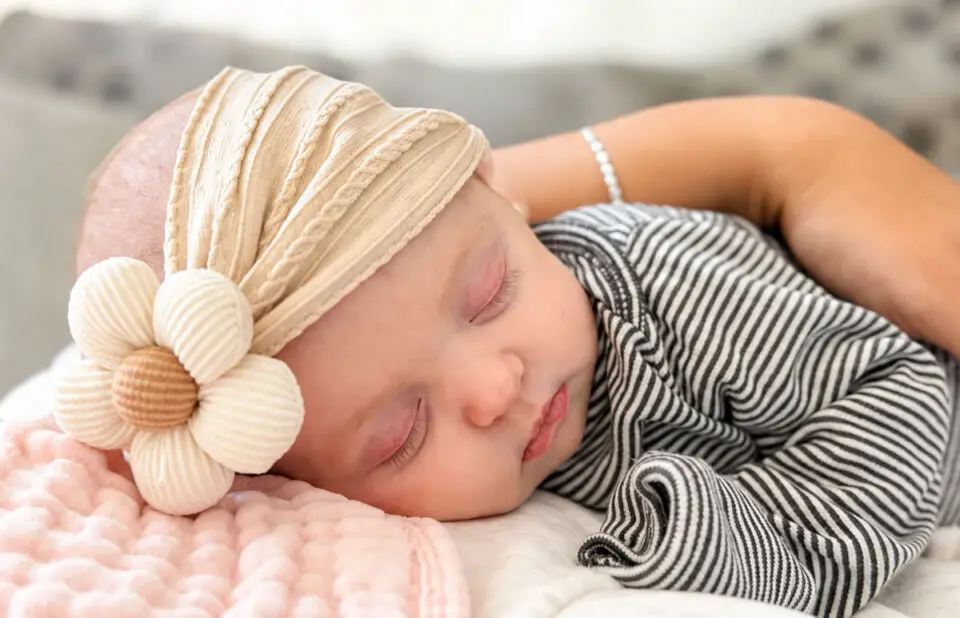
CARLSBAD — After doctors determined that their daughter was not strong enough for a heart transplant, a Carlsbad Navy family began searching for an experimental treatment for her rare genetic disorder.
Delaney Holian, 10 months old, was born with Noonan syndrome with multiple lentigines, a rare genetic disorder that can affect the heart, hearing and other parts of the body. The condition is linked to changes in the PTPN11 gene and can cause small, dark spots on the skin called lentigines.
Delaney has hypertrophic cardiomyopathy, a condition in which the heart muscle thickens, making it harder to pump blood. She was also born deaf. There is no cure for the genetic disorder.
Doctors initially told her parents, Daniel and Erin Holian, that Delaney might survive only 48 hours and later gave her about a 20% chance of reaching her first birthday.
Now approaching that milestone, Delaney is a happy baby who loves to laugh and spend time with her three older siblings, her mother said. She also has blue eyes, while both of her parents have brown eyes.
At a 37-week ultrasound, doctors informed the Holians of serious complications, prompting an early delivery.
“So I had 28 people in the delivery room,” Erin Holian said. “She came out, and they didn’t even let me hold her. They just took her, and then they put her in an ambulance and took her to a different hospital. So now I am babyless in the hospital recovering … I thought that I had a, you know, normal pregnancy.”
Delaney spent the next six weeks in the neonatal intensive care unit, where doctors delivered more devastating news to her parents.
“We would go visit her in the hospital where she was for 6 straight weeks and every day, somebody would come in and almost hand us a grenade, pull the pin out and then walk out,” Erin Holian said. “They were like, ‘we think she has a terminal …’ and then they’ll do genetic testing and then someone will say, ‘oh, she has Noonan syndrome.’ And then come in and say, ‘Her heart is so bad. It’s terminal, and she’ll probably need a heart transplant.’ Pull the plug on that grenade, walk out.”
Her mother said a hearing test also revealed that Delaney was deaf.
“They did a hearing test on her … and she’s completely deaf from her syndrome,” Erin Holian said.
The family continued to hope that a heart transplant might be an option. But doctors ultimately determined that Delaney was not strong enough to undergo the procedure, her mother said.
“Up until two months ago, we had one last lifeline,” Erin Holian said. “Delaney could receive a heart transplant … that was a fallback option. And that door closed two months ago when Rady Children’s decided that she wasn’t strong enough to make it through a transplant. And that’s when I think that was the fourth grenade that they handed us.”
The news left the family devastated.
“I just hit the floor,” Erin Holian said. “We both did because we, basically they were telling us, ‘Nothing else can be done.’ Current medicine has reached the limits of what it can do.”
In search of alternatives, the family reached out to friends.
“Dan and I turned to our network of friends,” Erin Holian said. “And just sent a picture of Delaney and a whole description of what was happening and just blasted it to everyone and said, ‘Help us. We need your help …’”
The search eventually led the family to Ross McCray of Rancho Santa Fe-based Thesis Labs, a bioengineering company using artificial intelligence to advance research into rare genetic disorders.
The company has used Delaney’s genetic information to design a potential individualized therapy aimed at her heart condition, according to the family. The proposed treatment remains experimental and would need further development and testing.
“Thesis has begun construction and testing on the next iteration of our robotic genetics laboratory, which we will leverage to develop and validate potential interventions for Delaney,” McCray said.
Developing treatments for rare diseases remains a challenge. Fewer than 5% of the more than 10,000 estimated rare diseases have approved treatments, according to the National Institutes of Health.
The family has also received support from Noonan syndrome expert Dr. Bruce Gelb of Mount Sinai, as well as Rady Children’s Hospital and UC San Diego, Erin Holian said.
“What we’re doing is we’re going to grow Delaney’s stem cells,” Erin Holian said. “UCSD caught wind of this, Rady Children’s caught wind of this, and they are now, for free, partnering with us to grow her stem cells, and then make a copy and send them to three different labs for their scientists to do experiments and try to make this treatment for her.”
McCray said Thesis plans to use its laboratory to help advance the search for a treatment.
“We believe that combining fully automated wet lab execution and data capture with AI-led experimental analysis and design will unlock a new breadth and depth of genetic research to help Delaney and millions of other people suffering from rare and ultra-rare genetic disorders,” McCray said. “We are excited and honored to work alongside a world-class team of experts to bring the best possible outcome for Delaney and her family. The new laboratory will be operational in Q1 2027.”
The effort also inspired the Holians to launch a nonprofit, Rare to Scale.
“We’re doing this for Delaney, and we want to scale it to do for the next families with children with rare diseases,” Erin Holian said. “And that’s our mission, and that’s why we started … our nonprofit. And we need to raise money for that.”
The nonprofit and a GoFundMe campaign are raising money to support the effort to develop a treatment.
“We haven’t made the medicine,” Erin Holian said. “That’s the big part that we’re raising money for … and that’s what costs millions.”
Whether the research will produce a safe and effective treatment for Delaney remains uncertain.
“We’re racing the clock,” Erin Holian said. “We can’t accept that she just will die.”