I was first introduced to Indian food in New York City decades ago. I was a transplant from Milwaukee, Wisconsin, where our family enjoyed all of the international specialties that came from the Midwest, such as German, Ukrainian, Polish, Norwegian and, of course, Italian and Chinese.
But in the 1960s, the cuisine of India had not yet reached Milwaukee. So, when I lived in New York City, I tried to sample as many varieties of cuisine as possible. One of the most memorable Indian restaurants was a tiny hole-in-the-wall that served tandoori chicken, naan made on the open grill and a condiment selection that took up half the table.
Pickles, sliced vegetables, toasted garlic, curry spice mixtures and the largest array of chutneys I had ever seen were all conveniently placed in a lazy Susan in the middle of the table. I left the restaurant with my clothes smelling of the musky flavor of the exquisite food and infinitely satisfied to have tasted a new cuisine.
As my search for food preservation techniques continues this week here in SoCal, I will feature chutney as a condiment as well as a food preservation technique.
I located a highly informative blog, “Cooking with Madhu,” by Madhu Gadia, which not only gives us historical background but a plethora of recipes as well. Among them, she shares the Indian classic genre of dishes called chutney.
From her blog:
“Per the dictionary, ‘Chutney is a spicy condiment made of fruits or vegetables with vinegar, spices, and sugar, originating in India.’ The word chutney is derived from the Hindi word ‘chatna,’ which literally means ‘to lick’ — finger-licking goodness.
“Chutneys and pickles are as Indian as curries. The concept of chutneys is no longer new to the Western world; they have become as well-known as salsa. Indian chutneys are typically piquant — with all its synonyms, hot, spicy, tangy, and sharp — palate-pleasing condiments that liven up any dish. They can also be sweet and mild.”
Try your first chutney
Although there are a multitude of books about chutneys, I located a gem at Cole Library in Carlsbad. “Cold Canning,” by Bruce Weinstein and Mark Scarbrough, introduces even the most newbie cook to the joy of creating chutneys.
“We serve our chutneys with the traditional curries and flatbread naan, but we also add liberally to more American fare such as burgers, hot dogs and sausages; and to our side dishes such as tuna or pasta salad.”
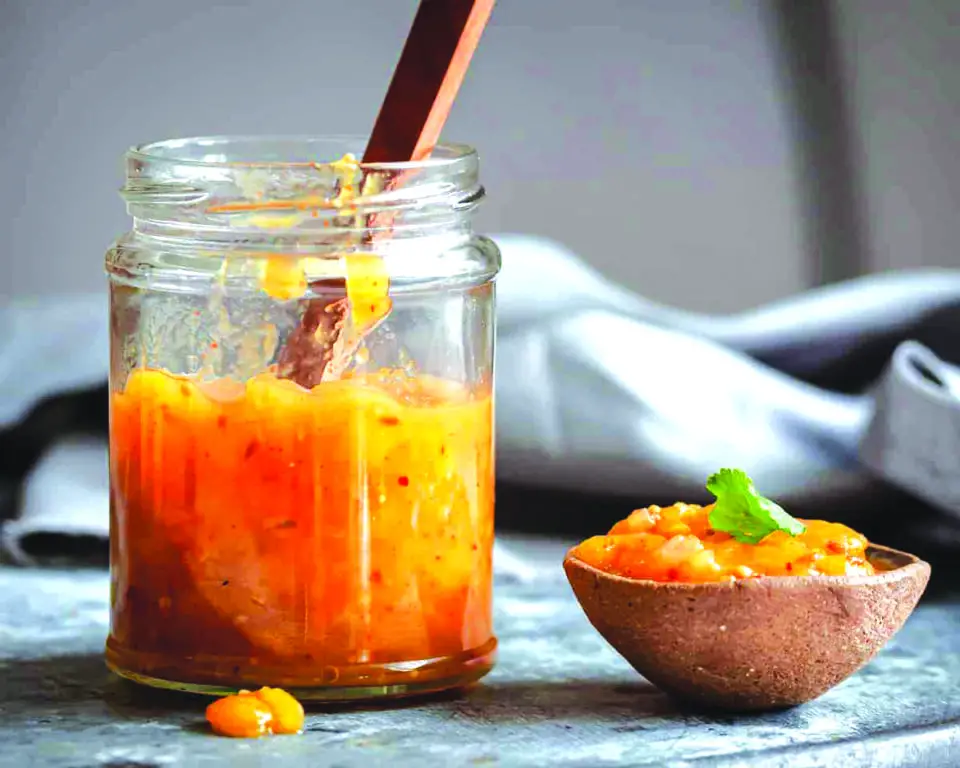
Since August is the best time of year to find local mangoes, here is their recipe for Classic Mango Chutney: “This one has a bright orange color and a fresh flavor, still redolent of the mangoes’ perfume. Ours is not spicy, it’s more spiky thanks to the crystallized ginger. Serve with raita and/or dal or curry or an American chicken salad.”
The “Cold Canning” cookbook goes on to feature Major Grey’s, Hot Tomato, Rhubarb-Chipotle, and the list goes on.
Classic Mango Chutney
(Makes 5 cups)
INGREDIENTS
• 4¼ pounds ripe mangoes (4 large to total 6 cups), pitted, peeled and chopped
• 2 cups granulated white sugar
• 6 tablespoons fresh lime juice
• 6 tablespoons white distilled vinegar
• ¼ cup chopped crystallized ginger
• One cinnamon stick
• 2 teaspoons fenugreek seeds
• 1 teaspoon yellow mustard seeds
• ½ teaspoon kosher salt
• ¼ teaspoon dried turmeric
DIRECTIONS
- Combine all the ingredients in large saucepan. Set the pan over medium-high heat, and cook, stirring often, until it comes to a boil, about five minutes.
- Reduce the heat to low and simmer, stirring to prevent scorching, until so thick that you can run a wooden spoon across bottom of pan and create a line that holds edges for a second. Total cook time 45 minutes.
- Turn off the heat, remove pan from burner, set aside for 2 minutes. Skim the surface to remove foam. Remove cinnamon stick.
- Transfer to five clean ½-pint jars leaving ½-inch headspace. Cover or seal. Refrigerate or freeze.
If you are looking for other chutney recipes featuring a variety of fruit and Indian spices, research the “Cooking with Madhu” blog or the Weinstein and Scarbrough cookbook — the possibilities are endless!
Jano Nightingale is a Master Gardener and horticulturist who teaches vegetable gardening at the Carlsbad Senior Center community garden. Call the Senior Center at 442-339-2650 to register. Contact her at [email protected] for upcoming classes and garden consultations.