It is the time of year when there might just be too much of one of the vegetables in our garden, and the UC Master Food Preservers of San Diego County have just the answers to our food preservation questions.
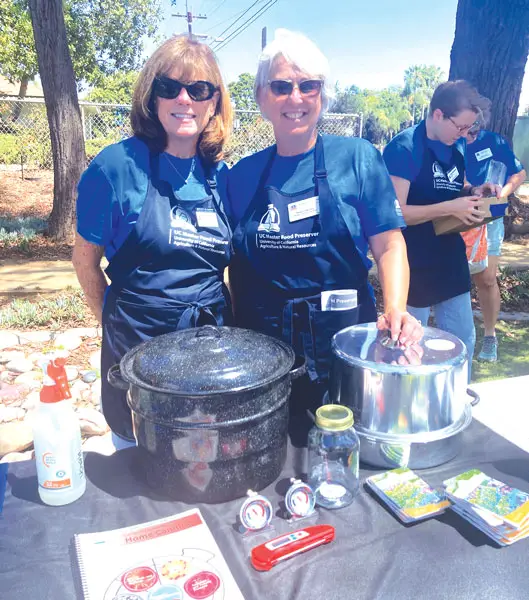
Three members of the group, Diane Foote, Megan Murfen and Ann Perreisa, visited the Cole Library in Carlsbad on Aug. 8 to present a full-scale demonstration, which covered all aspects of food preservation.
For those gardeners and cooks familiar with food preservation, the methods of canning, freezing and dehydration might be in your wheelhouse, but I, for one, had never explored the method of fermentation. Many health food stores carry newer versions of sauerkraut, kombucha and kimchi, but not many of us have ever tried fermentation in our own kitchen.
Foote explained the fermentation process of making sauerkraut this way: “Making sauerkraut is like making bread. You add a few ingredients, knead those ingredients, wait for a certain amount of time, and you get sauerkraut!”
How to make sauerkraut
Adapted from the UC Master Food Preservers of San Diego County:
Ingredients
(Weight and measurement are important – check website for larger amounts)
• One head green cabbage (weight 1¼ pounds)
• One quart wide-mouth Mason jar with new lids (don’t reuse old lids)
• Pickling salt (for 1¼ pound cabbage use 4½ teaspoon salt)
• One jar weight (available at hardware stores)
Instructions
(Recipe will fill one quart Mason jar)
- Remove outer leaves from the cabbage and rinse heads with cold water and drain.
- Cut the heads into halves and remove cores.
- Shred cabbage using sharp knife, mandoline or food processor.
- Once shredded, place cabbage in a large bowl and sprinkle with pickling salt.
- With clean hands, thoroughly mix the salt into the cabbage as if you were kneading bread.
- When all the salt has been added and dissolved and the cabbage is juicy, begin packing cabbage firmly into jar.
- Use your fist or wooden mallet to firmly and evenly press the cabbage into the jar. As you pack, you will notice the juice coming from the cabbage. You will need enough juice to cover the packed cabbage. Be certain to leave at least 3-4 inches of head space between the cabbage and top of jar.
- Once the jar is adequately filled and the juice is covering cabbage, put weight on the kraut. Weights are sold at hardware stores, or use a food-grade glass disk.
- Place the fermenting lid and screw band on top of the jar and set in a warm location to ferment.
- Store at 70-75 degrees while fermenting (see note).
Note: The UC Master Food Preservers website explains various fermentation time periods and further preservation methods, which the reader can check while making this sauerkraut recipe. It is noted that the smaller the container, the faster the kraut will ferment.
Check daily, by smelling and/or tasting the batch. After perfecting your first batch, try adding grated carrot, beet, turnip, kale or hot pepper to the mix, or add Asian spices to imitate kimchi.
For any questions about any of the products and processes, call UC Master Food Preservers of San Diego County at 858-822-7919 or email [email protected]
Interview your family’s home preservers
I remember when I was a child in Milwaukee, Wisconsin, I discovered a large, gray, 5-gallon crock in my German grandmother’s basement. I had no idea what was inside, except that when you lifted the lid, it smelled like sauerkraut!
Many of these food preservation methods have been lost over the years, since many women, such as my mother, were not interested in the process. In the 1950s, with the invention of the TV dinner, many of our mothers tried to save time in the kitchen rather than spend days or weeks involved in food preservation. Take time to talk to family members who might remember these age-old methods.
For those of us who are throw-backs and interested in these food processes, the UC Master Food Preservers program will help educate you! Check out their website and their Facebook page for upcoming workshops.
The Oceanside Public Library will host classes in September: call 760-435-5600 or check the Oceanside Public Library events page for details.
Let us know if you have any of your grandparents’ favorite canning recipes, and we might include them in our column.
Jano Nightingale is a Master Gardener and horticulturist who teaches classes in North County. Contact her at [email protected] for information.