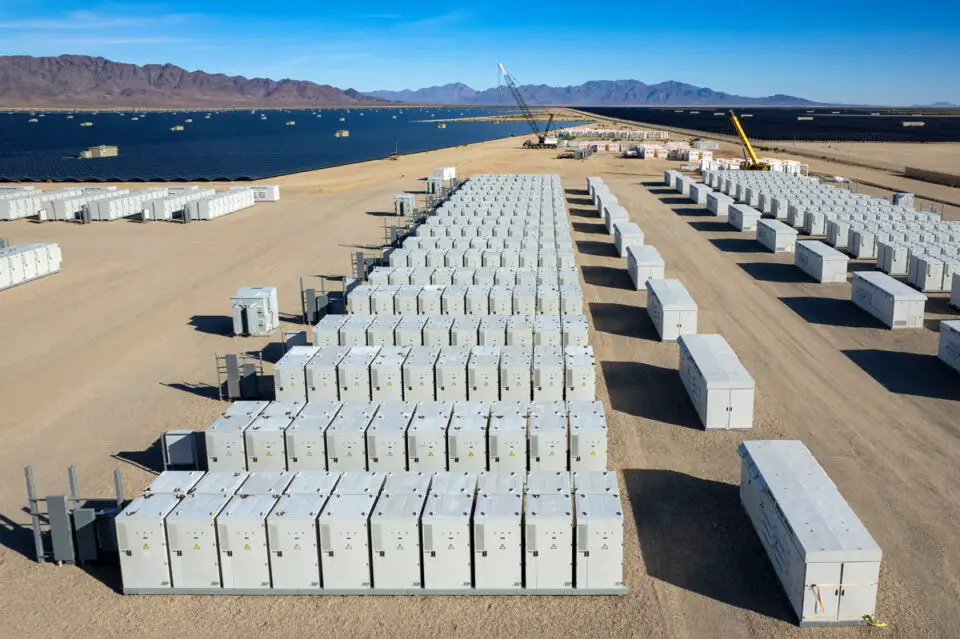
SAN DIEGO — The county Board of Supervisors unanimously backed a solar energy and battery storage project Wednesday to be built near the southeastern community of Boulevard.
After hearing from more than 60 people, including many area residents opposed to the project, supervisors voted to adopt the major use permit, various environmental findings and a report for the Starlight Solar Project.
The 588-acre project site, on land owned by the Haagen Company, is one mile south of Interstate 8 and Old Highway 80, and one mile north of the U.S.-Mexico border.
Officials said the applicant, identified as Empire II, has entered into a 12-year agreement with San Diego Gas & Electric for the first project phase “to provide renewable electricity to customers in the SDG&E service territory,” including cities and unincorporated regions of San Diego County, as well as portions of Orange County.
According to the county, the Starlight project will include battery energy storage system equipment, electrical infrastructure, internal access roads, photovoltaic modules, inverters, transformers, an on-site collector substation, and 448 acres of open space outside the facility.
Once online, the two-phase Starlight project will generate up to 100 megawatts of power and house a 217.4-megawatt battery energy storage system.
Supervisors added other conditions, including:
- Requiring that the battery energy storage system remain in its original northern location.
- Requiring groundwater monitoring and testing prior to project construction or after a fire, along with the applicant treating any contamination and restoring depleted water levels.
- Requiring the developer to use a special San Diego Community Power “green tariff” program to provide rebates to low-income residents.
Jim Whalen, of J. Whalen Associates, the Starlight project manager, told City News Service the energy facility could be online “no sooner than a year.”
“We like to think we checked all the boxes” to win approval, he said.
Whalen said developers are proposing an $8.5 million community benefit fund, paid in phases.
The county Planning Commission recommended approving the project during its July 10 meeting. During a presentation Wednesday, Vince Nicoletti, county Planning & Development Services director, described Starlight as “the largest solar project we’ve seen proposed in our jurisdiction.”
Nicoletti said the project has undergone design modifications over the past nine months.
“We recognize there are still aspects of the project (where) the community would like to see additional changes,” he said.
Supervisor Joel Anderson, whose district includes Boulevard, requested the green tariff benefit.
He said in an emailed statement that community benefits “go a long way towards helping the residents deal with such a large renewable energy project in their backyard.”
Before voting, board Chair Terra Lawson-Remer thanked residents for their input and said with California and the nation facing rising energy costs, “there (are) really not a lot of great choices,” noting the risks of various types of energy, including nuclear.
Lawson-Remer said state law allows for projects to be greenlit without local approval, so it was important to give residents a voice on the Starlight facility.
During a lengthy public hearing, opponents — many of whom wore black T-shirts with the names of Boulevard and other nearby towns — cited numerous concerns, including water usage, safety, battery-caused fires, and other environmental risks.
Jessica Avilez said supervisors “took a solemn oath to protect public health and safety, yet approving the Starlight solar project violates that oath.”
Avilez said fire evacuation plans are purely speculative, and people living in mobile homes or trailers cannot shelter in place if there’s a toxic chemical plume.
Thomas Wall said the project’s cumulative impacts are significant and will change the rural community forever.
“We’re fully opposed to this project, and do not give our consent,” he said.
A backcountry real estate agent asked supervisors not to “gamble with Boulevard’s water, homes and property values.”
It’s possible to replace a solar panel or battery, “but you cannot replace an aquifer,” she added.
Anthony Ralphs, vice chair of the Boulevard Planning Group, said his group voted in favor of the energy project as long as developers meet certain conditions, which are being met or codified.
Ralphs added that after watching their town “quickly become littered with endless wind projects, massive electric lines and sexually violent predators,” residents have learned what happens if they don’t immediately engage with the process.
He also said he looked forward to battery safety improvements.
Angela Elliot Santos, chairwoman of the Manzanita tribe, asked supervisors to delay a vote.
“We’re against the industrialization of our homeland,” she said. “My people have lived there for thousands of years. Please stand up for us and give a little bit more time so this can be done in the right way.”
Representatives from several environmental groups and local labor unions spoke in favor of the project. Jonah Henry, a volunteer organizer with the Sunrise Movement, said Starlight will help stabilize electrical power and let SDG&E reduce its reliance on gas-fired plants that contribute to climate change.
“There’s obviously no perfect place or parcel for industrial development, but the benefits far outweigh the negative impacts,” Henry said.
A Haagen Company official said Starlight will create hundreds of good-paying jobs for those building and maintaining the facility, and also financially help Boulevard.
“We have worked very hard from day one on this to minimize impacts to the community,” Chris Fahey told supervisors. “Without this project, there would be zero dollars for community benefits.”