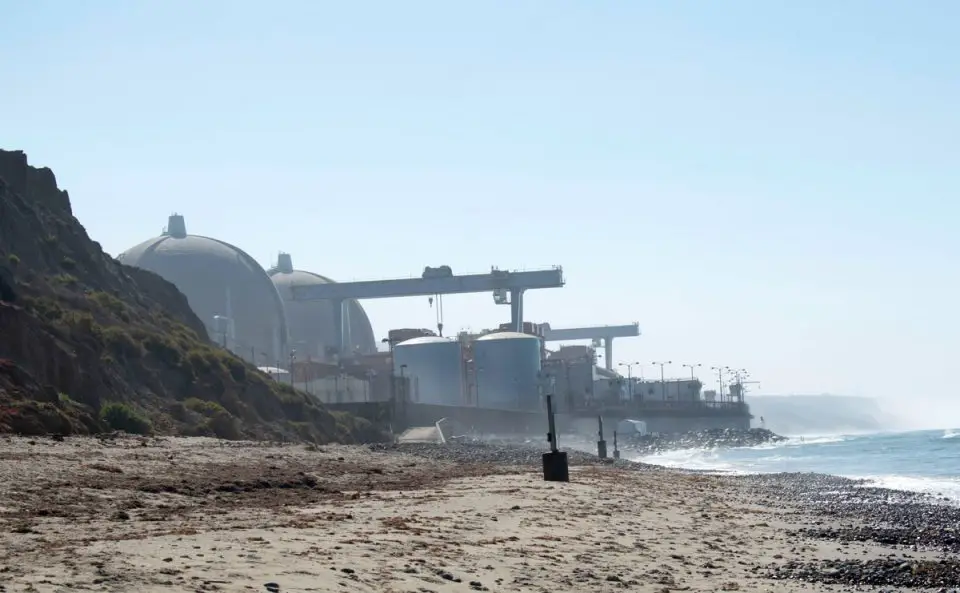
REGION — As the federal government continues to delay a permanent repository for spent nuclear fuel, the San Diego County Board of Supervisors has agreed to support research and development to potentially recycle hundreds of tons of spent fuel stored at the decommissioned San Onofre Nuclear Generating Station.
Supervisors unanimously approved the proposal on Dec. 9, introduced by Supervisor Jim Desmond, whose district includes the portion of Camp Pendleton where the former nuclear power plant — also known as SONGS — sits along the coast next to San Onofre State Beach and the Orange County border.
“Right now, in my district, there are over 1,400 tons and over 100 canisters of spent nuclear fuel sitting at the San Onofre site with nowhere to go — and it’s not going anywhere quick,” Desmond said.
Desmond noted that the federal government has long considered where to store the nation’s spent nuclear fuel.
Nuclear power plants use nuclear fuel to produce electricity. According to the Nuclear Regulatory Commission, the fuel becomes extremely hot and radioactive while used in the reactor core to heat water, but after about five years, it is no longer useful and is removed.
The spent fuel is then removed from the reactor and stored in on-site pools, where it cools over time and its radioactivity decays.
The pools were intended to provide temporary storage for spent fuel before it was sent off-site for reprocessing, so usable portions could be recycled; however, that never occurred.
To increase the amount of spent fuel stored on site, nuclear plants either replaced storage racks in the pools with racks made of special materials that allow fuel to be packed closer together, or placed older fuel in dry storage casks housed in specially built onsite facilities.
SONGS currently has 123 canisters of spent nuclear fuel stored on site.
Nationwide, more than 90,000 metric tons of spent nuclear fuel from commercial nuclear power plants are still awaiting placement in a permanent repository. The Department of Energy is responsible for disposing of the waste, but has not yet built a facility because lawmakers have been unable to agree on a location.
Desmond said his approach would “create a parallel path” by pursuing recycling options, if possible, rather than focusing solely on finding a permanent storage site.
“That spent nuclear fuel is cooking for about the next 1,000 years, and those canisters aren’t going to last that long,” he said.
Desmond noted that emerging technologies could enable recycling of spent nuclear fuel, which could also provide new energy sources for the nation and financial relief for families facing high power bills.
“Reprocessing it could unlock enormous amounts of energy,” he said. “It’s time we use technology as it keeps improving to make our community safer, reduce costs, and hopefully give families a break.”
In late summer, two companies launched efforts to recycle spent nuclear fuel. California-based Oklo announced plans to design, build, and operate a spent-fuel recycling facility in Tennessee, while Washington, D.C.-based Curio announced the completion of a laboratory-scale demonstration of its NuCycle voloxidation processing technology.
In the spring, Moltex Energy Canada Inc. also developed a Waste-to-Stable-Salt (WATSS) process, which appears to be another promising method for recycling spent nuclear fuel.
Several other laboratories across the country, including Idaho National Laboratory and Argonne National Laboratory, are also working on potential solutions for recycling nuclear waste.
The board also approved an amendment from freshman Supervisor Paloma Aguirre, who requested that the resolution include formal support for the bipartisan Nuclear Waste Administration Act, introduced by Rep. Mike Levin, D-San Juan Capistrano, and Rep. August Pfluger, R-San Angelo, Texas. The bill would establish an independent Nuclear Waste Administration to manage the nation’s nuclear waste, create a consent-based siting process for nuclear waste facilities, and ensure reliable funding for nuclear waste management.
“We need assurances that any approach follows best practices for consent-based siting — that means communities hosting potential facilities and communities along the transport routes must be fully informed and must consent,” Aguirre said. “Second, I think it’s important that we don’t ignore the safety risks associated with testing new uranium processing technologies. These are emerging methods and I want to make sure that any facility involved, whether transport or reprocessing, demonstrates strong defense in depth, rigorous safeguards, and a precautionary approach that protects workers and nearby residents.”
Desmond agreed, noting that he had previously supported Levin’s bill. Desmond is also co-chair of the Spent Fuel Solutions coalition.
Meanwhile, SONGS continues to make progress on its decommissioning path.
According to the most recent quarterly update, SONGS has about three years remaining in major demolition work, with most buildings already removed. More than 6,400 shipments have occurred, and more than 570 million pounds of materials have been hauled offsite.
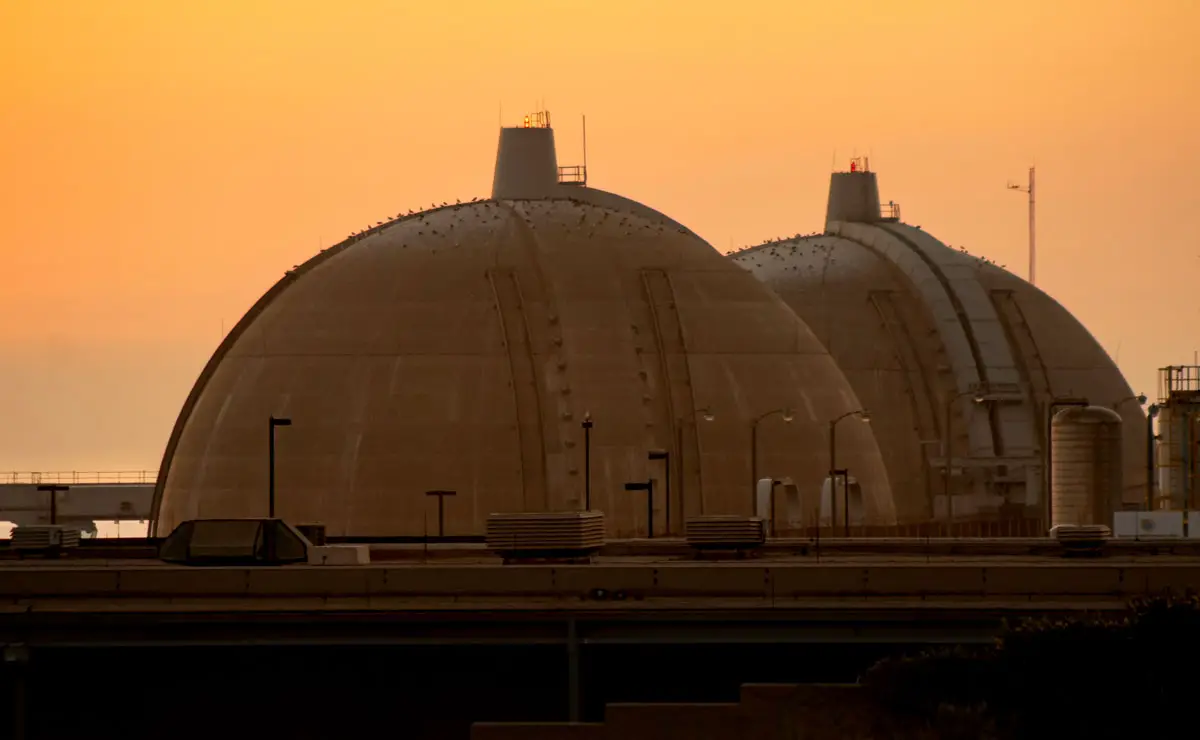
Demolition of the plant’s most recognizable features — the two large containment domes visible from Interstate 5 — is expected to begin in late 2026.