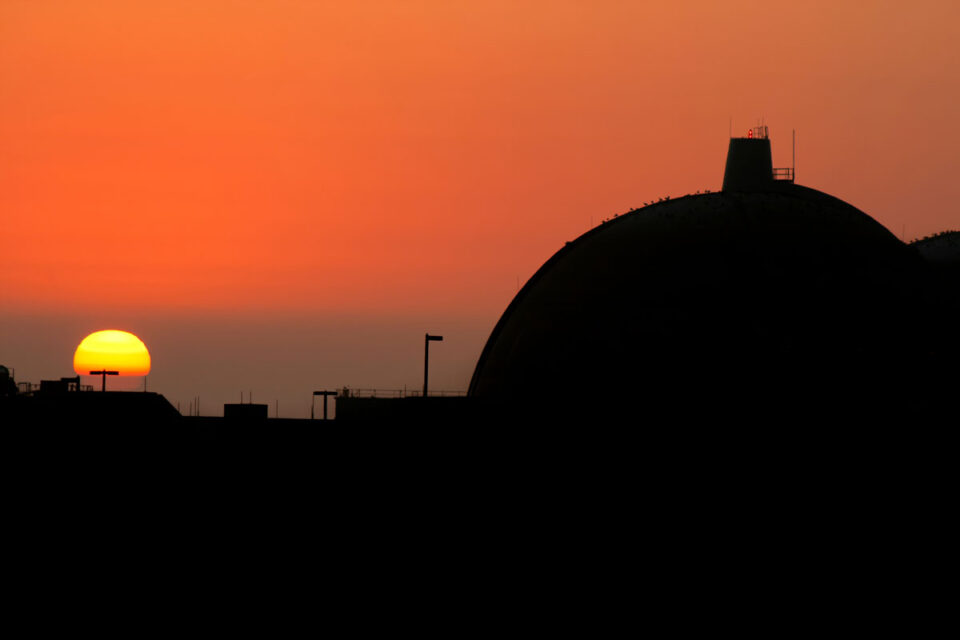
Sept. 30, 2025, may mark the day communities in Southern California first took initiative to protect themselves from deadly nuclear waste that has been stranded indefinitely at the decommissioning San Onofre Nuclear Generating Station.
With Irvine Mayor Larry Agran spearheading the effort, a special study session of the Irvine City Council convened on Sept. 30 to address the risks of 3.6 million pounds of highly radioactive spent nuclear fuel (SNF) stored in temporary canisters, out in the open, in an earthquake zone, and just 108 feet from the shoreline.
The safety threats include terrorism, sea level rise, earthquakes, tsunamis, and canister corrosion from exposure to moist, salty air.
Because many of the fission products of nuclear reactors, like cesium-137, are highly radioactive and extremely long-lived, SNF requires isolation for hundreds of thousands of years. Each of San Onofre’s 123 canisters contains about one-third the amount of cesium-137 released during the 2011 Fukushima nuclear disaster.
The canisters were not designed for long-term storage and lack the necessary methodology to monitor in real-time for radiation leaks or canister degradation.
The nuclear waste will remain at San Onofre for the foreseeable future because the federal government failed to create a permanent geologic repository for the nation’s commercial spent nuclear fuel, as mandated by law.
In response, some lawmakers are hoping to convince communities in Texas and New Mexico to store spent fuel in “consolidated interim storage” (CIS) facilities until a geologic repository becomes available.
So far, such efforts have been blocked by those states out of fear of becoming de facto permanent waste dumps.
For us living near San Onofre, it is critical to understand that, even if a community somewhere consented to hosting CIS, the earliest one could open would be 2038-2040, according to the Department of Energy. Then, it could take a few more decades for all of San Onofre’s SNF to relocate due to competition with other nuclear plants that also want to transfer their waste.
This means we should be planning for spent fuel rods to remain at San Onofre until at least 2060.
Mayor Agran’s opening remarks emphasized the responsibility of every level of government, including local jurisdictions, to protect its citizens. He is calling on the city of Irvine to commission the development of a plan to move San Onfre’s spent nuclear fuel into a safer storage configuration until the federal government can take possession of it.
Agran’s proposal includes relocating the canisters away from the shore, onto higher ground at Camp Pendleton, and into a storage building, both of which are fortified to eliminate exposure to the marine environment and threats such as earthquakes, tsunamis, and terrorism, and equipped to repackage the waste if the canisters fail.
There is urgency to relocate the waste now while the canisters retain enough structural integrity to be moved. Components of the proposal have been informally endorsed by several nuclear safety experts with whom I have consulted privately in working alongside Agran.
Former chairman of the Nuclear Regulatory Commission, Gregory Jaczko, topped the study session’s speakers list. His voiced concerns included the renewal of official permits allowing San Onofre’s nuclear waste to remain stored, as is, going forward. He supports efforts on the local level to “move forward” to a better interim storage solution.
A presentation followed from David Richardson, a professor of environmental and occupational health at UC Irvine. Although he primarily researches cancer risks associated with radiation exposure, he explained how a radiation release also significantly alters people’s relationship with the environment, including property values, the use of gardens, and decisions about where to live. He has consented to assist in developing a plan for San Onofre.
Dan Stetson, chairman of the Community Engagement Panel for the decommissioning of the San Onofre plant, described the panel’s purpose as providing a venue for the public to engage in what are often “spirited” discussions with Southern California Edison (SCE).
Stetson emphasized that both Edison and the public are focused on the safe storage of nuclear waste and its prompt removal. The panel’s solution, however, is finding communities to host consolidated interim storage.
The final presenters were SCE representatives: Chief Nuclear Officer Frederic Bailly and Manuel Camargo, principal manager of decommissioning. Bailly explained SCE’s view that “the spent fuel storage is safe where it is” and that “there is no credible scenario that could result in the release of radiological material beyond the site.”
Camargo, however, stressed Southern California Edison’s energetic support of “getting the spent fuel offsite” and explained that amendments to existing law would be necessary to make way for consolidated interim storage.
About 150 members of the public filled the council chambers. The 17 public commenters were unanimous in voicing concerns about leaving the nuclear waste as is.
The session concluded with poignant testimony from Councilmember Mike Carroll, who recounted his personal experience in exposing biohazardous government research in New York, which led to the shutdown of the laboratory. He enumerated many shortcomings he sees in how San Onofre’s spent fuel rods are currently stored.
A council vote on Agran’s proposal will take place sometime soon. He hopes that, with Irvine taking the lead, other jurisdictions in Orange and San Diego counties will join in to keep everyone in Southern California safe.
Sarah Mosko is a Laguna Beach psychologist with a background in brain science who writes about environmental issues and solutions. A former longtime San Diego County resident, she has spent the past five years working with Irvine Mayor Larry Agran on strategies to safely store spent nuclear fuel at San Onofre.