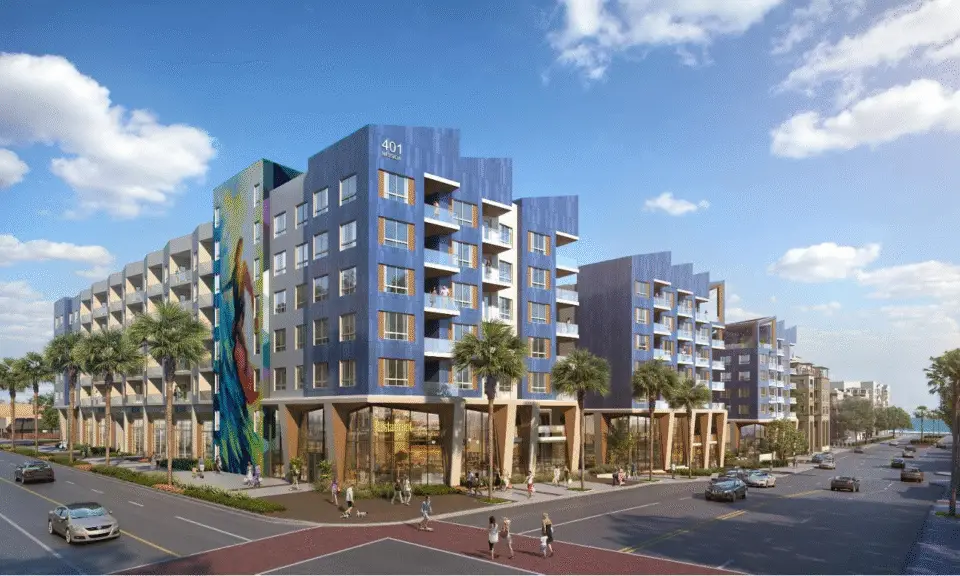
The Oceanside City Council’s recent motion to delay a decision on the Regal Plaza mid-rise, mixed-use project at 401 Mission Avenue shows that both the City Council and the developer are listening to the community, which is a positive development.
However, these delays are costly for the developer and also require additional time and effort on behalf of Oceanside’s city staff, who are currently overwhelmed due to several high-level staff resignations, including those in our planning department.
Oceanside is in a major budget crunch. Every public service that the City of Oceanside provides is underfunded. City staff are underpaid compared to our peer cities. Our Police Department has been housed in an old Mega Foods grocery store since 1999, with no clear path forward to building an actual headquarters. Our roads are rated at an “F” level of pavement condition index, based on the city’s own data. City staff have informed us directly that they have no intention of repaving the worst roads, as it is too expensive, and will instead focus on slurry sealing roads that are already in an acceptable condition.
After school activities for disadvantaged youth were terminated for 14 years in a row. A Wildlife Corridor Planning Zone was put on the table, and then left to collect dust for 15 years due to a lack of funding. A road diet to make Coast Highway safer for drivers, cyclists, and pedestrians has been in limbo since 2009, with no public update since January 2024, and no response from the City regarding its current status.
The City’s traffic calming program was terminated for a decade and now has a backlog of more than 500 requests. Thanks to this decades-long termination, Oceanside continues to have a high rate of traffic fatalities: 20 people died on our roads in 2024 alone. We rank #3 out of 61 peer cities in terms of the number of speed-related traffic injuries and fatalities. (To be clear, a higher ranking here is worse.)
Almost all of the major wins that City leadership has touted with ribbon-cutting ceremonies over the past several years are due to state and federal grant awards or our regressive Measure X sales tax, which penalizes low-income earners the most and requires voter approval each time it comes up for reauthorization.
(Remember that the City of San Diego did not renew their ballot sales tax measure in November of last year and thus found themselves $258M in the red overnight.)
But here’s the kicker: the City of Oceanside is not competitive for grants because many grants require the jurisdiction to pony up approximately 50% of the total project cost as a gesture of fiscal solvency and willingness to carry the project to fruition.
Oceanside does not have the general fund revenue to meet these project costs at 50%, so the city is not considered a competitive candidate for grants. That’s the primary reason why Oceanside lags behind its peers — not because we didn’t have a professional grants lead until recently, but because we can’t match the 50% required funds. In short, being broke means you fall into a spiral of cutting services and not investing in your city, which causes revenue to plummet, and the cycle continues.
Oceanside gets the majority of its general fund revenue from property taxes and sales taxes. Without recurring sources of both, the City would become bankrupt, as is currently the case with Escondido. However, cities do not declare bankruptcy like businesses.
They simply cut public services and may even proudly announce a budget surplus at the end of the year. That “surplus” is a result of cutting public services. That’s not a genuine surplus.
When a high-profile city block is hemorrhaging cash, such as the Regal Plaza (Regal closed 39 locations just in 2023), it should be allowed to adapt with the times and change into something that generates recurring revenue for both the property owner and, in turn, the city. The city then invests that revenue into public services.
The proposed redevelopment is mixed-use, allowing for small businesses to open on the ground floor and housing on the upper floors. That means both property tax and sales tax revenue. Though these new market-rate units are oft discarded as “luxury housing”, we know empirically that when housing developments have at least 100 new units, these allow for “vacancy chains” where the burden of demand for housing in low-income neighborhoods is relieved because middle- and upper-income residents can move into new housing instead of bidding up the price of older housing.
When housing is scarce, the price of all housing goes up. When we build more housing, especially a variety of unit sizes that skew smaller than single-family detached housing, such as condos and apartments, this allows families to move into different units based on their needs and frees up their previous housing unit for someone else. Our favorite video on this subject can be found here.
But what this whole debate has highlighted is that our residents desperately need a third place in downtown. Our Civic Center Plaza should have been that third place, but it historically had no permanent outdoor seating. (A small, gated-off section now has a shaded area for seating.) It does have a very large fountain with palm trees, though. If you get ice cream across the street at Handel’s, there is nowhere to sit, so residents often sit on the edge of the fountain, which was not designed for human use.
There’s an eerie, deliberate lack of seating, and a substantial amount of water occupies valuable public space that could be used for human activity. You know, a civic center.
Therefore, we historically used the Regal Plaza as a third place, utilizing its outdoor dining patio as a socializing hub, as the Civic Center Plaza failed to do so. It even hosts the annual Christmas Tree lighting ceremony, again, because the Civic Center Plaza failed.
When we are dependent on private property for our third place, especially one like the Regal, which technically requires spending cash at a vendor such as the restaurants or the movie theater, that makes our City vulnerable to these inevitable changes.
We want Oceanside to be resilient, solvent, and adaptable. Trying to “save the Regal” makes it seem like Oceanside should be encased in amber, unable to adapt, stuck in a time period that is long gone, so that we can relive our childhood.
Yes, we need third places, but not at the expense of holding this redevelopment hostage and having the city lose out on millions of dollars of recurring general fund revenue, not to mention the 332 housing units, which include 34 affordable units. Currently, the Regal Plaza has zero housing units and no affordable units.
The 401 Mission Avenue project promotes all of the things we love as urbanists: allowing people to live near attractions like downtown and the beach instead of having to drive there and compete for spaces in a parking deck. The development offers greatly needed housing units that are not single-family detached homes in a city that has built only 2,500 housing units from 2014 to 2024.
The project offers mixed-use space, allowing small businesses to take a chance on a small-footprint location where an ample supply of pedestrians can patronize them and keep them in business; provides recurring property tax and sales tax revenue to the city at a much higher rate than the parcel generates currently- revenue that goes into funding every public service our city provides; and shows our city can adapt when moviegoing is on the decline and housing is in a crisis.
When we ask Oceanside residents what the #1 issue is that they are facing in their community, it is always something revolving around housing costs, lack of housing options, lack of affordable housing, skyrocketing rent, lack of walkability in downtown, dangerous car-dependent city design, double-digit traffic fatalities year over year, etc.
The 401 Mission Avenue mid-rise, mixed-use project tackles all of these issues. For the things it doesn’t improve directly, it generates the necessary revenue to fund other city services that are currently lacking. Where it lacks is creating a third place for all residents to socialize.
If the project returns with a redesign that includes more public space, that could be a compromise that satisfies both sides.
GT Wharton is co-founder of Strong Towns Oceanside, a 501(c)(3) non-profit organization that advocates for safer streets, walkable communities, reducing car dependency, reducing suburban sprawl and transparent municipal budgets.